The 60-second verdict
Driving lessons demand continuous attention to the road, the learner, other road users and the possibility of intervention. The right documentation workflow therefore begins with a strict boundary: complete the drive first, then use a recorder only after the vehicle is safely and legally parked.
Best fit: Driving Instructors who need recoverable audio and human-verified notes in an authorised workflow. Use another method when: recording is prohibited, a participant declines or the approved process requires manual notes.
Evidence basis and limits
- Decision factors covered: The drive → park → reflect → plan workflow; Stage 1: Drive with full attention; Stage 2: Park before documentation.
- Evidence rule: The decision is based on the complete capture-to-action workflow, not a single feature or marketing accuracy percentage.
- Boundary: Examples and workflow recommendations must be tested with representative recordings, the intended users and the actual approval process before rollout.
An AI voice recorder for driving instructors can support a parked learner debrief, a private instructor reflection and the drafting of progress notes. It cannot observe the drive, supervise the learner, decide whether a fault is serious or determine test readiness.
The drive → park → reflect → plan workflow
| Stage | Instructor priority | Record created |
|---|---|---|
| Drive | Road safety, instruction and intervention | No device operation |
| Park | Stop in a safe, legal place and secure the vehicle | Clear boundary before documentation |
| Reflect | Compare learner view with observable evidence | Checked lesson debrief |
| Plan | Select the next route, task and independence level | Updated progress record |
This workflow makes the recorder an administrative aid rather than an in-car distraction.
Stage 1: Drive with full attention
The current DVSA Approved Driving Instructor code of practice says instructors should not use mobile devices when driving or supervising a client’s driving and should use them only when parked in a safe and legal place. It also addresses the responsible handling of audio and video recorded in or around the tuition vehicle.
See the DVSA ADI code of practice.
Do not start, stop, check, hold or dictate into the recorder while the vehicle is moving or while the learner is driving. Voice activation does not remove the instructor’s duty to supervise. Use a short memory cue only if it can be retained without diverting attention.
Stage 2: Park before documentation
Choose a safe and legal place that does not obstruct traffic or create pressure for the learner. Secure the vehicle and complete any immediate road-related instruction before beginning a recording.
If a suitable place is unavailable, defer the detailed debrief. Never stop in an unsafe location merely to preserve a note.
Stage 3: Reflect on the situation, not the label
A strong lesson note identifies the road situation, observable behaviour, level of support and learner explanation.
| Field | Useful example |
|---|---|
| Situation | Busy multilane roundabout in wet conditions |
| Observable behaviour | Mirror check and lane decision occurred late |
| Instructor support | Verbal prompt before the lane change |
| Learner reflection | Attention remained on navigation instructions |
| Next objective | Earlier planning on a graduated route |
Replace “bad at roundabouts” or “not confident” with evidence the learner can understand and act on.
Stage 4: Plan the next level of independence
For each objective, state:
- The road or traffic situation to practise.
- The current level of instructor support.
- The cue or strategy the learner will use.
- The route difficulty and conditions.
- The evidence needed to reduce support.
- The review point.
Progress may move from explanation and demonstration to guided practice, prompted practice and independent performance. AI can organise the plan but cannot judge whether the learner has demonstrated consistent safety.
Use the learner’s reflection before giving the answer
A parked debrief should be a two-way review, not a recorded lecture. Ask:
- What went well?
- Which situation felt most demanding?
- What did you notice before the decision?
- What would you do earlier next time?
- Which objective should we practise next?
Then add the instructor’s evidence and agree one or two priorities. This produces a more useful record than a transcript containing only instructor commentary.
Record interventions accurately
Where the instructor used a verbal prompt, dual-control intervention, steering assistance or another safety action, record what occurred, when and why. Do not minimise an intervention or convert it into a vague “needed help.”
Distinguish:
- A preventive prompt.
- A corrective instruction.
- A physical or dual-control intervention.
- A repeated pattern.
- An isolated error under unusual conditions.
The final note should support honest progress planning without trying to mimic a driving-test result.
Keep test-readiness decisions human
Test readiness depends on consistent safe driving across different roads, conditions and tasks, with an appropriate level of independence. A recorder has not seen the drive. It cannot decide whether a learner is ready or whether a behaviour would be assessed as a fault.
Use direct observation, the current training standard and the approved progress record. Explain the evidence behind the recommendation and record the learner’s view.
Protect routes, identity and personal information
Lesson notes may include a home address, pickup point, regular route, test date, disability, health information or confidence concerns. Collect only what is needed, use an approved business account and restrict access.
Explain the purpose of a parked debrief recording, who can access it and how long source audio is retained. Avoid speaking payment-card information, passwords or unnecessary identifying details. A concise verified progress entry is normally more useful than indefinite audio storage.
Separate dashcam, training camera and voice-note purposes
Each recording system has a different purpose and audience. Explain them separately. Agreement to a dashcam does not automatically cover an AI-processed learner debrief, social-media content or marketing use.
Do not publish or circulate footage from driving tests without the required permissions. Keep public content separate from confidential learner records.
A 60-second parked debrief script
- Lesson: identify learner, date and main objective.
- Context: state route, traffic and weather where relevant.
- Strength: name one observable success.
- Risk pattern: describe the situation and level of support.
- Learner view: record their explanation or question.
- Next plan: state route, task and desired independence level.
Check road names, left and right, speed limits, dates and intervention detail before transferring the draft to the official record.
How NERALVO Halo can support driving-instructor administration
View Halo specifications for driving instructors use can support safely parked lesson debriefs, permitted learner reviews and private instructor reflection. It includes NOTE mode, supported CALL capture, 64GB local storage, up to 35 hours of recording and Bluetooth sync with DOWAY. DOWAY can create transcripts, summaries, speaker-separated notes, templates, translations, mind maps and exportable files, with one year of DOWAY Max included from activation.
Halo is not a navigation tool, driving-safety system or test-readiness assessor. It should never be operated while driving or supervising a learner.
Driving-note quality check
- Was the device untouched throughout the moving lesson?
- Was the vehicle safely and legally parked before recording?
- Does the note identify a road situation rather than a label?
- Is the level of instructor support recorded accurately?
- Does the learner’s reflection appear?
- Is the next objective linked to a route and independence level?
- Is the test-readiness decision based on direct human observation?
- Are personal and route details limited to what is needed?
- Has source audio been handled under the business policy?
A strong driving-lesson note protects attention during the drive and turns a parked reflection into one clear, evidence-based objective for the next lesson.
Cloud software, a dedicated recorder or manual notes?
For Driving Instructors, the right answer changes with the setting. This matrix deliberately gives each method a situation where it can be the strongest choice.
| Situation | Best starting point | Reason |
|---|---|---|
| scheduled remote meetings | Cloud meeting software | Native remote-meeting workflows can be more efficient here. |
| in-person or mobile work | Dedicated recorder | A separate battery and recoverable local source improve resilience. |
| recording is refused or prohibited | Manual notes or an approved alternative | Manual notes are the correct control when recording is unavailable. |
| mixed online and offline work | Governed hybrid | A hybrid can combine automation with reliable physical capture. |
Related AI voice recorder guides
See the guides for private tutors, corporate trainers and car salespeople.
Related guides
Profession workflow
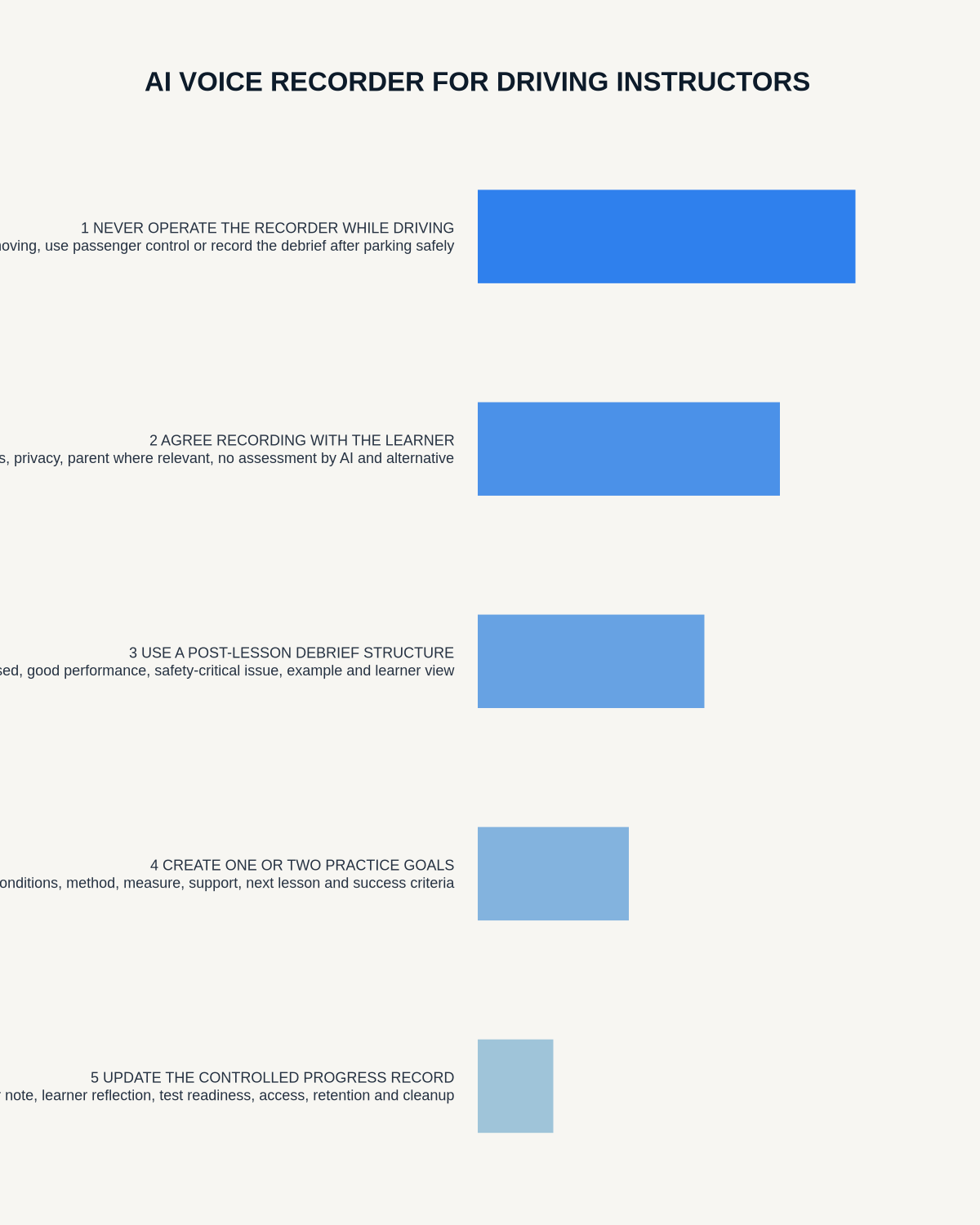
Visual map for AI Voice Recorder for Driving Instructors: Lesson Debriefs, Learner Goals and Progress Notes
- Prepare the approved useDefine purpose, safe position, permission and the required formal record.
- Capture context firstState the case, asset, person, location or event identifier before detail.
- Human-verify evidenceCheck technical terms, units, names, dates, decisions and uncertainty.
- Complete the formal recordTransfer only verified information and apply access and retention controls.
On this page
Related guides
See whether Halo fits this workflow
Review the NERALVO Halo specifications, included services, delivery information and current offer only after completing the guide.
Found an error or an out-of-date claim? Email support@neralvo.com with the article address and a supporting source.