The 60-second verdict
Nursing students need to notice changing information, prioritise risk, communicate clearly and reflect on feedback. A recorder can help with approved simulation and private revision, but it must not create an unauthorised copy of real care or patient information.
Best fit: Nursing Students who need recoverable audio and human-verified notes in an authorised workflow. Use another method when: recording is prohibited, a participant declines or the approved process requires manual notes.
Evidence basis and limits
- Decision factors covered: The observe → prioritise → communicate → reflect workflow; Use a hard placement boundary; Stage 1: Observe the approved scenario.
- Evidence rule: A claim earns weight only when the source, date, configuration and limitation are clear enough for a reader to check.
- Boundary: Examples and workflow recommendations must be tested with representative recordings, the intended users and the actual approval process before rollout.
An AI voice recorder for nursing students can support permitted lectures, consenting role-play and approved simulation debriefs. It is not automatically suitable for placement, handover, bedside teaching or clinical records.
The observe → prioritise → communicate → reflect workflow
| Stage | Student question | Output |
|---|---|---|
| Observe | What information changed or mattered? | Factual scenario evidence |
| Prioritise | What risk or need requires action first? | Reasoned priority |
| Communicate | What must another professional know and do? | Clear structured handover |
| Reflect | What feedback changes future practice? | Authentic learning action |
This workflow is designed for approved educational scenarios—not for recording real patients on a personal consumer device.
Use a hard placement boundary
Do not record bedside care, ward rounds, handovers, telephone discussions, clinical teaching involving real patients or health records on a personal recorder unless both the university and placement provider have expressly authorised the complete arrangement.
The NMC Code requires privacy, confidentiality, secure records and clear, accurate documentation. A patient may remain identifiable through their voice, condition, family detail, location or sequence of events even when their name is removed.
See the NMC Code.
Stage 1: Observe the approved scenario
In simulation or consenting role-play, record material information rather than every spoken detail:
- Presenting concern.
- Change from baseline.
- Relevant observations.
- Medicine or allergy information supplied by the scenario.
- Communication need.
- Risk or escalation cue.
- Student action and response.
Keep patient report, simulated observation, educator information and student interpretation separate. AI summaries may merge these categories into one confident narrative.
Stage 2: Prioritise safely
After the scenario, explain why one issue came before another. Use a structure such as:
- Immediate threat or deterioration.
- Required escalation.
- Time-critical medicine or intervention.
- Safeguarding or communication need.
- Ongoing care and monitoring.
- Documentation and follow-up.
AI should not determine priority or invent a deterioration score. Verify every conclusion against the scenario, educator feedback and approved learning resources.
Stage 3: Practise structured communication
A permitted recording can help review a simulated handover, escalation call or patient explanation. Check:
| Communication element | Review question |
|---|---|
| Identification | Was the student’s role and the simulated person clear? |
| Situation | Was the immediate concern stated early? |
| Background | Was only relevant context included? |
| Assessment | Were findings and uncertainty separated? |
| Recommendation | Was the requested action specific? |
| Closed loop | Was understanding or instruction confirmed? |
Do not memorise an AI-written handover. Practise selecting the information that another professional needs.
Stage 4: Reflect from evidence
Reflection is more than a transcript of what happened. It should connect observation, feedback, professional standards and one change in future practice.
A useful reflection includes:
- The educational context.
- The student’s role.
- What went well.
- A material gap or risk.
- Feedback received and source.
- Why the issue matters.
- The next supervised practice action.
- How improvement will be demonstrated.
The NMC’s practice-learning information explains that assessment uses observations and other appropriate methods, with student reflection contributing to the evidence. An AI summary cannot replace assessor judgement or direct observation.
See the NMC’s practice-assessment guidance.
Verify medicines, calculations and clinical language
Speech recognition can confuse similar medicine names, decimal points, dose units, routes, timings and negation. Before using the note, verify:
- Medicine name and formulation.
- Dose, unit, route and frequency.
- Calculation method.
- Allergy information.
- Observation values and units.
- Anatomical side.
- Escalation threshold.
- Procedure or policy reference.
Do not use an AI transcript to guide real patient care. Ask an educator or supervisor where uncertainty remains.
Create anonymised learning notes—not parallel care records
A private post-placement reflection should focus on the student’s learning without recreating a patient’s story. Follow university and placement rules and exclude names, dates of birth, addresses, exact locations and distinctive combinations of facts.
Do not dictate real clinical notes, copy records or upload placement audio to a consumer service. The authorised care record remains the clinical record.
Act on safety and safeguarding immediately
Urgent clinical or safeguarding concerns must be escalated through the placement process immediately. Do not wait for audio to upload, transcribe or summarise.
Recording is not an emergency system and should never delay supervision or care.
Protect academic and professional integrity
Portfolio entries, reflections and assessments must be truthful and comply with programme rules. AI must not fabricate:
- Patient encounters.
- Skills performed.
- Feedback.
- Medicine administration.
- Clinical observations.
- Assessor comments.
The student should understand every submitted entry and disclose AI assistance where required.
A concise simulation-debrief script
- Scenario: identify the module and objective.
- Observation: state the material change or cue.
- Priority: explain what required action first.
- Communication: review the handover or escalation.
- Feedback: attribute the educator or peer comment.
- Verification: name the medicine, calculation or policy to check.
- Practice action: define the next supervised task.
How NERALVO Halo can support nursing study
Assess Halo against the nursing students workflow matrix can support permitted lectures, consenting role-play, approved simulation and private revision. It includes NOTE mode, supported CALL capture, 64GB local storage, up to 35 hours of recording and Bluetooth sync with DOWAY. DOWAY can create transcripts, summaries, speaker-separated notes, templates, translations, mind maps and exportable files, with one year of DOWAY Max included from activation.
These features do not make Halo or DOWAY approved for patient or placement information. The university and care provider control which devices, accounts and processors may handle their data.
Nursing-study quality check
- Was recording limited to approved teaching, simulation or private revision?
- Was all real-patient and placement information excluded?
- Were observation and interpretation separated?
- Was the priority explained from scenario evidence?
- Was structured communication reviewed accurately?
- Were medicines, calculations and units verified?
- Does reflection use feedback and create one practice action?
- Were urgent safety or safeguarding issues escalated immediately?
- Is assessed work authentic and attributable?
A strong nursing-student recording workflow turns approved simulation into clearer prioritisation, safer communication and evidence-based reflection without compromising people receiving care.
Cloud software, a dedicated recorder or manual notes?
For Nursing Students, the right answer changes with the setting. This matrix deliberately gives each method a situation where it can be the strongest choice.
| Situation | Best starting point | Reason |
|---|---|---|
| scheduled remote consultations | Cloud meeting software | Auto-join and central collaboration can remove routine admin. |
| in-person consultations or ward handovers | Dedicated recorder | Dedicated hardware suits movement, variable rooms and offline source capture. |
| a patient declines or policy prohibits recording | Manual notes or an approved alternative | A clear alternative respects policy and participant choice. |
| mixed remote and clinical work | Governed hybrid | One governed process prevents gaps between desk and field work. |
Related AI voice recorder guides
See the guides for nurses, medical students, pharmacists and university lecturers.
Related guides
Profession workflow
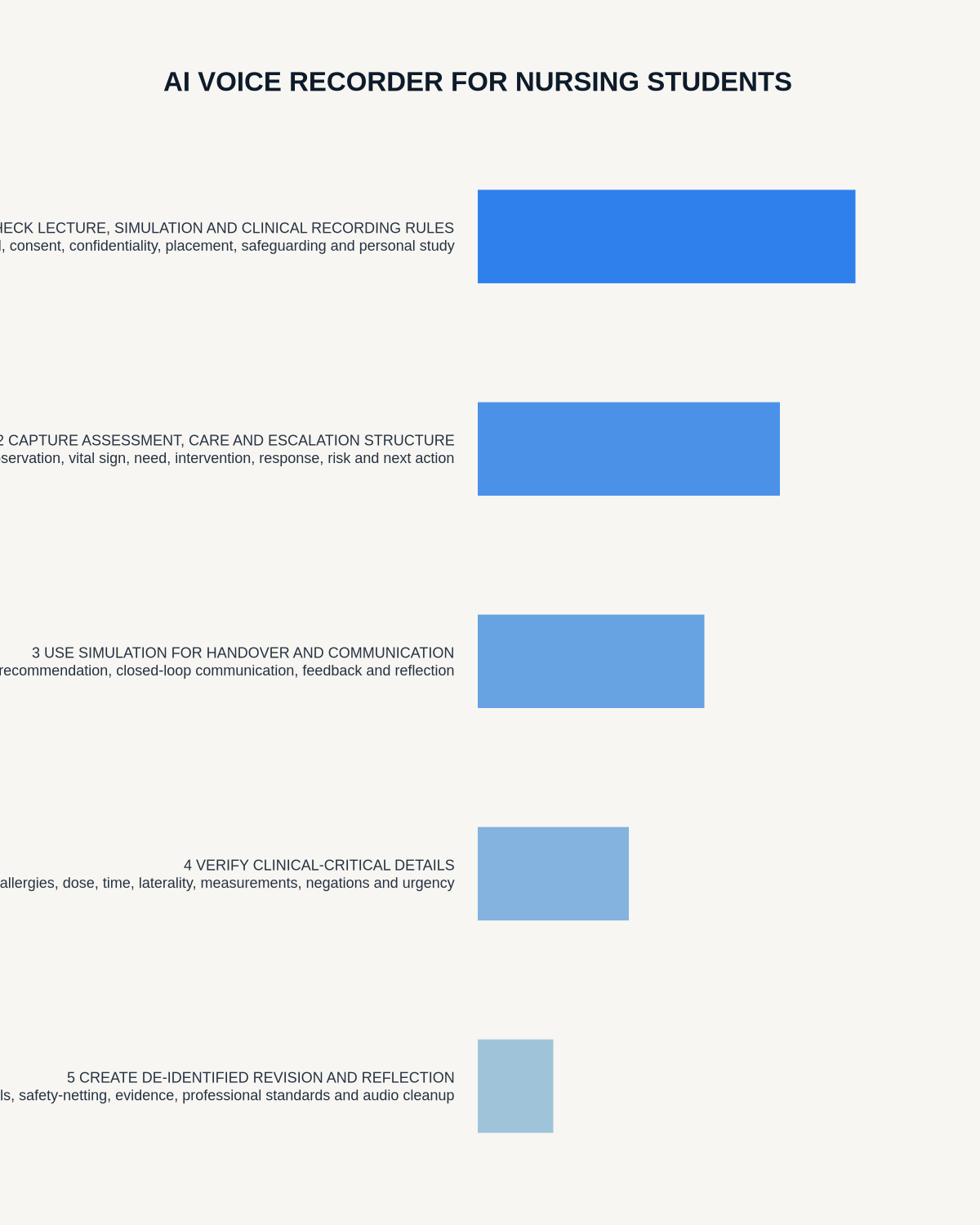
Visual map for AI Voice Recorder for Nursing Students: Lectures, Simulation and Reflective Notes
- Prepare the approved useDefine purpose, safe position, permission and the required formal record.
- Capture context firstState the case, asset, person, location or event identifier before detail.
- Human-verify evidenceCheck technical terms, units, names, dates, decisions and uncertainty.
- Complete the formal recordTransfer only verified information and apply access and retention controls.
On this page
Related guides
See whether Halo fits long-form study capture
After checking permission and your institution’s rules, compare Halo’s stated battery, storage and export workflow with the way you actually study.
Found an error or an out-of-date claim? Email support@neralvo.com with the article address and a supporting source.