The 60-second verdict
Law students need to separate a lecturer’s explanation from the legal authority that supports it. A transcript can preserve structure and questions, but it is not a statute, judgment or reliable statement of current law.
Best fit: Law Students who need recoverable audio and human-verified notes in an authorised workflow. Use another method when: recording is prohibited, a participant declines or the approved process requires manual notes.
Evidence basis and limits
- Decision factors covered: The proposition → authority → status → application method; Stage 1: Extract the legal proposition; Stage 2: Locate the authority.
- Evidence rule: A claim earns weight only when the source, date, configuration and limitation are clear enough for a reader to check.
- Boundary: Examples and workflow recommendations must be tested with representative recordings, the intended users and the actual approval process before rollout.
An AI voice recorder for law students can support permitted lectures, private case explanation and mooting practice. It cannot verify that an authority exists, establish that legislation is in force or replace independent legal research and analysis.
The proposition → authority → status → application method
| Stage | Legal-study question | Output |
|---|---|---|
| Proposition | What precise rule or argument is being asserted? | Testable legal statement |
| Authority | Which primary or permitted secondary source supports it? | Verified source |
| Status | Does jurisdiction, court level, later treatment and date make it applicable? | Current legal weight |
| Application | How does the rule interact with the problem facts and counterargument? | Independent analysis |
This method converts lecture audio into research tasks instead of treating a fluent AI summary as legal proof.
Stage 1: Extract the legal proposition
After a permitted lecture or private revision recording, identify each proposition that would need support in an answer.
Write it narrowly:
- The legal test.
- The element or exception.
- The burden or standard.
- The remedy or consequence.
- The date or jurisdiction condition.
“The defendant owes a duty” is too broad. A useful proposition identifies the relevant duty test, relationship, jurisdiction and factual condition.
Stage 2: Locate the authority
| Source type | Examples | Use |
|---|---|---|
| Primary legislation | Act, regulation or rule | Verify text, extent, commencement and amendments |
| Case law | Judgment or tribunal decision | Read holding and reasoning in context |
| Official material | Practice direction, explanatory note or regulator guidance | Confirm purpose and legal weight |
| Secondary source | Textbook, article or commentary | Understand debate and locate primary authority |
| Lecture transcript | Teaching explanation | Create questions—not final authority |
The National Archives’ Find Case Law service is an official public source for many judgments and tribunal decisions. Coverage varies by court and not every decision is written or published, so students may also need authorised databases and historical sources.
Use legislation.gov.uk to locate UK legislation, then check the version, amendments, extent and commencement relevant to the problem date.
Stage 3: Check the authority’s status
Before relying on a case or statutory provision, verify:
- Neutral citation and court.
- Jurisdiction.
- Whether the relevant passage is the holding, reasoning, submission or dissent.
- Court hierarchy and precedent value.
- Later appeal, treatment or statutory change.
- Whether legislation was in force at the relevant time.
- Any transitional or territorial provision.
An AI summary may confidently combine two cases, invent a citation or omit a later appeal. Open the source and read the relevant paragraphs.
Stage 4: Apply the law to the facts
Application requires more than attaching a rule to a conclusion. Separate:
- Material fact.
- Legal element or factor.
- Argument supporting one outcome.
- Competing interpretation.
- Uncertainty or missing evidence.
- Reasoned conclusion.
The final analysis should remain the student’s own. AI can organise an outline but should not choose which facts matter or hide ambiguity.
Build a case note from the judgment
Use this structure:
- Citation: verify exact form.
- Material facts: include only facts relevant to the issue.
- Procedural history: identify how the case reached the court.
- Issue: state the precise legal question.
- Decision: record the outcome.
- Holding and reasoning: distinguish the legal rule from broader discussion.
- Separate opinions: preserve concurrence or dissent where relevant.
- Later treatment: check appeal and subsequent authority.
- Significance: explain scope without overstating it.
Do not quote from an unchecked transcript or summary.
Use recording for mooting practice
A private or agreed recording can reveal time control, weak signposting and difficulty responding to judicial interventions.
A useful oral-submission structure is:
- Issue: identify the question before the court.
- Submission: state the proposition clearly.
- Authority: give the verified source and relevant passage.
- Application: connect the rule to the facts.
- Counterargument: address the strongest opposing point.
- Relief: state what the court is asked to do.
Practise from a structured note rather than memorising an AI-generated script. Every authority mentioned must be real and accurately represented.
Keep clinics and placements outside the ordinary study workflow
Legal clinics and placements may involve client confidentiality, privilege, litigation strategy, personal data and professional duties. Do not record client, supervisor or case discussions on a personal device without explicit organisational and university approval.
Removing a name may not anonymise a distinctive legal problem. Use the clinic or placement’s authorised systems and follow any professional rules that apply.
Protect moot and competition materials
Moot problems, skeleton arguments and team strategy may be subject to competition rules or embargoes. Agree any practice recording, control access and delete it according to team and organiser requirements.
Maintain academic integrity
Follow the course rules for transcription, research assistance and generative AI. Do not submit:
- Invented authorities.
- Unverified quotations.
- Generated legal analysis presented as independent work.
- AI-written assessed answers where prohibited.
- False clinic or placement experience.
Use the required citation method and retain evidence of the student’s research process.
A concise legal-study voice-note script
- Topic: module and legal issue.
- Proposition: state the rule or argument precisely.
- Authority needed: identify case, legislation or source type.
- Status checks: court, jurisdiction, date and later treatment.
- Application: name the material fact and counterargument.
- Research action: specify the primary source to open.
How NERALVO Halo can support legal study
Assess Halo against the law students workflow matrix can support permitted lectures, private mooting practice and spoken case revision. It includes NOTE mode, supported CALL capture, 64GB local storage, up to 35 hours of recording and Bluetooth sync with DOWAY. DOWAY can create transcripts, summaries, speaker-separated notes, templates, translations, mind maps and exportable files, with one year of DOWAY Max included from activation.
Halo is a study aid—not a legal research database, citation checker or approved client-recording system.
Legal-study quality check
- Was the lecture or practice recording permitted?
- Has every legal proposition been stated precisely?
- Was each authority opened and verified?
- Were court, jurisdiction, date and later treatment checked?
- Was legislation checked for extent and commencement?
- Does application address competing arguments?
- Are clinic, placement and confidential materials excluded?
- Does assessed work comply with academic-integrity rules?
- Has temporary audio been retained or deleted appropriately?
A strong law-student recording workflow captures the explanation, extracts the proposition and then proves or rejects it through current legal authority.
Cloud software, a dedicated recorder or manual notes?
For Law Students, the right answer changes with the setting. This matrix deliberately gives each method a situation where it can be the strongest choice.
| Situation | Best starting point | Reason |
|---|---|---|
| scheduled remote consultations | Cloud meeting software | Auto-join and central collaboration can remove routine admin. |
| in-person consultations or ward handovers | Dedicated recorder | Dedicated hardware suits movement, variable rooms and offline source capture. |
| a patient declines or policy prohibits recording | Manual notes or an approved alternative | A clear alternative respects policy and participant choice. |
| mixed remote and clinical work | Governed hybrid | One governed process prevents gaps between desk and field work. |
Related AI voice recorder guides
See the guides for solicitors, barristers, recording in legal settings and university lecturers.
Related guides
Profession workflow
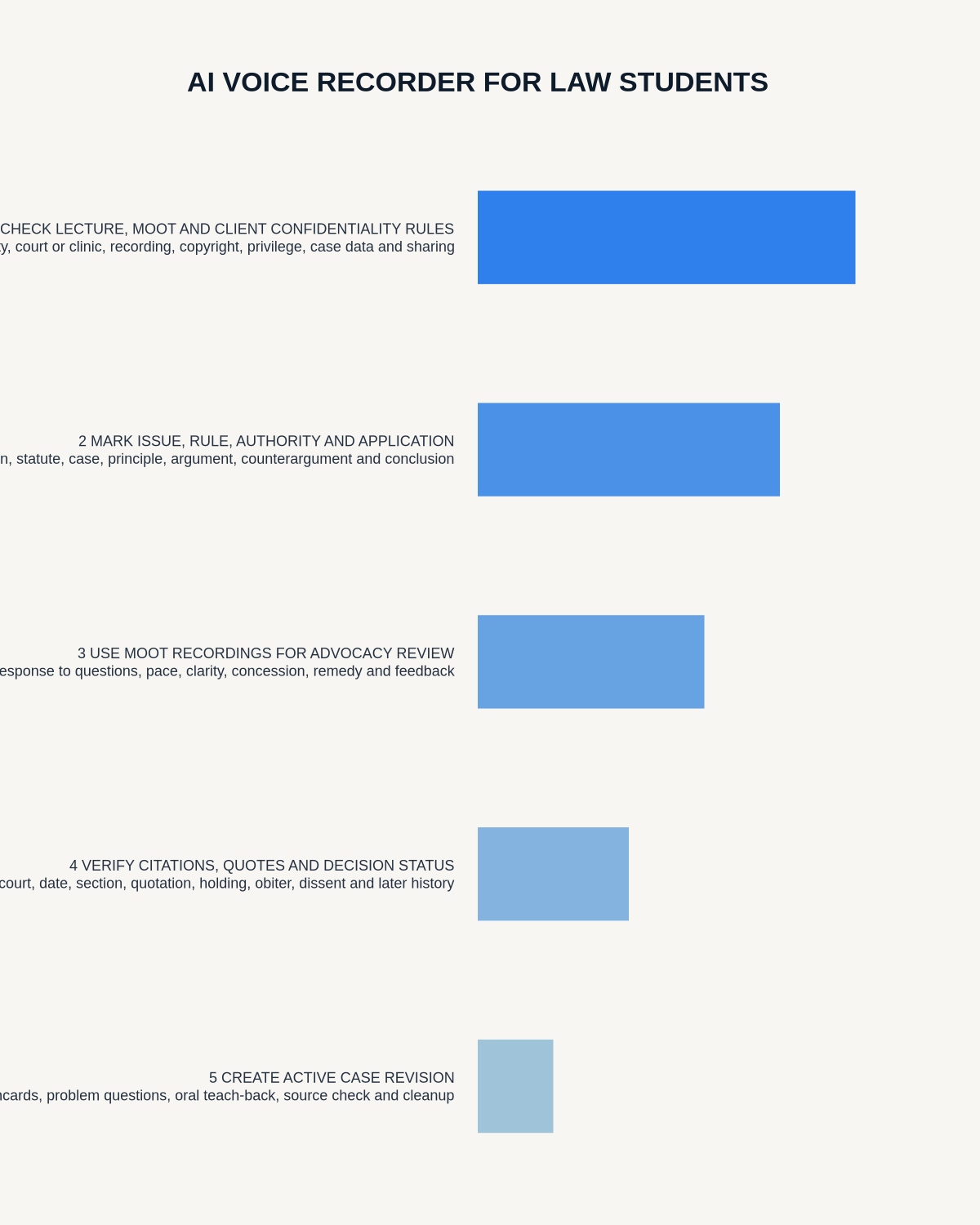
Visual map for AI Voice Recorder for Law Students: Lectures, Mooting and Case Revision
- Prepare the approved useDefine purpose, safe position, permission and the required formal record.
- Capture context firstState the case, asset, person, location or event identifier before detail.
- Human-verify evidenceCheck technical terms, units, names, dates, decisions and uncertainty.
- Complete the formal recordTransfer only verified information and apply access and retention controls.
On this page
Related guides
See whether Halo fits long-form study capture
After checking permission and your institution’s rules, compare Halo’s stated battery, storage and export workflow with the way you actually study.
Found an error or an out-of-date claim? Email support@neralvo.com with the article address and a supporting source.