The 60-second verdict
Doctoral research produces ideas, decisions and observations across reading, supervision, fieldwork, laboratories and conferences. The risk is not only forgetting an insight; it is losing where the insight came from, what kind of claim it represents and which controlled research system should contain it.
Best fit: PhD Students who need recoverable audio and human-verified notes in an authorised workflow. Use another method when: recording is prohibited, a participant declines or the approved process requires manual notes.
Evidence basis and limits
- Decision factors covered: The capture → provenance → evidence status → integration workflow; Choose the research lane before recording; Stage 1: Capture the minimum useful note.
- Evidence rule: The decision is based on the complete capture-to-action workflow, not a single feature or marketing accuracy percentage.
- Boundary: Examples and workflow recommendations must be tested with representative recordings, the intended users and the actual approval process before rollout.
An AI voice recorder for PhD students can support private idea capture, approved supervision notes and permitted fieldwork. It cannot replace ethics approval, establish evidence, authenticate research data or become the only research record.
The capture → provenance → evidence status → integration workflow
| Stage | Research question | Output |
|---|---|---|
| Capture | What minimum information is worth preserving? | Focused audio note |
| Provenance | Where, when and from whom did it arise? | Traceable context |
| Evidence status | Is it a question, hypothesis, observation, analysis or finding? | Correct claim label |
| Integration | Which approved notebook, dataset or project record must be updated? | Controlled research record |
This workflow prevents a fluent voice note from turning an untested idea into an apparent result.
Choose the research lane before recording
| Recording category | Typical content | Required gate |
|---|---|---|
| Private scholarly idea | Published literature, question or hypothesis | Normal institutional data rules |
| Supervision administration | Actions, deadlines and unresolved questions | Agreement and university process |
| Participant data | Interview, focus group or identifiable speech | Ethics, consent and data-management approval |
| Field observation | Context, event and reflexive note | Approved method and site permissions |
| Confidential collaboration | Partner, patent, clinical or commercial information | Contract and institutional approval |
Do not move high-risk material into a personal consumer account simply because it is quicker than the approved research route.
Stage 1: Capture the minimum useful note
Start with the project, date and category. Then preserve:
- The question or observation.
- The source or setting.
- Why it may matter.
- What remains uncertain.
- The next verification step.
A private literature idea might be: “Chapter three—compare the author’s sampling explanation with the 2024 replication—verify both methods before adding to the review.” Avoid speaking identifiable or confidential information where it is not necessary.
Stage 2: Preserve provenance
Research value depends on traceability. Record enough context to locate the original material:
- Author, paper, document or dataset.
- Page, figure, timestamp or file.
- Meeting, field site or experiment.
- Participant or sample identifier permitted by the protocol.
- Instrument, software or code version where relevant.
- The person who made a decision.
AI must not invent a reference, page number, quotation or source connection. Return to the original before citing or analysing it.
Stage 3: Label the evidence status
| Status | Meaning | Required treatment |
|---|---|---|
| Question | An issue to investigate | Do not present as a claim |
| Hypothesis | A testable proposed explanation | Label untested |
| Source note | An argument attributed to another work | Verify and cite the original |
| Observation | An event documented under a method | Preserve context and limitations |
| Analysis | An interpretation produced through a stated process | Keep method and audit trail |
| Finding | A claim supported by completed analysis | State evidence and uncertainty |
Summarisation can make tentative speech sound certain. Restore qualifiers and unresolved alternatives before integrating the note.
Use an ethics gate for participant data
Participant interviews, focus groups and identifiable field material should follow the approved protocol covering recruitment, information, consent, recording, transcription, access, retention, sharing and future use.
Changing from one recorder or transcription provider to another can alter where data is processed and who can access it. Check whether an ethics amendment, data-protection review or new participant information is required before use.
UKRI provides guidance on ethical research across the project lifecycle.
Make consent specific enough
Consent to participate does not automatically cover every recording, AI-processing, quotation, archive or secondary-use decision. Participant information should explain:
- What is recorded.
- Why and where it is processed.
- Who can access it.
- How long audio and transcripts are kept.
- Withdrawal limits.
- Whether quotations may be identifiable.
- Whether future sharing or reuse is planned.
Keep the consent record and the version of the information supplied.
Integrate ideas into the research notebook
A recorder is a temporary capture point. Transfer useful material into a dated, backed-up research notebook with:
- Project and context.
- Provenance.
- Evidence status.
- Source link or identifier.
- Decision or question.
- Next action and deadline.
For laboratory or computational research, connect the entry to protocols, samples, instruments, code, software versions and data files. Do not replace required laboratory records or version control with audio.
Turn supervision into a decision record
Supervision may include unpublished ideas, authorship, progress, wellbeing and confidential collaboration. A short agreed action record is often more proportionate than full-session recording.
Where recording is approved, convert it into:
- Decision made.
- Evidence or reading required.
- Action and owner.
- Deadline.
- Unresolved disagreement or risk.
- Formal progress system to update.
Check attribution with the supervisor. The transcript does not replace the university’s progress-monitoring process.
Verify transcripts and participant quotations
Automatic transcription may alter names, technical terms, pauses, uncertainty and speaker identity. For research use:
- Listen to material passages.
- Document correction conventions.
- Preserve the link to source audio while required.
- Apply approved anonymisation or pseudonymisation.
- Represent non-verbal features only where methodologically relevant.
- Never quote from an unchecked summary.
Decide whether source audio remains necessary after verification through the approved data-management plan.
Protect confidential and intellectual-property material
Industry partnerships, patentable results, source code, clinical information and embargoed data may be controlled by contracts or institutional policy. Check with the supervisor, research office or partner before using an external device or AI service.
Do not speak passwords, access credentials or unnecessary restricted detail. Recording a conversation does not transfer ownership or publication rights.
Document AI use
Institutions, funders, journals and disciplines may set different rules for AI-supported transcription, coding, analysis and writing. Record:
- Tool and version where required.
- Purpose of use.
- Input-data category.
- Human verification performed.
- Material changes made.
- Disclosure required by the university, funder or publisher.
The researcher remains responsible for accuracy, originality, authorship, citations and every research decision. See UKRI’s good research practice policy.
A concise doctoral voice-note script
- Category: idea, supervision, participant data, fieldwork or collaboration.
- Provenance: source, site, person or dataset.
- Status: question, hypothesis, observation, analysis or finding.
- Ethics condition: approval, consent or confidentiality restriction.
- Verification: source, quotation or technical detail to check.
- Integration: notebook, dataset, code or formal record to update.
- Action: owner and deadline.
How NERALVO Halo can support approved doctoral work
View Halo specifications for phd students use can support private research ideas, approved supervision notes and permitted fieldwork. It includes NOTE mode, supported CALL capture, 64GB local storage, up to 35 hours of recording and Bluetooth sync with DOWAY. DOWAY can create transcripts, summaries, speaker-separated notes, templates, translations, mind maps and exportable files, with one year of DOWAY Max included from activation.
Halo is not automatically approved for participant data, confidential research or regulated environments. The university and project must assess the device, DOWAY processing and data flow before use.
Doctoral-record quality check
- Was the recording category identified before capture?
- Was only the minimum necessary information recorded?
- Is provenance complete enough to locate the source?
- Is the evidence status labelled correctly?
- Were ethics, consent and data-management requirements satisfied?
- Were quotations and technical details verified?
- Has the note been integrated into the controlled research system?
- Is confidential or intellectual-property material protected?
- Was AI use documented where required?
A strong doctoral voice note preserves an insight without losing its source, evidential status or research-governance requirements.
Cloud software, a dedicated recorder or manual notes?
For PhD Students, the right answer changes with the setting. This matrix deliberately gives each method a situation where it can be the strongest choice.
| Situation | Best starting point | Reason |
|---|---|---|
| scheduled remote consultations | Cloud meeting software | Native remote-meeting workflows can be more efficient here. |
| in-person consultations or ward handovers | Dedicated recorder | A separate battery and recoverable local source improve resilience. |
| a patient declines or policy prohibits recording | Manual notes or an approved alternative | Manual notes are the correct control when recording is unavailable. |
| mixed remote and clinical work | Governed hybrid | A hybrid can combine automation with reliable physical capture. |
Related AI voice recorder guides
See the guides for researchers, university lecturers, research interviews and international students.
Related guides
Profession workflow
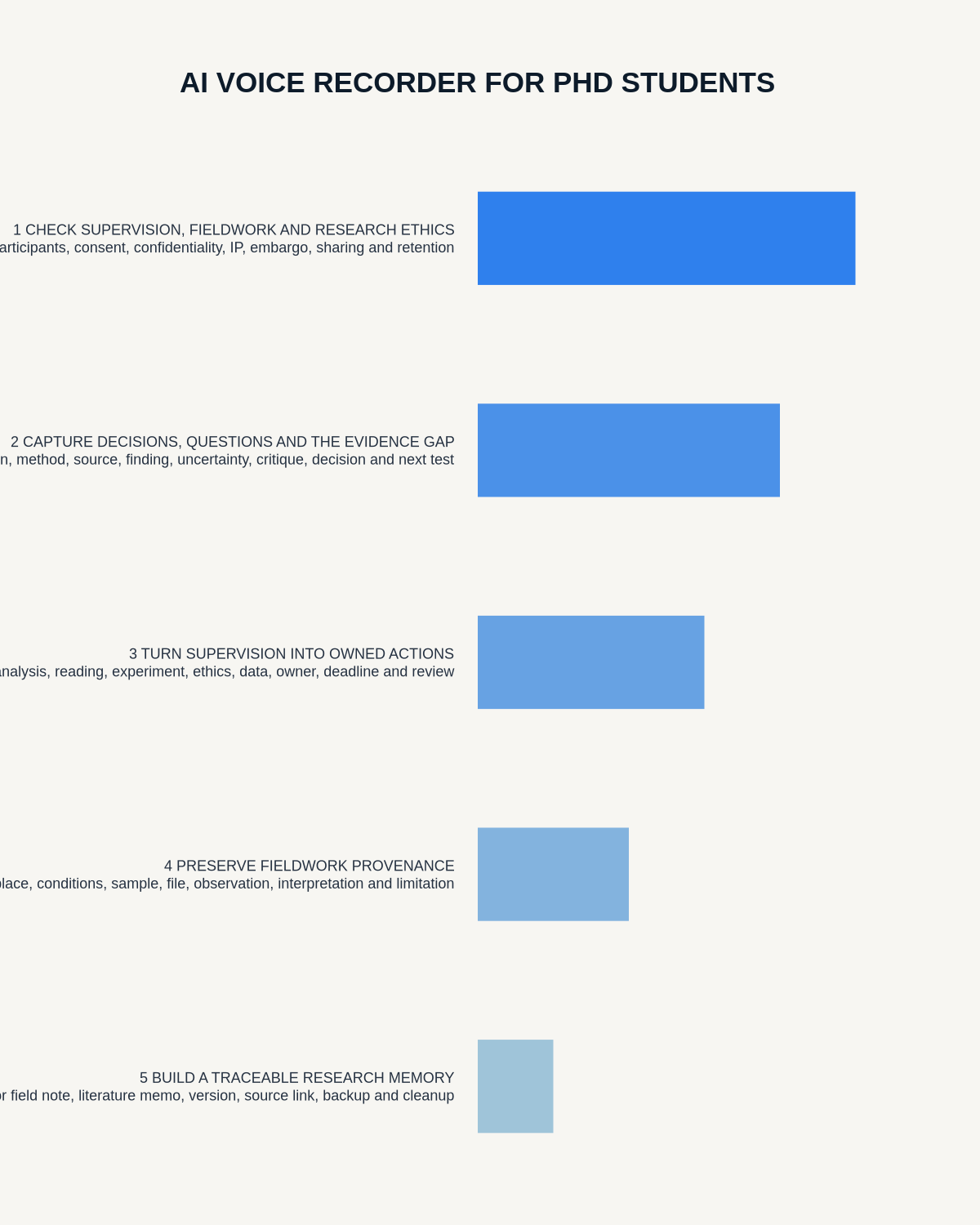
Visual map for AI Voice Recorder for PhD Students: Supervision, Research Ideas and Fieldwork Notes
- Prepare the approved useDefine purpose, safe position, permission and the required formal record.
- Capture context firstState the case, asset, person, location or event identifier before detail.
- Human-verify evidenceCheck technical terms, units, names, dates, decisions and uncertainty.
- Complete the formal recordTransfer only verified information and apply access and retention controls.
On this page
Related guides
See whether Halo fits long-form study capture
After checking permission and your institution’s rules, compare Halo’s stated battery, storage and export workflow with the way you actually study.
Found an error or an out-of-date claim? Email support@neralvo.com with the article address and a supporting source.