The 60-second verdict
Quick answer: use an AI voice recorder at a project kickoff to capture agreed outcomes, scope, exclusions, assumptions, authority, risks, dependencies and first actions, then move the verified information into the project’s controlled charter, registers, plan and task system. The transcript is source material—not the project baseline.
Best fit: Project Kickoffs who need recoverable audio and human-verified notes in an authorised workflow. Use another method when: recording is prohibited, a participant declines or the approved process requires manual notes.
Evidence basis and limits
- Decision factors covered: Define the decisions the kickoff must produce; Separate kickoff statement types; Use a decision-focused kickoff agenda.
- Evidence rule: Claims are weighted by consequence: capture failure, changed meaning, access and recovery matter more than polished wording.
- Boundary: Examples and workflow recommendations must be tested with representative recordings, the intended users and the actual approval process before rollout.

A kickoff creates the operating foundation for delivery. If scope, roles and assumptions remain ambiguous, the project can move quickly in the wrong direction. Check whether NERALVO Halo fits project kickoffs work can preserve approved discussion while the project manager focuses on alignment.
Define the decisions the kickoff must produce
A kickoff should not be a long presentation followed by vague enthusiasm. It should establish a shared operating model for delivery.
- What outcome is the project expected to create?
- How will success be measured and from which baseline?
- What work is included?
- What is explicitly excluded?
- Who owns delivery, sponsorship and decisions?
- Which assumptions must be tested?
- Which constraints cannot be ignored?
- What are the first milestones and actions?
Separate kickoff statement types
| Type | Meaning |
|---|---|
| Approved scope | Work formally included in the project |
| Exclusion | Work deliberately outside the current commitment |
| Assumption | Belief treated as true until validated |
| Constraint | Fixed limit such as budget, law, date or technology |
| Preference | Desirable outcome that is not mandatory |
| Open question | Information still required |
| Idea or option | Possible future work not yet accepted |
| Decision | Authorised direction with stated conditions |
| Change request | Proposed alteration after the baseline is approved |
AI frequently merges these categories. Human review must prevent a suggestion, preference or assumption from becoming an apparent requirement.
Use a decision-focused kickoff agenda
- Business context and objective.
- Measurable success outcomes and baseline.
- Deliverables, boundaries and exclusions.
- Stakeholders, roles and decision authority.
- Assumptions and validation owners.
- Constraints and dependencies.
- Top risks and escalation routes.
- Delivery method, milestones and controls.
- Communication, reporting and meeting rhythm.
- Change-control process.
- Immediate actions and next checkpoint.
Define the project outcome
State the problem, intended users, desired result and success measures. Distinguish the outcome from the activities the team expects to perform. “Deliver a portal” is an output; “reduce the time required to complete the service” is an outcome that can be measured.
Make scope and exclusions explicit
- Included deliverables.
- Explicit exclusions.
- Acceptance criteria.
- Constraints.
- Dependencies.
- Budget and timing boundaries.
- Customer, supplier or operational responsibilities.
- Change-control route.
Record exclusions as carefully as deliverables. Many later disputes arise from work that participants assumed was included but never formally accepted.
State assumptions aloud and assign validation
Common untested assumptions include:
- Data will be accurate and available.
- Customer or user access will be provided.
- A supplier will meet a date.
- Named staff will be available.
- Integration or technical capability already exists.
- Approval can be obtained within the plan.
- Budget covers all dependencies.
- The current requirement will not change.
Each material assumption needs a source, owner, evidence, validation date, affected decision and consequence if false. High-impact assumptions should be tested early.
Map roles and decision authority
Identify the sponsor, project manager, workstream owners, technical approvers, budget authority, user or client representative and escalation route. Record who can:
- Approve scope and budget.
- Accept deliverables.
- Prioritise requirements.
- Approve design or technical choices.
- Accept risk.
- Authorise changes.
- Stop or escalate the project.
Attendance at the kickoff does not automatically confer authority.
Create the first risk and dependency view
For each material risk, record cause, uncertain event, possible impact, current control, owner and review point. For each dependency, identify the required input or condition, provider, receiving workstream, needed-by date, assurance evidence and consequence of delay.
Capture immediate actions
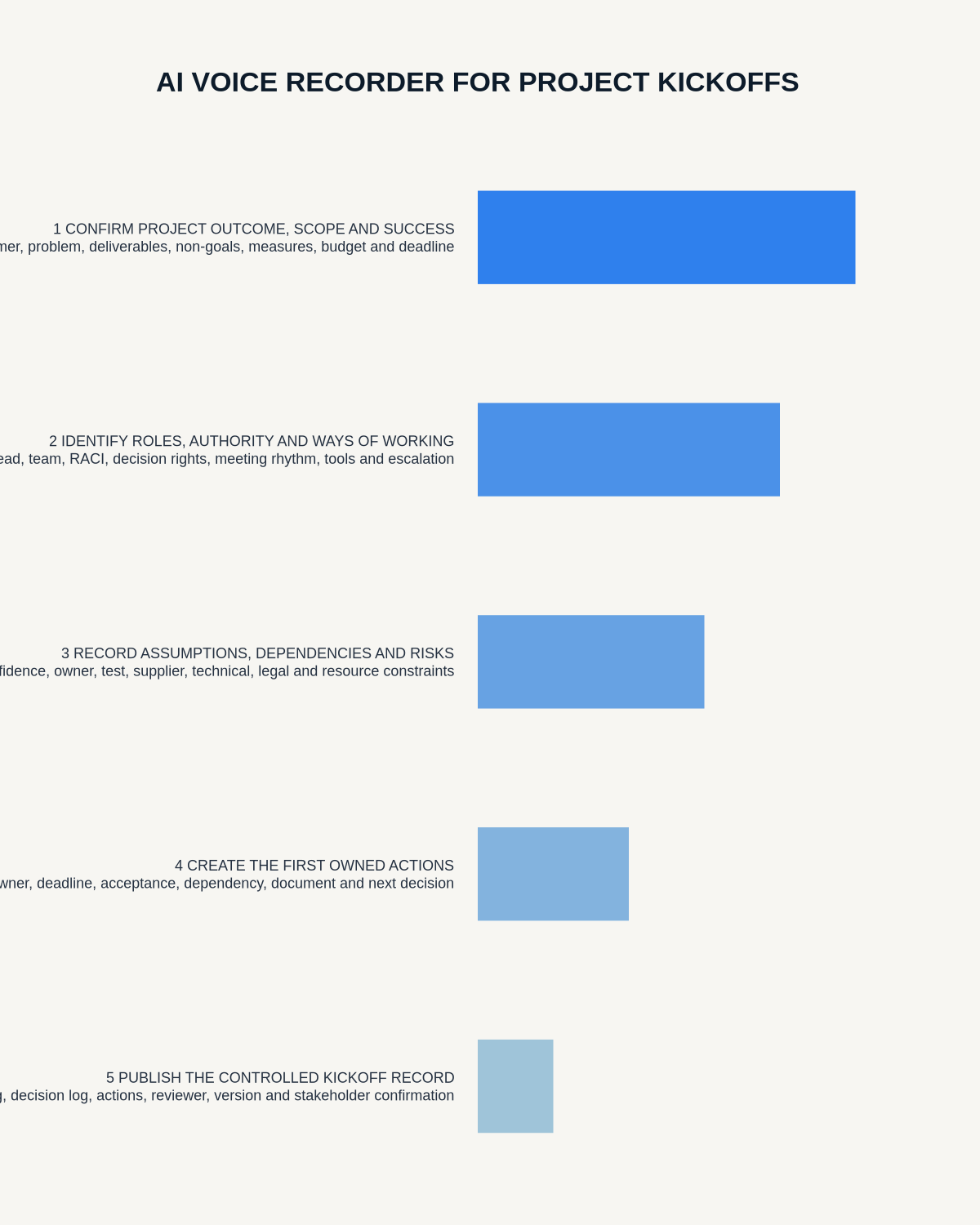
Each action needs one accountable owner, a specific deliverable, deadline, dependency and evidence of completion. “Team to review” is not a complete action. Move actions into the project system promptly instead of leaving them in the transcript.
Create the controlled kickoff pack
- Approved project brief or charter.
- Outcome, success measures and baseline.
- Scope, exclusions and acceptance criteria.
- Role and governance map.
- Assumption and decision logs.
- Initial risk and dependency registers.
- Milestone or delivery plan.
- Communication and reporting rhythm.
- Change-control process.
- Action tracker.
Use the baseline toolkit
| Baseline component | Approval evidence |
|---|---|
| Outcome and success measures | Sponsor-confirmed project brief |
| Scope and exclusions | Approved scope statement |
| Milestones | Delivery plan with dependencies |
| Budget and resources | Named authority and limits |
| Requirements | Status, source and acceptance criteria |
| Risks and assumptions | Owners, evidence and review dates |
Use a controlled post-kickoff workflow
- Generate and correct the transcript.
- Verify stakeholder names, roles, dates, numbers and terminology.
- Separate approved scope from ideas, preferences and open questions.
- Transfer assumptions into a log with validation owners and dates.
- Transfer risks and dependencies into their registers.
- Record decisions, authority, rationale and conditions.
- Create actions with owners and deadlines.
- Draft or update the charter, baseline and delivery plan.
- Circulate the checked kickoff record for correction and approval.
- Begin validation of the highest-risk assumptions.
- Apply retention to temporary audio and drafts.
Use a formal change request after baseline approval
For any proposed change, record the request, reason, affected deliverables, cost, timing, quality, benefits, risk, dependency, options, authority and decision. Do not allow a spoken preference to overwrite the baseline.
Use a first-ten-days plan
- Publish the approved brief and role map.
- Verify assumptions with the highest delivery impact.
- Close missing decisions.
- Confirm data, access, supplier and technical dependencies.
- Start only work supported by the baseline.
- Review risks and stakeholder communication.
Do not treat the transcript as a contract or charter
Spoken discussion can contain negotiation, examples and provisional language. Important scope, price, responsibilities, acceptance and terms should be recorded in the required approved documents. The AI summary can support drafting but does not replace formal authorisation.
How NERALVO Halo fits project kickoffs
NERALVO Halo includes NOTE mode, supported CALL mode, 64GB local storage, up to 35 hours of recording and Bluetooth sync with DOWAY. DOWAY can create transcripts, summaries, templates, translations, mind maps and exports, with one year of DOWAY Max included.
Use verbal markers for scope, exclusion, assumption, decision and action. DOWAY can draft the kickoff pack, but the sponsor and project manager should approve the controlled records before delivery begins.
Cloud software, a dedicated recorder or manual notes?
For Project Kickoffs, the right answer changes with the setting. This matrix deliberately gives each method a situation where it can be the strongest choice.
| Situation | Best starting point | Reason |
|---|---|---|
| scheduled remote meetings | Cloud meeting software | Calendar automation and shared integrations are usually the strongest advantage. |
| in-person or mobile work | Dedicated recorder | Independent capture reduces reliance on an active phone or laptop. |
| recording is refused or prohibited | Manual notes or an approved alternative | The boundary takes priority over convenience. |
| mixed online and offline work | Governed hybrid | Use each method only in the setting it actually fits. |
Frequently asked questions
Can a kickoff transcript replace a project charter?
No. It can support drafting, but the approved charter, plan and registers remain authoritative.
Should every stakeholder request become a requirement?
No. Distinguish ideas, preferences, questions, candidate requirements and formally accepted scope.
How can scope disputes be reduced?
Record exclusions, assumptions, acceptance authority and change control as clearly as the deliverables.
Can AI identify project risks automatically?
It can surface possible risks, but people must assess likelihood, impact, ownership and controls.
What should happen immediately after the kickoff?
Issue a checked record, update the governing documents and validate the highest-risk assumptions.
Final kickoff checklist
- Outcome and measures defined.
- Scope and exclusions explicit.
- Requirements, preferences and assumptions separated.
- Authority mapped.
- Assumptions have owners, evidence and dates.
- Risks and dependencies owned.
- First actions assigned.
- Controlled baseline and records created.
- Change-control route understood.
- Source audio retained deliberately.
Bottom line: a strong kickoff creates alignment before pressure and change arrive. AI capture preserves context; explicit scope, authority, validated assumptions and accountable actions make it operational.
Related guides
See the guides for project managers, programme managers and change managers.
On this page
Related guides
See whether Halo fits this workflow
Review the NERALVO Halo specifications, included services, delivery information and current offer only after completing the guide.
Found an error or an out-of-date claim? Email support@neralvo.com with the article address and a supporting source.