Reviewed and expanded: 4 August 2026.
The 60-second verdict
Quick answer: use an AI voice recorder in a retrospective only through an agreed team process, then convert the discussion into a small number of measurable experiments with owners, evidence and review dates. The useful output is not the transcript. It is the checked learning summary, the chosen improvement experiment and the evidence that will show whether it worked.
Best fit: Retrospectives who need recoverable audio and human-verified notes in an authorised workflow. Use another method when: recording is prohibited, a participant declines or the approved process requires manual notes.
Retrospectives are intended to improve the next cycle, not merely describe the last one. A device such as Check whether NERALVO Halo fits retrospectives work can preserve approved discussion, but recording may reduce candour if purpose, access, attribution and retention are unclear.
Evidence basis and limits
- Decision factors covered: Decide whether recording is necessary; Set the team conditions before the session; Use a structured reflection sequence.
- Evidence rule: Claims are weighted by consequence: capture failure, changed meaning, access and recovery matter more than polished wording.
- Boundary: Examples and workflow recommendations must be tested with representative recordings, the intended users and the actual approval process before rollout.
NERALVO sells the Halo AI voice recorder. This guide explains a general retrospective workflow and does not claim that AI can determine root cause, employee performance or team sentiment reliably.
Decide whether recording is necessary
A facilitator summary, shared board, anonymous written input or action log may be sufficient. Record only when the benefit—such as accessibility, complex evidence, distributed participation or difficult terminology—justifies the additional privacy and trust considerations.
Before recording, answer explicitly:
- What learning purpose does the audio serve?
- Who can access it?
- Will comments be attributed?
- Can participants contribute without being recorded?
- Will the recording be excluded from hidden performance or disciplinary use?
- When will audio and full transcripts be deleted?
- What checked output will replace the source recording?
Set the team conditions before the session
- Explain the purpose and intended output.
- State who can access audio, transcript and final summary.
- Define retention and deletion.
- Exclude private performance, health and grievance matters.
- Offer an alternative route for sensitive concerns.
- Confirm that the retrospective is about learning, not blame.
- State whether comments will be named, anonymised or grouped by theme.
Use a structured reflection sequence
- What outcome did the team expect?
- What actually happened?
- What evidence supports that view?
- What helped?
- What created friction?
- Which explanation remains only a hypothesis?
- What small change should be tested next?
- What measure and review date will determine whether the change worked?
Separate observation from explanation
| Type | Meaning | Example |
|---|---|---|
| Observation | What happened | Three stories missed the planned release date |
| Impact | The consequence | Customer testing started four days late |
| Interpretation | Why someone thinks it happened | The team believes approvals were too slow |
| Root-cause hypothesis | An explanation requiring evidence | Security review began too late in the cycle |
| Experiment | A controlled change | Start security review at refinement for two sprints |
| Measure | Signal of improvement | Approval lead time and blocked-story count |
AI summaries often collapse these categories. Human review must preserve uncertainty and prevent a repeated opinion from becoming an apparent fact.
Keep the discussion psychologically safer
Focus on systems, priorities, workflow, tools, handoffs, decision rights and workload. Individual performance issues belong in the appropriate private process. Do not use AI to infer emotion, commitment, attitude or blame from speech patterns.
Useful facilitator prompts include:
- What did the process make difficult?
- Which dependency was invisible until late?
- Where did the team lack authority or information?
- What evidence challenges our preferred explanation?
- Which change is within the team’s control?
Preserve minority views and unresolved uncertainty
A strong summary should not smooth a contested discussion into false agreement. Record:
- material disagreement;
- evidence that points in different directions;
- assumptions still untested;
- risks created by the preferred experiment;
- conditions that would cause the team to stop or change course.
Worker-monitoring and formal-process boundary
Retrospective recordings must not become hidden performance or disciplinary evidence. If an employer analyses or monitors workers, the purpose should be necessary, proportionate and transparent. The ICO’s worker-monitoring guidance explains relevant transparency, necessity and proportionality principles.
A learning-not-blame approach does not replace formal duties. Serious misconduct, safety, safeguarding, grievance, discrimination or whistleblowing concerns should move immediately into the correct authorised process rather than remaining inside a retrospective transcript.
Choose fewer, stronger experiments
Limit the final plan to changes the team can realistically implement and review. Each experiment should have one owner, a start date, a measurable signal, a review date and a clear keep, change or stop decision.
Retrospective experiment toolkit
| Experiment field | Required detail |
|---|---|
| Observed problem | Specific event and impact |
| Evidence | Current data, examples and limitations |
| Hypothesis | Proposed cause, clearly unverified |
| Change | Small intervention the team controls |
| Owner | One accountable person |
| Start date | When the experiment begins |
| Measure | Signal expected to improve |
| Guardrail | Unintended effect that must not worsen |
| Review | Date and keep, change or stop decision |
Example experiment
“Observation: five items entered development without acceptance examples. Hypothesis: refinement ends before test conditions are clear. Experiment: for two sprints, no item enters development until one product and one test owner confirm acceptance examples. Measure: rework count and blocked-test hours. Guardrail: refinement time must not increase by more than 20%. Review: 28 August.”
Use anti-blame language
Replace labels about attitude or competence with observable workflow, handoff, capacity, priority and system evidence.
| Avoid | Use instead |
|---|---|
| “The team was careless” | “The review checklist was not completed on four items” |
| “Nobody communicates” | “The dependency changed without an update in the shared board” |
| “The supplier is unreliable” | “Three agreed delivery dates were missed and no revised date was confirmed” |
Use a controlled post-retrospective workflow
- Generate the transcript and mark it as draft.
- Correct names, dates, figures and technical terminology.
- Separate observations, impacts, interpretations and hypotheses.
- Preserve material dissent and uncertainty.
- Choose a limited number of experiments.
- Assign one owner, measure, guardrail and review date to each.
- Update the team’s task or improvement system.
- Publish a checked learning summary rather than the full transcript.
- Apply retention and deletion to source audio and drafts.
Measure retrospective quality
A useful retrospective should improve delivery, not merely produce notes. Track:
- percentage of experiments actually started;
- percentage reviewed on time;
- repeat blockers across cycles;
- actions without owners;
- experiments kept, changed or stopped based on evidence;
- participant trust and willingness to raise problems;
- whether the same issue is repeatedly discussed without intervention.
How NERALVO Halo fits
NERALVO Halo provides NOTE recording, supported CALL capture, 64GB local storage, up to 35 hours of recording and Bluetooth sync with DOWAY. DOWAY can generate transcripts, summaries, templates, mind maps and exports. One year of DOWAY Max is included from activation.
Use Halo only where the team agrees to recording and the organisation has a defined access and deletion process. Use verbal markers such as “observation,” “hypothesis,” “experiment” and “action.” DOWAY can draft the structure, but people must verify evidence, ownership and employment boundaries.
Cloud software, a dedicated recorder or manual notes?
For Retrospectives, the right answer changes with the setting. This matrix deliberately gives each method a situation where it can be the strongest choice.
| Situation | Best starting point | Reason |
|---|---|---|
| scheduled remote meetings | Cloud meeting software | Calendar automation and shared integrations are usually the strongest advantage. |
| in-person or mobile work | Dedicated recorder | Independent capture reduces reliance on an active phone or laptop. |
| recording is refused or prohibited | Manual notes or an approved alternative | The boundary takes priority over convenience. |
| mixed online and offline work | Governed hybrid | Use each method only in the setting it actually fits. |
Frequently asked questions
Should every retrospective be recorded?
No. Use the least intrusive method that produces a useful improvement record.
Can AI identify the root cause?
It can organise suggestions, but root causes require evidence, testing and team judgement.
Should names appear in the final summary?
Only where attribution is necessary for actions, evidence or formal accountability. Avoid unnecessary personal detail.
What if serious misconduct or a safeguarding concern is raised?
Use the appropriate formal process immediately. The retrospective’s learning approach does not replace those duties.
How many experiments should a team choose?
Usually one to three, depending on team capacity. A smaller number with real ownership and review is stronger than a long list.
Should the transcript be kept?
Only for the defined purpose and retention period. The checked learning summary and experiment record will often need longer retention than the source audio.
Useful resources
- Association for Project Management: lessons learned
- ICO worker-monitoring guidance
- How to Build a Decision Log from Meeting Recordings
- AI Voice Recorder for Daily Standups
- Check whether NERALVO Halo fits retrospectives work
Retrospective checklist
- Recording need justified.
- Team process agreed.
- Use excluded from hidden performance or disciplinary monitoring.
- Observations and hypotheses separated.
- Blame and private performance discussion avoided.
- Serious concerns routed to the correct formal process.
- Minority views preserved.
- Experiments measurable.
- Owners, guardrails and review dates assigned.
- Checked learning summary published.
- Source access and retention controlled.
Bottom line: a retrospective recording is useful only when it protects candour, preserves uncertainty, keeps formal employment issues separate and turns evidence into a small experiment the team genuinely reviews.
Profession workflow
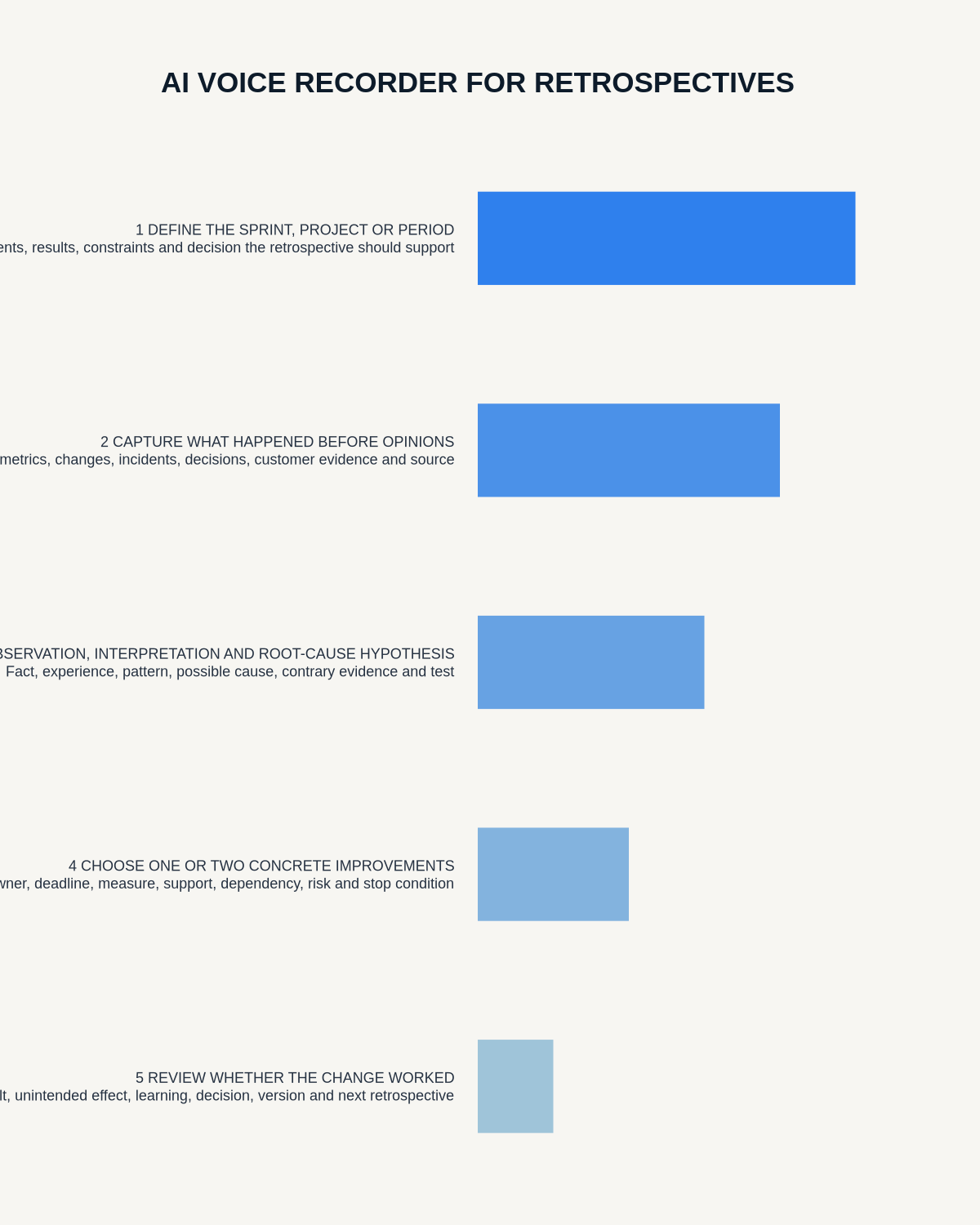
Visual map for AI Voice Recorder for Retrospectives: Turn Team Reflection into Real Improvement
- Prepare the approved useDefine purpose, safe position, permission and the required formal record.
- Capture context firstState the case, asset, person, location or event identifier before detail.
- Human-verify evidenceCheck technical terms, units, names, dates, decisions and uncertainty.
- Complete the formal recordTransfer only verified information and apply access and retention controls.
On this page
Related guides
See whether Halo fits this workflow
Review the NERALVO Halo specifications, included services, delivery information and current offer only after completing the guide.
Found an error or an out-of-date claim? Email support@neralvo.com with the article address and a supporting source.