The 60-second verdict
Quick answer: veterinarians can use an AI voice recorder to support approved consultation drafts, clinical handovers and post-visit notes, but the tool cannot examine an animal, diagnose disease, prescribe safely or replace the practice’s clinical and client records.
Best fit: Veterinarians who need recoverable audio and human-verified notes in an authorised workflow. Use another method when: recording is prohibited, a participant declines or the approved process requires manual notes.
Evidence basis and limits
- Decision factors covered: Use a species-to-plan workflow; Verify species, weight and medicine calculations; Preserve informed client decisions.
- Evidence rule: The decision is based on the complete capture-to-action workflow, not a single feature or marketing accuracy percentage.
- Boundary: Examples and workflow recommendations must be tested with representative recordings, the intended users and the actual approval process before rollout.
A compact device such as View Halo specifications for veterinarians use can preserve complex discussions while the veterinarian remains responsible for animal welfare, professional judgement, informed client consent and every treatment decision.
Use a species-to-plan workflow
- Species and context: species, breed, age, life stage, use, weight and husbandry.
- Problem: client concern, history, timing and effect on welfare.
- Evidence: examination, measurements, tests and source.
- Assessment: diagnosis, differentials and uncertainty.
- Options: investigation, treatment, referral, monitoring or humane outcome.
- Decision: client choice, authority and consent.
- Plan: medicine, procedure, owner, review and safety net.
Separate every information source
- Client reported
- Veterinarian observed
- Measured or tested
- Professional assessment
- Client decision
- Treatment completed
A transcript records speech; it does not prove that a client report is correct or that a differential has been confirmed.
Verify species, weight and medicine calculations
Check the exact animal, measured weight, medicine, formulation, concentration, dose, route, frequency, duration and quantity. Consider species-specific contraindications, legal status, food-chain implications, withdrawal periods and current authoritative guidance where relevant.
Repeat the calculation independently. AI output must not direct real treatment.
Preserve informed client decisions
Record the condition and uncertainty, reasonable options, material risks, likely benefits, costs, practical consequences, referral choices and what may happen without treatment. State what the client accepted, declined or deferred.
Do not let a summary turn “will consider referral” into “referral agreed.”
Keep animal welfare first
Where there is significant pain, respiratory distress, collapse, uncontrolled bleeding, neurological deterioration or another urgent welfare concern, act immediately through the clinical process. Documentation follows care.
Create a referral-quality record
- Animal and client identifiers
- Reason and urgency
- History and relevant findings
- Tests and images
- Treatment already given
- Response and current stability
- Exact clinical question
- Pending results and contact plan
Build client instructions around observable actions
A useful discharge or follow-up note should tell the owner or keeper:
- what to give or do;
- how and when to do it;
- what a normal response may look like;
- which sign requires urgent contact;
- activity, feeding, wound or housing instructions;
- the recheck date or result pathway; and
- how to contact the practice.
Check that the client understands. A polished transcript is not proof that the instructions were clear.
Protect client and practice confidentiality
Consultations may contain financial information, addresses, farm data, breeding details and sensitive commercial information. Explain any recording arrangement clearly and provide the practice-approved alternative where appropriate. Use only approved accounts and storage, minimise unrelated detail and avoid ambient recording in shared treatment areas.
How NERALVO Halo may fit veterinary practice
NERALVO Halo provides NOTE recording, supported CALL capture, 64GB local storage, up to 35 hours of recording and Bluetooth sync with DOWAY. DOWAY can generate transcripts, summaries, speaker-separated notes, templates, translations, mind maps and exports, with one year of DOWAY Max included from activation.
Any veterinary use requires practice approval of the complete device, app, processing, access and retention route. The practice-management system and professional clinical record remain authoritative.
Final veterinary-record checklist
- Species, context and weight correct
- Animal and owner or keeper identity confirmed
- Client report separated from examination
- Differentials and uncertainty preserved
- Medicines and calculations independently checked
- Client consent and declined options accurate
- Urgent welfare action completed first
- Referral question and follow-up clear
- Client instructions practical and understood
- Authorised record updated
Bottom line: AI can support documentation, but veterinary care remains a human professional decision grounded in examination, evidence and animal welfare.
Veterinary clinical evidence and farm-visit toolkit
| Evidence level | Example | Record status |
|---|---|---|
| Owner or keeper report | Appetite reduced for two days | Attribute the source |
| Direct observation | Posture, behaviour or visible sign | Describe objectively |
| Examination finding | Checked clinical finding | Record method and context |
| Differential | Plausible explanation | Keep provisional |
| Working diagnosis | Current conclusion guiding management | Show evidence and uncertainty |
| Confirmed diagnosis | Supported by appropriate testing | Link the result |
Farm and group map
For herd, flock or group work, identify premises, group, number affected, production stage, housing, feed, environment, chronology and representative animals examined. Keep group-level conclusions separate from individual findings and link samples, photographs, laboratory results and medicine records through stable identifiers.
Medicine decision gate
- Correct animal or group and measured weight.
- Product, concentration and legal status.
- Dose, route, frequency and duration.
- Contraindications, interactions and monitoring.
- Food-chain or withdrawal requirements where relevant.
- Client instructions and review.
Client-choice record
State the options, likely benefits, material risks, costs, uncertainty, referral availability and practical constraints. Preserve declined investigation or treatment accurately without implying neglect or agreement that did not occur.
NERALVO Halo workflow
Use approved capture in a controlled consultation or a private post-visit note. In farm environments, prioritise animal handling, biosecurity, machinery and personal safety. DOWAY can structure the draft; the veterinarian must verify the record against examination, tests and medicines sources.
Cloud software, a dedicated recorder or manual notes?
For Veterinarians, the right answer changes with the setting. This matrix deliberately gives each method a situation where it can be the strongest choice.
| Situation | Best starting point | Reason |
|---|---|---|
| scheduled remote meetings | Cloud meeting software | Native remote-meeting workflows can be more efficient here. |
| in-person or mobile work | Dedicated recorder | A separate battery and recoverable local source improve resilience. |
| recording is refused or prohibited | Manual notes or an approved alternative | Manual notes are the correct control when recording is unavailable. |
| mixed online and offline work | Governed hybrid | A hybrid can combine automation with reliable physical capture. |
Related veterinary guides
See the guides for veterinary nursing handovers, farm event records, field evidence grids and choosing an AI voice recorder.
Profession workflow
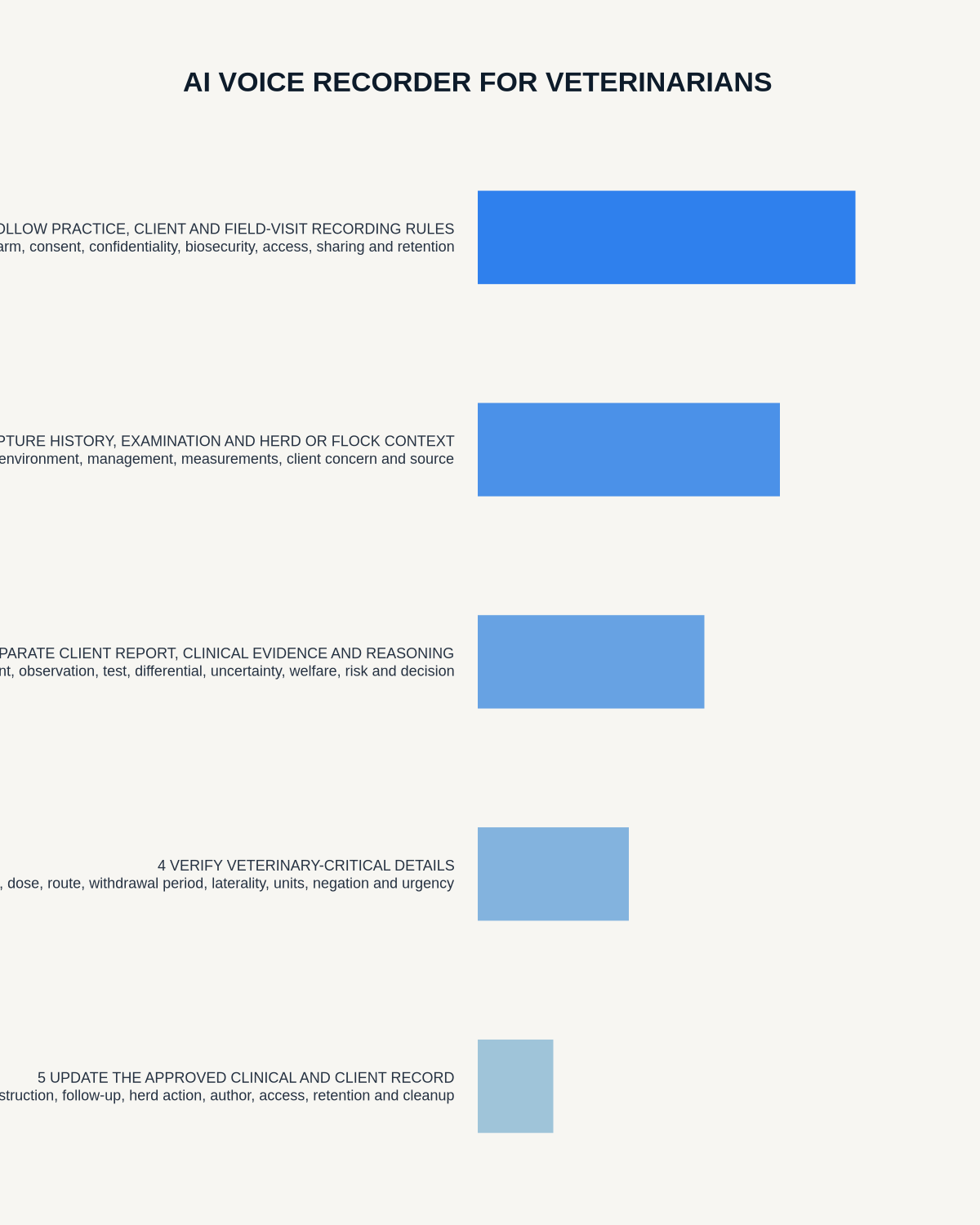
Visual map for AI Voice Recorder for Veterinarians: Consultations, Farm Visits and Clinical Notes
- Prepare the approved useDefine purpose, safe position, permission and the required formal record.
- Capture context firstState the case, asset, person, location or event identifier before detail.
- Human-verify evidenceCheck technical terms, units, names, dates, decisions and uncertainty.
- Complete the formal recordTransfer only verified information and apply access and retention controls.
On this page
Related guides
See whether Halo fits this workflow
Review the NERALVO Halo specifications, included services, delivery information and current offer only after completing the guide.
Found an error or an out-of-date claim? Email support@neralvo.com with the article address and a supporting source.