The 60-second verdict
Quick answer: veterinary nurses can use an AI voice recorder for approved handovers, theatre debriefs, inpatient updates and private post-shift notes, but the recording must never replace direct observation, medicine checks, patient monitoring or the authorised veterinary record.
Best fit: Veterinary Nurses who need recoverable audio and human-verified notes in an authorised workflow. Use another method when: recording is prohibited, a participant declines or the approved process requires manual notes.
Evidence basis and limits
- Decision factors covered: Use a patient-state handover; Separate report, observation and decision; Verify medicine and fluid details.
- Evidence rule: Claims are weighted by consequence: capture failure, changed meaning, access and recovery matter more than polished wording.
- Boundary: Examples and workflow recommendations must be tested with representative recordings, the intended users and the actual approval process before rollout.
Check whether NERALVO Halo fits veterinary nurses work can help preserve detail after a busy shift, while the veterinary nurse remains responsible for animal welfare, escalation, medicine safety and accurate communication with the veterinary surgeon and client.
Use a patient-state handover
- Identity: animal, species, breed, age, sex, location and responsible clinician.
- Reason for care: diagnosis, procedure or presenting problem.
- Current state: behaviour, comfort, observations and change from baseline.
- Treatment: medicines, fluids, nutrition, wound or device care.
- Risk: deterioration, pain, escape, aggression, infection or welfare concern.
- Pending work: tests, review, discharge or client communication.
- Next action: owner, time and escalation trigger.
Separate report, observation and decision
Keep client information, nurse observation, measured values, veterinary assessment and authorised plan distinct. A fluent AI summary may incorrectly present a client’s suspicion as a diagnosis or a proposed medicine as administered.
Verify medicine and fluid details
Check animal identity, allergy or adverse reaction, medicine, formulation, concentration, dose, route, frequency, time, quantity, administration status and monitoring. Verify calculations independently and use the authorised chart or practice-management system.
The transcript must not become the medicines administration record.
Preserve monitoring trends
Record the direction and timing of change in temperature, pulse, respiration, pain, demeanour, intake, urine output, weight, wound condition, neurological status and response to treatment. Check every number and unit against the original measurement.
Use a theatre and recovery closeout
- Confirm procedure and site.
- Record anaesthetic and analgesia status through the authorised system.
- Document equipment, samples and implants where relevant.
- Preserve complications and actions accurately.
- State recovery observations and discharge criteria.
- Assign continuing monitoring and client instructions.
Protect welfare and escalate immediately
Unexpected deterioration, uncontrolled pain, breathing difficulty, haemorrhage, seizure, collapse, medicine error or safeguarding concern requires immediate action through the practice procedure. Do not wait for an AI transcript.
Handle client communication carefully
A client update should distinguish confirmed findings, current treatment, uncertainty, costs or consent still required, and the next planned contact. Do not promise a diagnosis, outcome or discharge time that the veterinary surgeon has not authorised.
Keep sensitive areas recording-free
Do not record ambient audio in kennels, treatment areas, operating theatres or client spaces without a specific approved purpose. Explain any direct recording arrangement through the practice-approved process and offer the approved non-recorded alternative where appropriate. Use a private post-event draft where possible and avoid capturing unrelated clients, staff or commercially sensitive information.
How NERALVO Halo may fit veterinary nursing
NERALVO Halo provides NOTE recording, supported CALL capture, 64GB local storage, up to 35 hours of recording and Bluetooth sync with DOWAY. DOWAY can generate transcripts, summaries, speaker-separated notes, templates, translations, mind maps and exports, with one year of DOWAY Max included from activation.
Its output should be reviewed and transferred into the practice’s approved system. The device is not a patient monitor, medicine system or emergency tool.
Final veterinary-nursing checklist
- Correct animal and current status confirmed
- Client report separated from clinical findings
- Medicine, dose and administration verified
- Monitoring trends preserved
- Urgent welfare action completed first
- Client commitments authorised
- Actions have owners and times
- Official record updated
Bottom line: AI can reduce forgotten detail, but safe veterinary nursing records depend on direct care, verified measurements and immediate welfare action.
Veterinary nursing continuity and escalation toolkit
| Handover field | Required detail | Verification source |
|---|---|---|
| Patient state | Current behaviour, comfort, mobility and time-stamped observations | Direct check and monitoring chart |
| Medicine | Last dose, next due, route, response and exception | Authorised medicines record |
| Fluids and nutrition | Plan, actual intake, losses, output and restrictions | Fluid and nursing chart |
| Wound or device | Site, dressing, line, drain, catheter or equipment condition | Direct observation and treatment plan |
| Pending work | Test, result, clinician review, discharge or client call | Practice system |
| Escalation | Specific trigger, responsible clinician and urgency | Authorised clinical plan |
Medicine double-check protocol
- Identify the correct patient and current weight.
- Check the authorised medicine and concentration.
- Verify calculation, dose, route and schedule independently.
- Confirm administration status and response.
- Record omitted, refused, delayed or unavailable doses accurately.
- Escalate discrepancies before further administration.
Theatre-to-ward continuity
Connect the procedure, significant anaesthetic events, recovery status, analgesia, airway or device information, samples, wound or dressing, nutrition, mobility, monitoring frequency and discharge criteria. A general statement such as “recovered well” is not enough for the next nurse to act safely.
Client-instruction release
Verify every medicine, food, activity, wound-care, monitoring and contact instruction against the veterinary surgeon’s approved plan. State who gave the update, what the client understood and when the next contact is due.
NERALVO Halo workflow
Use a private structured note after active care or an approved handover meeting. DOWAY can draft the patient-state summary, but the nurse must reconcile it with monitoring, medicine and practice records before release. Delete temporary audio under the practice’s defined rule.
Cloud software, a dedicated recorder or manual notes?
For Veterinary Nurses, the right answer changes with the setting. This matrix deliberately gives each method a situation where it can be the strongest choice.
| Situation | Best starting point | Reason |
|---|---|---|
| scheduled remote consultations | Cloud meeting software | Calendar automation and shared integrations are usually the strongest advantage. |
| in-person consultations or ward handovers | Dedicated recorder | Independent capture reduces reliance on an active phone or laptop. |
| a patient declines or policy prohibits recording | Manual notes or an approved alternative | The boundary takes priority over convenience. |
| mixed remote and clinical work | Governed hybrid | Use each method only in the setting it actually fits. |
Related veterinary guides
See the guides for veterinary consultation records, farm event ledgers, structured care handovers and choosing an AI voice recorder.
Profession workflow
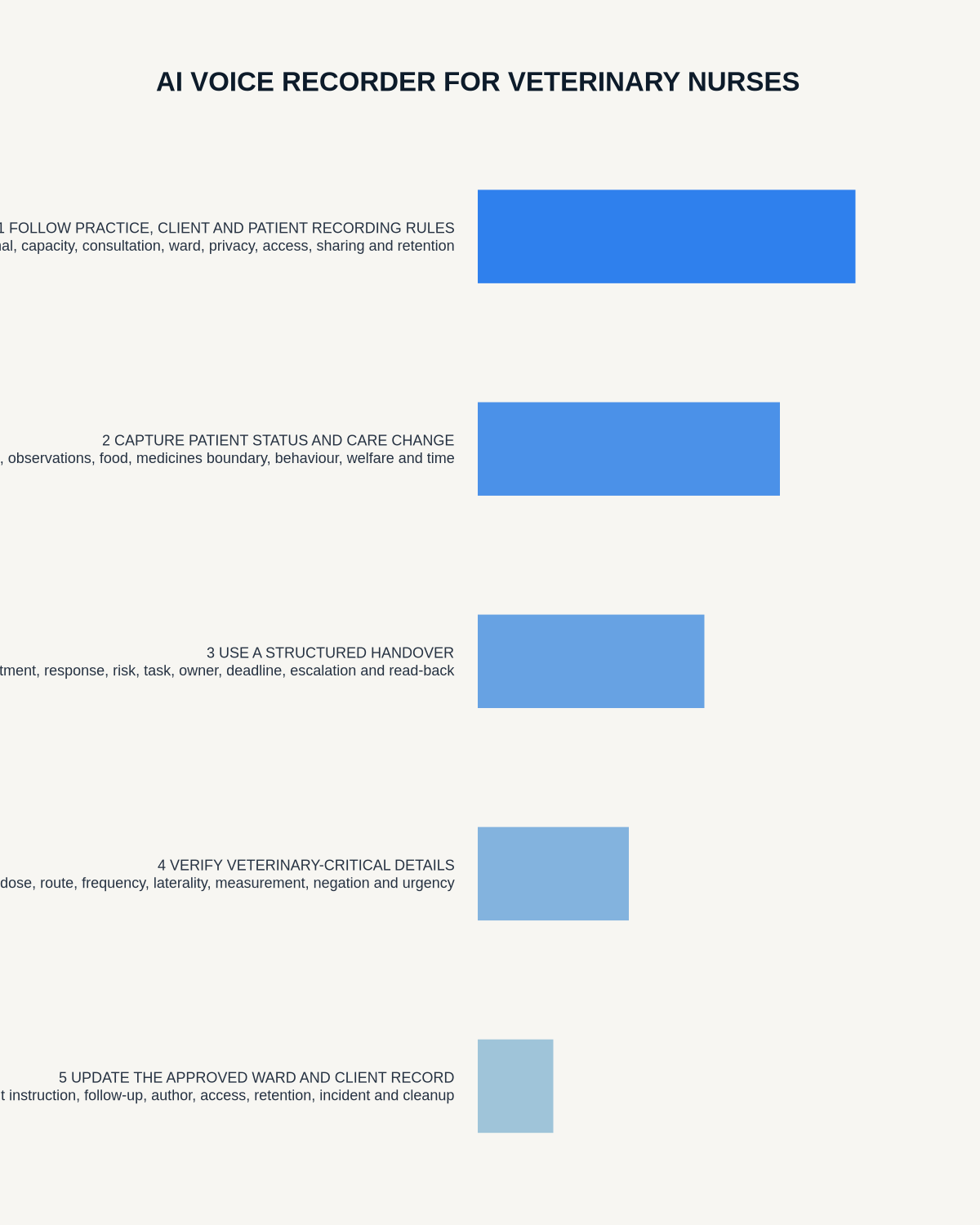
Visual map for AI Voice Recorder for Veterinary Nurses: Patient Handover, Client Instructions and Ward Notes
- Prepare the approved useDefine purpose, safe position, permission and the required formal record.
- Capture context firstState the case, asset, person, location or event identifier before detail.
- Human-verify evidenceCheck technical terms, units, names, dates, decisions and uncertainty.
- Complete the formal recordTransfer only verified information and apply access and retention controls.
On this page
Related guides
See whether Halo fits this workflow
Review the NERALVO Halo specifications, included services, delivery information and current offer only after completing the guide.
Found an error or an out-of-date claim? Email support@neralvo.com with the article address and a supporting source.