The 60-second verdict
Quick answer: automotive technicians can use an AI voice recorder to preserve intermittent-fault context, test sequences, measured results and repair evidence after the vehicle and work area are safely controlled. The device cannot diagnose the vehicle or replace scan tools, measurements, manufacturer procedures, workshop records or technician judgement.
Decision focus: use the method below only where it produces a recoverable source, a verifiable output and a clear next action. If one of those fails, change the workflow rather than trusting a polished summary.
Evidence basis and limits
- Decision factors covered: Create a symptom fingerprint; Use a symptom → condition → test → proof workflow; Keep evidence levels separate.
- Evidence rule: A claim earns weight only when the source, date, configuration and limitation are clear enough for a reader to check.
- Boundary: Examples and workflow recommendations must be tested with representative recordings, the intended users and the actual approval process before rollout.
Intermittent faults are difficult because the symptom may disappear before the vehicle reaches the workshop. A customer remembers a sound, vibration, warning or loss of performance, but a vague repair-order line such as “check noise” removes the conditions needed to reproduce it.
Apply this guide before assessing NERALVO Halo can preserve details that are easily lost between intake, road test, inspection and workshop documentation. The official repair order and diagnostic evidence remain authoritative.
Create a symptom fingerprint
Capture the complaint under eight fields:
- Behaviour: sound, sensation, warning, smell or performance change.
- Trigger: braking, steering, acceleration, load, road surface or electrical demand.
- Temperature: cold start, warming up, fully hot or ambient condition.
- Speed and engine state: vehicle speed, engine speed, gear and throttle position.
- Location: where the customer perceives the symptom.
- Frequency: constant, occasional, first journey, long journey or a specific sequence.
- History: recent repair, impact, battery event, software update or change in use.
- Reset: what makes the symptom stop or a warning disappear.
Preserve the customer’s wording before translating it into technical hypotheses. “Grinding when reversing after rain” records conditions. “Rear brake fault” is a diagnosis that still requires evidence.
Use a symptom → condition → test → proof workflow
- Symptom: the customer’s exact description.
- Condition: speed, load, temperature, road, weather, frequency and warning status.
- Test: scan, measurement, inspection or controlled reproduction.
- Finding: evidence, result and confidence.
- Repair: authorised work and parts completed.
- Proof: retest under relevant conditions and confirmed outcome.
Keep evidence levels separate
| Level | Example | How to record it |
|---|---|---|
| Reported | Customer hears a knock on left turns | Attributed customer statement; not verified |
| Observed | Technician reproduces one knock | Route, speed, load and conditions |
| Measured | Movement exceeds specification | Value, unit, method and source specification |
| Supported hypothesis | Evidence points to an assembly | Reasoning, alternatives and remaining checks |
| Confirmed cause | Fault found and linked to symptom | Inspection, measurement or test evidence |
| Validated repair | Symptom absent under matching conditions | Post-repair test and any limitation |
AI summaries can collapse these levels into a confident diagnosis. Keep the status visible until evidence supports progression to the next level.
Record safely
Do not operate a recorder while driving, lifting, working below an unsupported vehicle, using rotating machinery or carrying out live electrical, high-voltage or fuel-system work. Stop and secure the task first.
If the reported defect may affect braking, steering, tyres, restraints, fuel, high-voltage systems or another safety-critical area, assess the vehicle before any road test. Immediate safety controls take priority over documentation.
Design the reproduction plan before testing
Use the symptom fingerprint to define:
- Conditions required to reproduce the symptom.
- Safety-critical checks before movement.
- Route or controlled environment.
- Technician and observer roles.
- Diagnostic equipment and data to capture.
- Stop conditions.
- What counts as successful reproduction.
Capture notes before the test or after stopping in a safe, legal place. Never handle the recorder while driving.
Verify every identifier, code and unit
Speech recognition can confuse characters, decimals and units. Check directly:
- Registration, VIN, job identifier and mileage.
- Diagnostic trouble codes and freeze-frame values.
- Module, software, calibration and part numbers.
- Voltage, current, resistance, pressure and temperature.
- Torque and dimensional measurements.
- Manufacturer bulletin and procedure references.
- Test-equipment identity and calibration status where required.
State the source specification beside the result. A number without its unit, test conditions and acceptable range is weak evidence.
Separate a diagnostic code from the cause
- Customer symptom: what the user experiences.
- Stored code: a recorded system condition.
- Measured condition: an observed value under stated circumstances.
- Possible cause: a hypothesis requiring a discriminating test.
- Confirmed failure: a cause supported by evidence.
- Repair proof: validation against the original symptom.
A diagnostic trouble code does not automatically identify the failed component.
Use a hypothesis matrix
| Hypothesis | Evidence for | Evidence against | Next discriminating test |
|---|---|---|---|
| Cause A | Matches temperature and load | No relevant code | Measure under hot loaded condition |
| Cause B | Recent work in the area | Symptom existed before repair | Inspect installation and compare history |
| Cause C | Known pattern for model | Current measurement normal | Follow the controlled manufacturer test |
Preserve failed tests. They prevent repeat work and make the handover useful when another technician continues the investigation.
Create a controlled diagnostic record
For each experiment, record:
- Hypothesis being tested.
- Authorised procedure and source.
- Vehicle state and environmental conditions.
- Expected result.
- Actual result and timestamp.
- Measurement, unit and acceptable range.
- Decision: reject, retain or refine the hypothesis.
- Any change made and its rollback or restoration.
Build a workshop handover that preserves vehicle state
Vehicle and repair order — exact customer symptom — safety status — reproduction status — tests completed — measured results — parts removed or systems isolated — current hypotheses — authorisation limit — next test — required evidence.
State whether the vehicle is safe, restricted, dismantled, awaiting approval or awaiting parts. Move the checked information into the official repair order and workshop system.
Control repair authorisation
Diagnosis and repair authority are separate. Before work proceeds, the authorised record should identify the supported finding, proposed work, parts or alternatives, estimate or quotation status, price and tax, spending limit, customer authority, timing assumptions and any further approval threshold.
Do not let a technical voice note become the only evidence of customer authorisation.
Validate the repair against the original symptom
Clearing a code or replacing a component does not prove resolution. Match validation to the original conditions where practical:
- Same temperature state.
- Same load, speed or operating sequence.
- Repeat measurement.
- Scan and system checks.
- Quality-control inspection.
- Clear limitation where the symptom cannot be fully reproduced.
Tell the customer what was confirmed, what was repaired, how it was checked and what remains uncertain.
Create a repair-verification record
- Original symptom reproduced or limitation documented.
- Cause supported by evidence.
- Repair and parts recorded.
- Related systems checked.
- Codes cleared only where appropriate.
- Road or functional test completed safely.
- Residual issue or advisory item disclosed.
- Official workshop record updated.
Protect customer and vehicle data
Use approved business accounts and minimise personal information. Do not record payment-card details, passwords, security answers, access codes or unnecessary identity data. Restrict raw audio and delete temporary material according to the organisation’s retention rules.
How NERALVO Halo may fit workshop work
NERALVO Halo includes NOTE mode, supported CALL mode, 64GB local storage, up to 35 hours of recording and Bluetooth sync with DOWAY. DOWAY can produce transcripts, summaries, templates, translations, mind maps and exports, with one year of DOWAY Max included.
It may support authorised customer symptom discussions, stationary post-test notes and workshop handovers. It is not scan, measurement, lifting, workshop-information or safety equipment.
Workflow choice matrix for How Automotive Technicians Can Capture Intermittent Faults Accurately
Choose the method that protects the source and reduces downstream correction. The table makes the non-hardware options explicit.
| Condition | Preferred route | Why |
|---|---|---|
| High-risk or mixed work | Governed hybrid | Separate capture, review, approval and retention rather than trusting one tool. |
| Recording is refused, prohibited or unnecessary | Manual notes / no recording | Respecting the boundary is the correct workflow, not a product failure. |
| In-person, mobile or unreliable-connectivity work | Dedicated recorder | Independent capture and a recoverable local source are usually more resilient. |
| Repeatable remote work with approved integrations | Cloud software | Automation and central collaboration may outweigh device independence. |
Frequently asked questions
Can AI diagnose an intermittent fault from the customer’s description?
No. The description helps define reproduction conditions and hypotheses; diagnosis requires controlled testing and evidence.
Does a fault code prove which component has failed?
No. Verify circuit conditions, measurements, procedures and competing causes.
Should a technician record notes during a road test?
No. Record before moving or after stopping safely.
What if the fault cannot be reproduced?
Document the attempted conditions, available evidence, limitations, safety assessment and the information needed if it recurs.
Final technician-note checklist
- Vehicle and task safely controlled.
- Customer wording preserved separately from diagnosis.
- Occurrence conditions specific enough to reproduce.
- Codes, identifiers, units and references verified.
- Evidence level visible for every conclusion.
- Hypotheses and failed tests retained.
- Vehicle state and next test clear in the handover.
- Work authorised through the correct process.
- Repair validated against the original symptom.
- Customer explanation and workshop record reconciled.
Bottom line: intermittent faults become easier to solve when the exact operating conditions, verified measurements, hypothesis chain and repair proof remain connected from customer intake to final handback.
Related guides
Workflow map
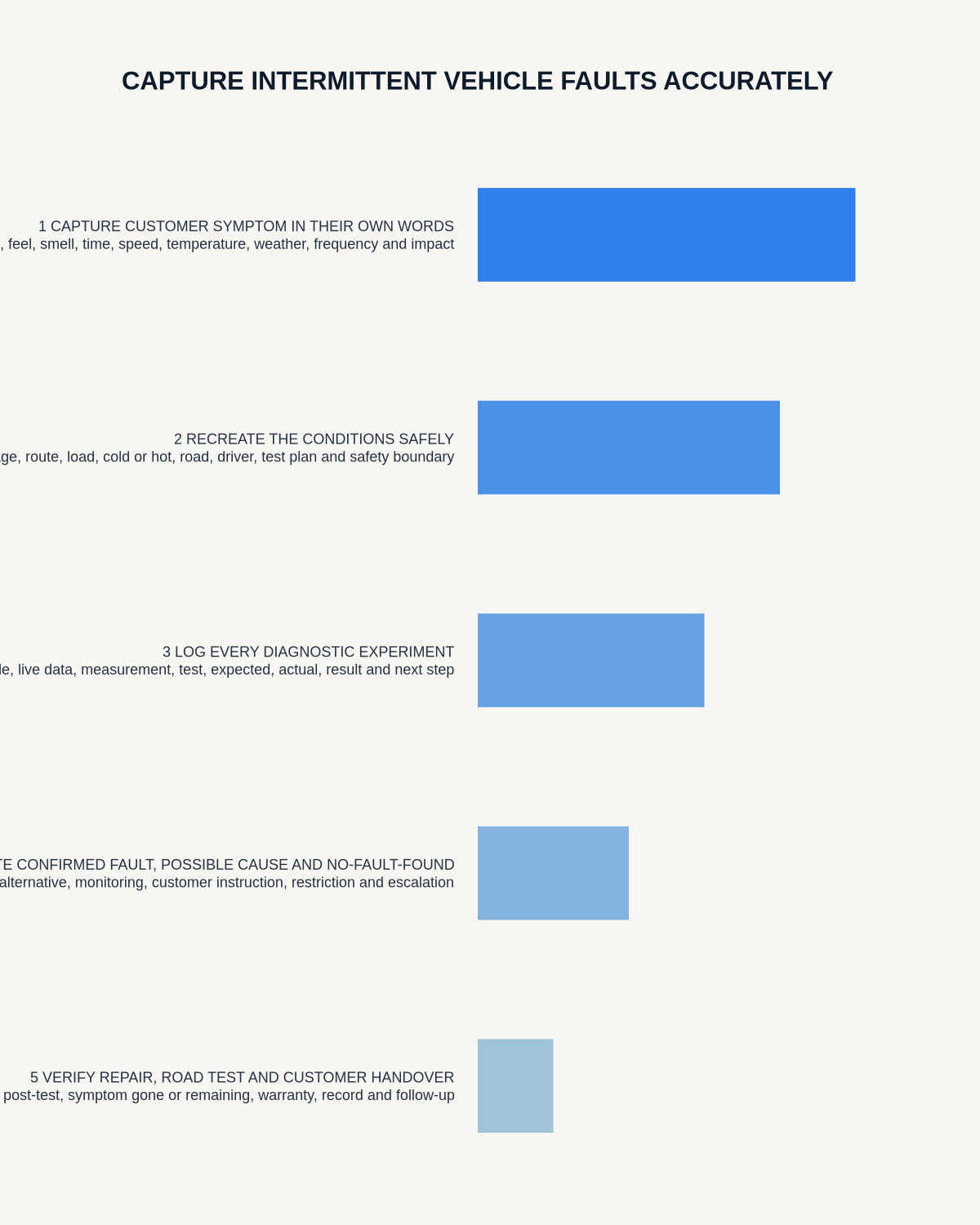
Visual map for How Automotive Technicians Can Capture Intermittent Faults Accurately
- Define the decisionState the question, required output and acceptance rule.
- Capture the sourceUse the approved route and preserve context, identity and limitations.
- Verify material detailsReplay or check names, numbers, negatives, decisions and actions.
- Move into the real recordAssign an owner, retain evidence and apply the deletion rule.
On this page
More in this topic: Field recording, setup and troubleshooting
Show 8 closely related guides
- AI Voice Recorder for Solar Installers: Roof Surveys, Design Changes and Handover Notes
- AI Voice Recorder for HVAC Engineers: Fault Diagnosis, Commissioning and Service Records
- AI Voice Recorder for Lift Engineers: Safer Fault Reports and Clearer Handover
- AI Voice Recorder for Plumbers: Customer Faults, Site Surveys and Job Notes
- How to Prevent Bluetooth and App Interruptions During Recording
- How Much Storage Does an AI Voice Recorder Need? A Practical Formula
- How to Use an AI Voice Recorder with a Phone Case or Magnetic Mount
- How to Position an AI Voice Recorder on Different Table Shapes
Related guides
See whether Halo fits this workflow
Review the NERALVO Halo specifications, included services, delivery information and current offer only after completing the guide.
Found an error or an out-of-date claim? Email support@neralvo.com with the article address and a supporting source.