The 60-second verdict
Quick answer: corporate trainers can turn learner questions into better courses by grouping recurring questions, linking each signal to a learning objective, identifying whether the problem is content, delivery, process, system or access, testing one controlled improvement and measuring whether the next cohort performs better.
Decision focus: use the method below only where it produces a recoverable source, a verifiable output and a clear next action. If one of those fails, change the workflow rather than trusting a polished summary.
Evidence basis and limits
- Decision factors covered: Separate course insight from employee monitoring; Use an objective → evidence → gap → improvement → review workflow; Apply the learning-objective test.
- Evidence rule: Claims are weighted by consequence: capture failure, changed meaning, access and recovery matter more than polished wording.
- Boundary: Examples and workflow recommendations must be tested with representative recordings, the intended users and the actual approval process before rollout.
An AI voice recorder can support approved workshops, private trainer reflections and course-development meetings. It should not become routine employee surveillance or replace attendance, assessment, competence or HR systems.

Create a question heatmap
| Category | What it may reveal | Typical response |
|---|---|---|
| Missing knowledge | Prerequisite content was assumed | Add foundation material or pre-work |
| Unclear instruction | The explanation, wording or example failed | Rewrite or demonstrate differently |
| Process ambiguity | The official procedure is unclear | Escalate to the process owner |
| System mismatch | The live tool differs from training | Update screenshots, exercise or environment |
| Role confusion | Ownership or escalation is uncertain | Add responsibilities and decision points |
| Access barrier | The format excludes some learners | Change materials, pacing or participation options |
Count repeated questions across cohorts. One unusual question may need an individual answer; the same question from several groups is probably a design signal.
Separate course insight from employee monitoring
Recording can affect participation. Define exactly what is captured and why. In many cases, a short trainer reflection after the session is more proportionate than recording the whole room.
Where recording is approved:
- Explain purpose, audience, access and retention
- Capture only the part needed
- Provide an appropriate alternative where required
- Remove unnecessary names from improvement notes
- Do not convert informal discussion into an undisclosed performance record
- Apply organisational access and retention controls
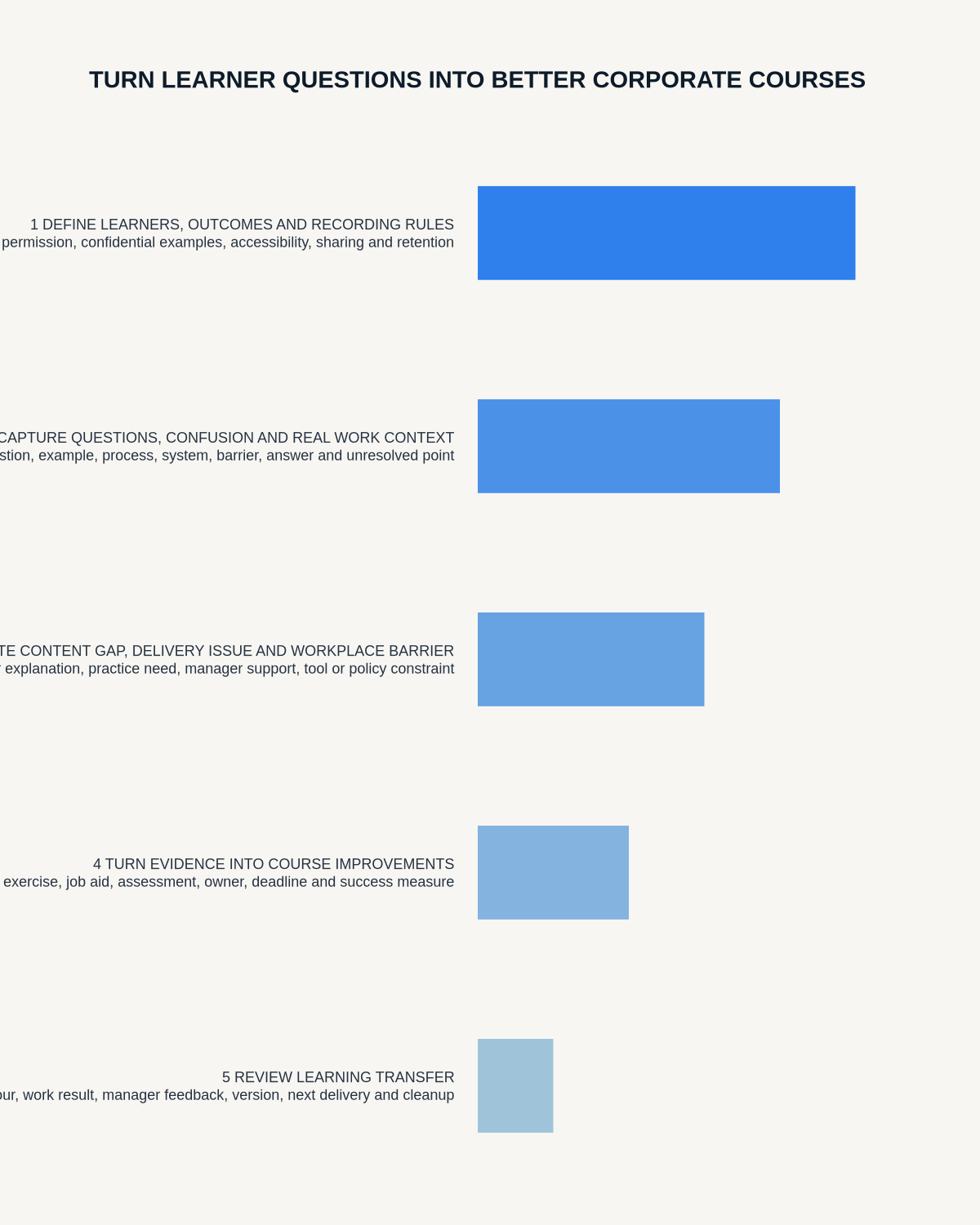
Use an objective → evidence → gap → improvement → review workflow
- Objective: what participants should know or do.
- Evidence: question, task, assessment or observation.
- Gap: unclear instruction, missing knowledge, system mismatch or unsuitable activity.
- Improvement: content, example, practice, support or process change.
- Review: how the next cohort will show whether it worked.
Apply the learning-objective test
- Which learning objective does the issue affect?
- What evidence shows the current version is not working?
- Is the problem content, delivery, process, system or access?
- What is the smallest useful change?
- Who owns the authoritative information?
- How will the revised version be tested?
This prevents the reflex of adding more slides to an already dense course.
Run a controlled course-change experiment
Baseline
Record the recurring question, activity result, timing problem or observed confusion in the current course version.
Change
Modify one element where possible: the example, explanation order, exercise, job aid, practice time or accessibility support.
Test
Use the revision with the next suitable cohort. Did the question disappear? Did practical performance improve? Did another misunderstanding appear?
Decision
Adopt, revise or reverse the change. Record the course version and owner.
Create a course-change log
| Field | Detail |
|---|---|
| Course and version | Controlled material affected |
| Learning objective | Required knowledge or performance |
| Issue | Observed learning problem |
| Evidence | Questions, results or facilitator observation |
| Change | Content, activity or support amended |
| Owner | Responsible content or process owner |
| Measure | How effectiveness will be checked |
| Decision | Adopted, revised or reversed |
Keep formal evidence in the formal system
A transcript does not prove attendance, understanding or competence. Keep attendance, assessment, authorisation, refresher and HR information in approved systems. AI must not fabricate scores, feedback or completion records.
Use reflections that avoid blame
| Weak note | Better note |
|---|---|
| “The group was slow.” | “The exercise required twelve minutes more than planned; three instructions were repeated.” |
| “They did not understand escalation.” | “Four learners asked who owns the decision after the first escalation step.” |
| “One learner was difficult.” | “The scenario wording led to disagreement about which policy applied.” |
Design for accessibility from the start
Review structure, plain language, captions, transcript accuracy, accessible digital files, alternative participation methods, breaks, pacing, practical barriers and private handling of individual adjustments. An AI transcript may help, but it is not automatically accurate or accessible.
Where NERALVO Halo fits
Check whether NERALVO Halo fits this workflow can capture approved workshops, private trainer reflections and supported remote development calls. It includes 64GB local storage, up to 35 hours of recording and Bluetooth sync with DOWAY. DOWAY can create transcripts, summaries, templates, translations, mind maps and exports. One year of DOWAY Max is included from activation.
Use the output to identify course-design signals. Verify technical, legal and procedural content with the responsible owner before changing controlled material.
Course-improvement checklist
- Recording purpose is clear and proportionate
- Unnecessary names and personal details removed
- Questions grouped by category and objective
- Course issues separated from individual performance
- Technical and regulatory answers verified
- Change has one owner and version
- Revised course tested with evidence
- Accessibility reviewed beyond transcript provision
- Formal assessment and HR records remain separate
- Current controlled version is identifiable
Workflow choice matrix for How Corporate Trainers Can Turn Learner Questions into Better Courses
Choose the method that protects the source and reduces downstream correction. The table makes the non-hardware options explicit.
| Condition | Preferred route | Why |
|---|---|---|
| Repeatable remote work with approved integrations | Cloud software | Automation and central collaboration may outweigh device independence. |
| In-person, mobile or unreliable-connectivity work | Dedicated recorder | Independent capture and a recoverable local source are usually more resilient. |
| Recording is refused, prohibited or unnecessary | Manual notes / no recording | Respecting the boundary is the correct workflow, not a product failure. |
| High-risk or mixed work | Governed hybrid | Separate capture, review, approval and retention rather than trusting one tool. |
Related guides
On this page
Related guides
See whether Halo fits this workflow
Review the NERALVO Halo specifications, included services, delivery information and current offer only after completing the guide.
Found an error or an out-of-date claim? Email support@neralvo.com with the article address and a supporting source.