The 60-second verdict
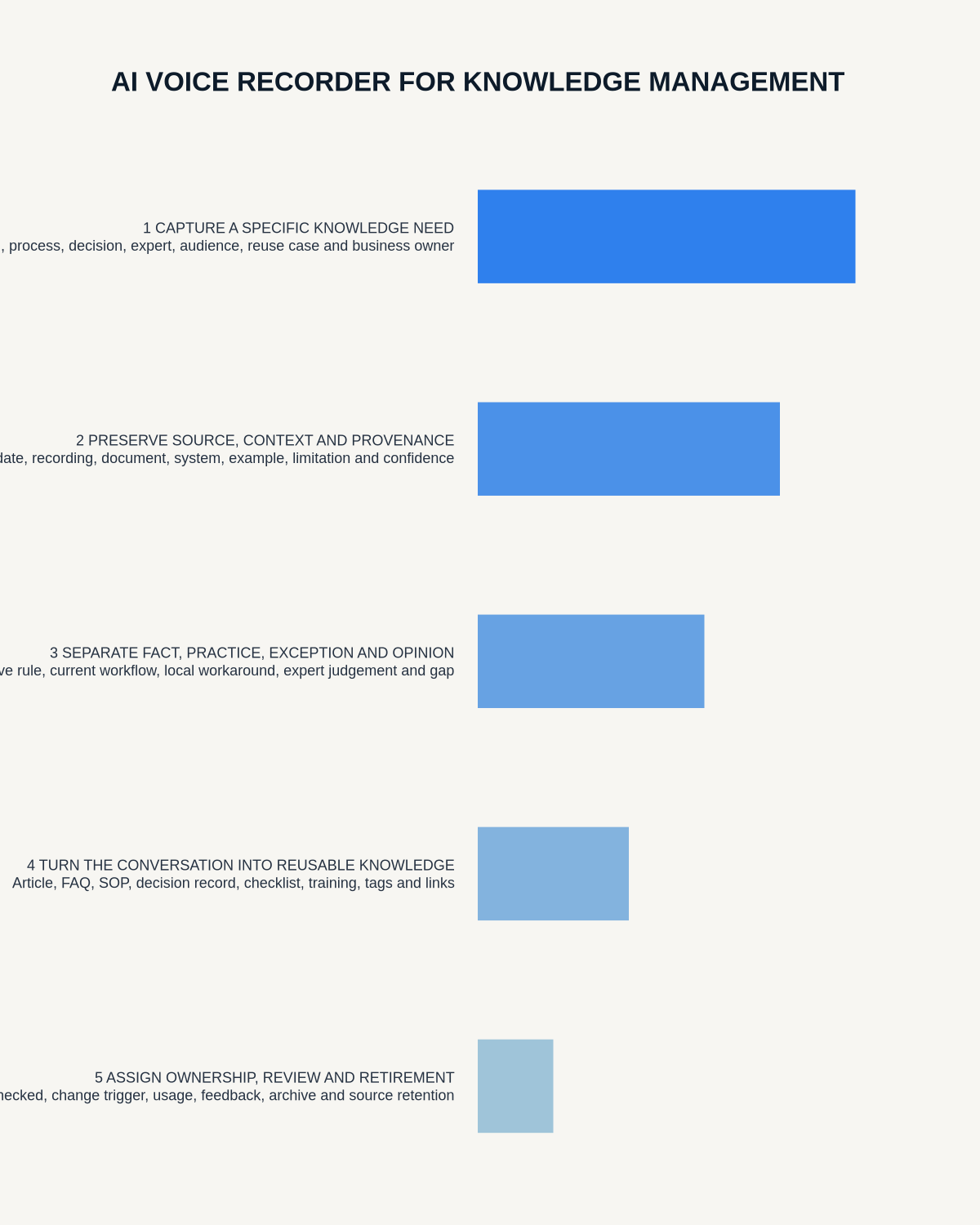
Quick answer: turn recorded conversations into reusable team knowledge by choosing a valuable knowledge gap, interviewing for reasoning and exceptions, verifying the answer, publishing one canonical resource and assigning an owner, version and review trigger.
Best fit: Knowledge Management who need recoverable audio and human-verified notes in an authorised workflow. Use another method when: recording is prohibited, a participant declines or the approved process requires manual notes.
Evidence basis and limits
- Decision factors covered: Choose knowledge worth preserving; Define the knowledge outcome; Interview for tacit knowledge, not only the normal steps.
- Evidence rule: Claims are weighted by consequence: capture failure, changed meaning, access and recovery matter more than polished wording.
- Boundary: Examples and workflow recommendations must be tested with representative recordings, the intended users and the actual approval process before rollout.

Meetings, demonstrations and expert explanations contain valuable knowledge, but a library of transcripts is not a knowledge base. An AI recorder such as Check whether NERALVO Halo fits knowledge management work can help capture the source while the organisation converts it into structured, maintained content.
Choose knowledge worth preserving
Do not record every conversation. Prioritise knowledge where loss, misunderstanding or inconsistency creates real operational cost.
| Capture priority | Examples |
|---|---|
| Single-expert dependency | A process only one person understands |
| Rare event | Failure recovery, exception handling or unusual customer issue |
| Frequent error | A repeated mistake not prevented by the current procedure |
| Judgement-heavy work | Early warning signs, escalation thresholds or trade-offs |
| Decision rationale | Why a design, supplier or policy was selected |
| Onboarding gap | Questions repeatedly asked by new employees |
Define the knowledge outcome
- How-to guide or checklist.
- Troubleshooting answer or diagnostic guide.
- Decision record.
- FAQ or onboarding article.
- Playbook or procedure.
- Known issue.
- Lesson learned or incident review.
- Training resource or decision tree.
State the intended audience and task before recording. Focused capture is easier to verify and maintain than a broad transcript containing many unrelated topics.
Interview for tacit knowledge, not only the normal steps
A walkthrough often describes what happens when everything works. The most valuable knowledge is frequently hidden in judgement, warning signs and exceptions.
Useful prompts include:
- What can go wrong at this stage?
- How do you recognise the problem early?
- Which reading, document or customer behaviour changes your decision?
- What should never be improvised?
- When does the standard procedure stop being suitable?
- Who must be consulted or informed?
- Which example would help a new person understand the difference?
- What has changed since the process was last documented?
Preserve provenance
Record who supplied the information, their role and authority, the date, system or product version, evidence used, governing documents and the assumptions or jurisdiction involved.
Provenance helps future users judge whether the answer still applies. It also prevents a personal workaround from being mistaken for approved practice.
Correct and classify the transcript
Before drafting the knowledge asset, verify names, product terms, technical vocabulary, numbers, tolerances, units, system references and document versions.
Label statements as:
- Approved process.
- Verified exception.
- Personal workaround.
- Historic practice.
- Hypothesis or opinion.
- Role-, customer-, jurisdiction- or risk-dependent advice.
- Uncertain point requiring another source.
When experts disagree, preserve the disagreement, identify the governing evidence or decision authority and do not let AI merge incompatible views into false consensus.
Convert conversation into the correct asset
| Knowledge type | Best output |
|---|---|
| Repeatable sequence | Procedure or checklist |
| Choice between options | Decision tree or decision guide |
| Early warning signs | Diagnostic guide or escalation matrix |
| Past event | Lesson learned or incident review |
| New-starter explanation | Onboarding article with examples |
| Complex relationships | Mind map linked to source documents |
Do not publish a full transcript merely because it is searchable. Create the shortest structured asset that solves the user’s task while preserving critical exceptions.
Verify before publishing
- Correct the transcript against the audio.
- Separate standard practice, exceptions and personal opinion.
- Check the content against current controlled documents and systems.
- Add screenshots, diagrams, forms or evidence references.
- Test the instructions with a representative user where practical.
- Obtain approval from the process owner and relevant technical, legal, security or compliance function.
- Publish the structured canonical asset.
- Assign an owner, version, review date and immediate change triggers.
- Remove unnecessary audio, drafts and duplicate exports.
Create one canonical answer
Search by user wording, product name, error message and task before publishing. Merge overlapping answers, redirect obsolete pages and link related resources so users do not find several conflicting instructions.
Do not create a second canonical answer merely because the information came from a new recording.
Design for findability and action
- Use the words users search for.
- Answer the main question near the top.
- State audience and prerequisites.
- Use descriptive headings and clear steps.
- Include exceptions, failure modes and escalation.
- Link to the authoritative system, policy or controlled document.
- Show owner, version and review date.
- Provide a route for users to report errors or outdated instructions.
Protect sensitive conversation
Expert interviews may include personal data, customer details, trade secrets, security weaknesses or confidential incidents. Remove unnecessary identifiers, restrict source access and publish the least detailed asset that still solves the operational need.
Raw expert and customer recordings should have a separate retention rule from the final knowledge page.
Use a canonical knowledge lifecycle
| State | Required control |
|---|---|
| Captured | Source, expert, date and question identified |
| Drafted | Facts, steps, exceptions and evidence separated |
| Verified | Subject owner and relevant policy or system checked |
| Published | Canonical location, audience and search terms defined |
| Maintained | Owner, review trigger and feedback route active |
| Archived | Replacement or reason for withdrawal visible |
Keep knowledge alive
Every asset should identify its owner, approval status, version or last-reviewed date, systems and documents it depends on, events that trigger immediate review and how users report an error.
Use risk-based review dates and immediate triggers such as system, supplier, legal, process, product or ownership changes.
Measure whether the knowledge works
Track successful and failed searches, task completion, time to answer, repeated support cases, onboarding time, error rates, incident recovery, stale-page reports and content with no owner.
Recording volume and total page count are not meaningful success measures.
How NERALVO Halo fits knowledge management
NERALVO Halo includes NOTE mode, supported CALL mode, 64GB local storage, up to 35 hours of recording and Bluetooth sync with DOWAY. DOWAY can create transcripts, summaries, templates, translations, mind maps and exports, with one year of DOWAY Max included.
It may support approved expert interviews and process walkthroughs. Device, app and account use must follow organisational security, confidentiality and retention rules. AI cannot verify expert advice or replace controlled procedures.
Cloud software, a dedicated recorder or manual notes?
For Knowledge Management, the right answer changes with the setting. This matrix deliberately gives each method a situation where it can be the strongest choice.
| Situation | Best starting point | Reason |
|---|---|---|
| scheduled remote meetings | Cloud meeting software | Calendar automation and shared integrations are usually the strongest advantage. |
| in-person or mobile work | Dedicated recorder | Independent capture reduces reliance on an active phone or laptop. |
| recording is refused or prohibited | Manual notes or an approved alternative | The boundary takes priority over convenience. |
| mixed online and offline work | Governed hybrid | Use each method only in the setting it actually fits. |
Frequently asked questions
Should full transcripts be searchable by everyone?
Not automatically. Publish the verified knowledge item and restrict source material according to need and sensitivity.
Can AI decide which answer is authoritative?
No. An accountable owner must verify and approve the content.
What happens when two experts disagree?
Preserve the disagreement and resolve it through evidence or the authorised decision owner.
When should knowledge be archived?
Archive or replace it when the process, product, policy or evidence changes and the old answer no longer applies.
Final knowledge-management checklist
- High-value knowledge gap selected.
- Audience and question defined.
- Reasoning, exceptions and warning signs captured.
- Source, authority, date and version recorded.
- Approved practice separated from workaround and opinion.
- Correct output format chosen.
- Facts and steps verified.
- Duplicate search completed.
- Canonical asset published.
- Owner, version and review trigger assigned.
- Sensitive source material restricted.
- Usefulness measured.
Bottom line: voice capture helps experienced people explain what they know naturally. Verification, structure, ownership and review turn that speech into dependable organisational capability.
Related guides
See the guides for retrospectives, daily standups and shift handovers.
On this page
Related guides
See whether Halo fits this workflow
Review the NERALVO Halo specifications, included services, delivery information and current offer only after completing the guide.
Found an error or an out-of-date claim? Email support@neralvo.com with the article address and a supporting source.