The 60-second verdict
Quick answer: engineering managers can use an AI voice recorder to preserve design rationale, interface risks, review actions, resource decisions and handover commitments. The recording should support the controlled decision, risk, configuration and project systems rather than become a parallel source of authority.
Best fit: Engineering Managers who need recoverable audio and human-verified notes in an authorised workflow. Use another method when: recording is prohibited, a participant declines or the approved process requires manual notes.
Evidence basis and limits
- Decision factors covered: Why engineering-management summaries can create false certainty; The requirement → evidence → options → authority → verification → release workflow; Use decision-status labels.
- Evidence rule: Claims are weighted by consequence: capture failure, changed meaning, access and recovery matter more than polished wording.
- Boundary: Examples and workflow recommendations must be tested with representative recordings, the intended users and the actual approval process before rollout.

Check whether NERALVO Halo fits engineering managers work can support approved reviews and post-meeting drafting. Accountable engineers and the organisation’s governance systems retain authority.
Why engineering-management summaries can create false certainty
Reviews often contain options, recommendations, challenge, conditional approval, budget constraints and unresolved risk. AI may compress that into a neat conclusion that hides who decided, what evidence was missing or which condition still applies.
“Team agreed to proceed with option B” is incomplete unless the record states the requirement, evidence, dissent, interface consequences, residual risks, verification, cost and the authority that approved release.
The requirement → evidence → options → authority → verification → release workflow
| Stage | Core question | Output |
|---|---|---|
| Requirement | What outcome and acceptance criteria must be met? | Agreed basis |
| Evidence | Which analysis, test, experience or supplier data supports the discussion? | Traceable source |
| Options | What alternatives and trade-offs were considered? | Decision rationale |
| Authority | Who can recommend, approve, fund, accept risk and release? | Accountable ownership |
| Verification | What proves the selected outcome works? | Evidence plan |
| Release | Which configuration and documents are authorised? | Controlled baseline |
Use decision-status labels
| Status | Meaning |
|---|---|
| Idea | Unreviewed possibility |
| Recommendation | Technical proposal awaiting decision |
| Conditional approval | Accepted only when stated conditions are met |
| Formal decision | Approved outcome with authority and date |
| Change request | Proposed alteration awaiting impact review |
| Released configuration | Approved baseline for implementation or operation |
Attendance, silence or a positive discussion does not automatically equal approval.
Map decision authority before the meeting
Identify who owns:
- Requirement acceptance.
- Technical design.
- Safety or risk acceptance.
- Budget and resource.
- Programme priority.
- Configuration release.
- Supplier acceptance.
- Operational handover.
One person may hold several roles, but the record should show which authority they exercised.
Create a decision record that survives staff changes
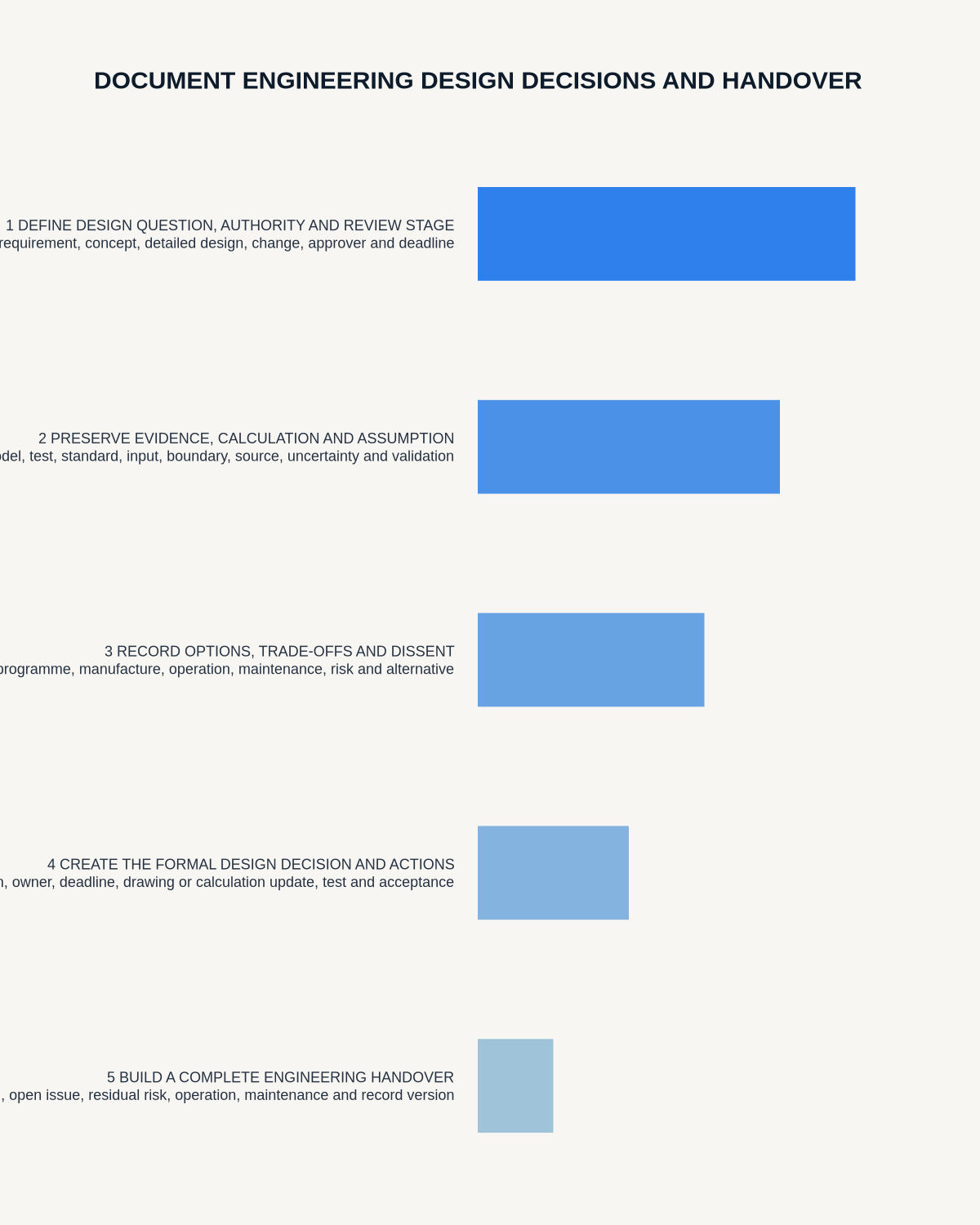
For each material decision, capture:
- Problem and affected requirement.
- Current baseline.
- Evidence and assumptions.
- Options considered.
- Benefits, costs and limitations.
- Safety, quality, reliability and operational impact.
- Interface consequences.
- Dissent and unresolved uncertainty.
- Selected outcome and authority.
- Verification and implementation plan.
- Documents and configuration affected.
- Review trigger.
The final record should explain why the choice was reasonable at the time, not merely state what was chosen.
Map interfaces explicitly
| Interface | Questions to answer |
|---|---|
| Mechanical, electrical and software | Inputs, outputs, limits, timing and failure response |
| Design and manufacturing | Tolerances, process capability, inspection and supply |
| Engineering and operations | Use, training, maintenance, alarms and support |
| Customer and supplier | Requirements, deliverables, assumptions and acceptance |
| Project and safety | Risk, sequence, resources and release dependency |
Every interface should have an owner, due date, evidence and acceptance route.
Turn review actions into verifiable outputs
“Engineering to review” is not a complete action. Specify the exact question, required output, one accountable owner, contributors, dependency, deadline, decision point and closure evidence.
Use speaker-separated notes as a draft aid, then confirm who actually accepted responsibility.
Record resource and schedule trade-offs honestly
When scope, time or resource changes, state:
- What is being reduced, delayed or accepted.
- Evidence supporting the trade-off.
- Safety and quality boundaries that cannot move.
- Residual risk and mitigation.
- Impact on verification, documentation and support.
- Decision authority.
- Review or reversal trigger.
Schedule pressure must not silently become technical approval.
Use review gates with clear entry and exit evidence
| Gate | Typical exit evidence |
|---|---|
| Requirements | Agreed needs, interfaces and acceptance criteria |
| Architecture or concept | Selected approach and major risks |
| Detailed design | Checked design and approved verification plan |
| Build or implementation | Controlled configuration and quality evidence |
| Validation | Evidence that user and operational needs are met |
| Operational release | Accepted residual risks, documentation, training and support |
A gate should not be marked complete because a meeting occurred. The required evidence and authority must be present.
Keep risk statements decision-ready
A useful technical risk includes cause, event, consequence, affected requirement, existing controls, likelihood and severity basis, additional action, owner, due date, residual risk and acceptance authority.
Do not allow a summary to replace a specific risk with “team discussed reliability concerns.”
Control design and configuration changes
For each change, record the baseline, reason, impact, analysis, verification, interfaces, affected documents, implementation sequence, rollback, approval and release status. Make sure suppliers and operations receive the same approved configuration.
Protect challenge and dissent
Strong engineering governance preserves material disagreement. Record the technical concern, evidence, response, decision and residual uncertainty without turning professional challenge into personal conflict.
Where a concern remains open, define who can accept it and when it must be reviewed.
Build an operational handover that is usable
Include:
- Released configuration and asset identity.
- Requirement and validation evidence.
- Operating envelope and limits.
- Open concessions, deviations and temporary measures.
- Residual risks and acceptance.
- Maintenance, inspection and support requirements.
- Training and user documentation.
- Spare parts, supplier and escalation routes.
- Known issues and monitoring.
- Receiving owner and acceptance date.
A folder of raw meeting recordings is not a handover.
Use a post-release effectiveness review
Define the measures that will show whether the decision worked: reliability, quality, safety, performance, support burden, cost or user outcome. Set a review period, owner and escalation trigger.
Protect intellectual property and sensitive programmes
Engineering-management discussions may include confidential design, supplier, security, personnel or export-controlled information. Use approved accounts, restrict access, minimise identifiers and apply the organisation’s retention rules.
How NERALVO Halo fits engineering management
NERALVO Halo includes NOTE mode, supported CALL mode, 64GB local storage, up to 35 hours of recording and Bluetooth sync with DOWAY. CALL mode is not universal, so test the exact phone, case and call route.
DOWAY can create transcripts, summaries, speaker-separated notes, templates, translations, mind maps and exports. One year of DOWAY Max is included from activation. These tools can help structure decisions and actions, but they do not confer authority or validate engineering evidence.
Cloud software, a dedicated recorder or manual notes?
For Engineering Managers, the right answer changes with the setting. This matrix deliberately gives each method a situation where it can be the strongest choice.
| Situation | Best starting point | Reason |
|---|---|---|
| scheduled video briefings | Cloud meeting software | Calendar automation and shared integrations are usually the strongest advantage. |
| site visits, inspections or mobile calls | Dedicated recorder | Independent capture reduces reliance on an active phone or laptop. |
| a restricted site or participant prevents recording | Manual notes or an approved alternative | The boundary takes priority over convenience. |
| office-to-site work | Governed hybrid | Use each method only in the setting it actually fits. |
Frequently asked questions
Can an AI summary become the design-decision record?
It can support a draft, but evidence, assumptions, authority, dissent, risk, verification and configuration impact must be checked before approval.
Can speaker separation prove action ownership?
No. It can help identify speakers, but the final action owner should explicitly accept the task through the approved workflow.
Should every engineering review be recorded?
No. Use a defined purpose, approved process and minimum necessary capture. Some restricted discussions may require different controls or no recording.
Final engineering-management checklist
- Requirement and decision status explicit.
- Authority mapped.
- Evidence and assumptions referenced.
- Options and trade-offs visible.
- Interfaces have owners.
- Risk and dissent preserved.
- Actions have verifiable outputs.
- Review-gate evidence complete.
- Configuration and documents updated.
- Operational handover and effectiveness review accepted.
Bottom line: an engineering-management recording creates value only when it becomes a traceable, authorised decision with verified interfaces, controlled release and accountable handover.
Related guides
See the guides for mechanical engineers, electrical engineers and project managers.
On this page
Related guides
See whether Halo fits this workflow
Review the NERALVO Halo specifications, included services, delivery information and current offer only after completing the guide.
Found an error or an out-of-date claim? Email support@neralvo.com with the article address and a supporting source.