The 60-second verdict
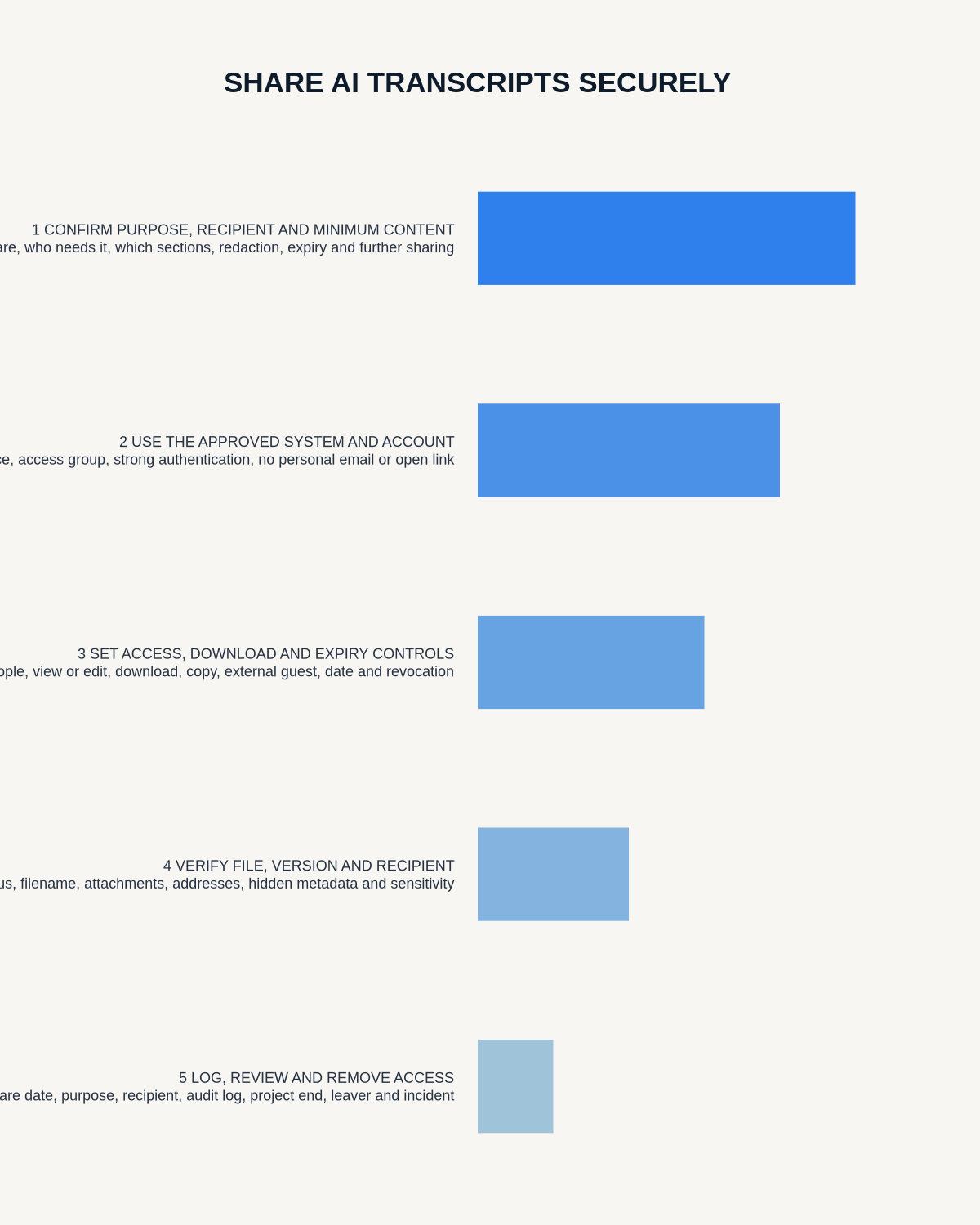
Quick answer: share AI transcripts securely by classifying the record status, confirming each recipient’s need, selecting the minimum approved output, verifying and redacting the content, using a controllable authenticated route, restricting download and onward sharing, setting expiry and correction processes, and deleting temporary copies when the purpose ends.
Decision focus: use the method below only where it produces a recoverable source, a verifiable output and a clear next action. If one of those fails, change the workflow rather than trusting a polished summary.
Evidence basis and limits
- Decision factors covered: Classify the transcript before sharing; Apply the minimum-audience rule; Prefer controlled links over attachments.
- Evidence rule: Claims are weighted by consequence: capture failure, changed meaning, access and recovery matter more than polished wording.
- Boundary: Examples and workflow recommendations must be tested with representative recordings, the intended users and the actual approval process before rollout.

A transcript may be easier to share than audio and more dangerous to misunderstand. It can expose personal information, confidential strategy, allegations, health details and unverified AI errors to people who never needed the source recording.
Secure sharing begins with purpose, audience and record status. It does not begin with an attachment.
Classify the transcript before sharing
| Status | Meaning | Sharing rule |
|---|---|---|
| Raw AI transcript | Unverified working output | Restricted review only |
| Corrected transcript | Material recognition errors checked | Share only where full detail is necessary |
| Approved extract | Relevant section checked and minimised | Preferred for focused recipients |
| Approved summary | Decisions and actions authorised | Use for ordinary follow-up |
| Authoritative record | Final minutes, case note or decision record | Store in the controlled destination system |
Do not distribute a raw transcript as though it were approved minutes.
Apply the minimum-audience rule
For every recipient ask:
- What task requires access?
- Do they need the full transcript or only an extract?
- Do they need names or can roles be used?
- Do they need the audio as well?
- How long should access remain?
- Can onward sharing be restricted?
A meeting invitation, department membership or senior title does not automatically create a need for the full source record.
Prefer controlled links over attachments
A secure repository link can provide authentication, access revocation, expiry and version control. Attachments create uncontrolled copies in inboxes, downloads, mobile devices and forwarded messages.
Where attachments are unavoidable:
- confirm every recipient
- use the approved secure channel
- apply appropriate file protection
- state the permitted purpose
- remove unnecessary personal data
- avoid combining unrelated matters
- record who received the file
Redact or minimise before sharing
Remove information that the recipient does not need, including unrelated personal details, third-party identifiers, private chat, contact details or confidential material outside the purpose.
Redaction must be effective. Covering text visually without removing the underlying content can leave it recoverable. Create and test a separate sharing copy.
Check accuracy and context
- Correct speaker labels, names, dates and figures.
- Preserve qualifications and uncertainty.
- Separate allegations from findings.
- Mark unresolved or inaudible passages.
- Link material decisions to supporting documents.
- State whether the document is draft, checked or approved.
Sharing a fluent but inaccurate transcript can spread misinformation faster than sharing no transcript.
Control external sharing
Before sending outside the organisation, confirm:
- the lawful and contractual basis for sharing
- confidentiality and privilege considerations
- recipient identity and authority
- international-transfer implications where relevant
- the processor or platform being used
- retention and onward-sharing restrictions
- the method for revoking access or correcting errors
Protect email use
If email is approved, verify recipients, avoid sensitive details in the subject line, use protected attachments where required and store the authoritative version elsewhere. Send passwords or access details through a separate approved channel when policy requires it. Email recall cannot recover a file already opened, downloaded or forwarded.
Record the disclosure
For higher-risk material, retain the purpose, recipient, authority, version, date, channel, expiry, restrictions and deletion requirement. This supports later correction, revocation and incident response without reproducing the transcript itself.
How NERALVO Halo outputs should be handled
Check whether NERALVO Halo fits this workflow can sync recordings to DOWAY for transcripts, summaries, templates, translations, mind maps and exports. One year of DOWAY Max is included from activation.
Treat each exported file as a new controlled copy. Transfer the verified output into the authoritative system, restrict access and remove temporary downloads when their purpose ends.
Sharing checklist
- Purpose documented
- Recipient identity, authority and need confirmed
- Record status labelled
- Material errors checked
- Full transcript avoided where an extract is enough
- Third-party data removed or protected
- Controlled link used where possible
- External sharing and transfer implications reviewed
- Access expiry, correction and revocation defined
- Disclosure recorded where required
- Temporary copies scheduled for deletion
Official ICO guidance
- Data sharing advice, including recorded online meetings
- Lawful basis for sharing personal data
- Security principle
Bottom line: secure sharing is a controlled disclosure decision, not a file-transfer habit.
Workflow choice matrix for How to Share AI Transcripts Securely
Choose the method that protects the source and reduces downstream correction. The table makes the non-hardware options explicit.
| Condition | Preferred route | Why |
|---|---|---|
| High-risk or mixed work | Governed hybrid | Separate capture, review, approval and retention rather than trusting one tool. |
| Recording is refused, prohibited or unnecessary | Manual notes / no recording | Respecting the boundary is the correct workflow, not a product failure. |
| In-person, mobile or unreliable-connectivity work | Dedicated recorder | Independent capture and a recoverable local source are usually more resilient. |
| Repeatable remote work with approved integrations | Cloud software | Automation and central collaboration may outweigh device independence. |
Related guides
On this page
Related guides
See whether Halo fits this workflow
Review the NERALVO Halo specifications, included services, delivery information and current offer only after completing the guide.
Found an error or an out-of-date claim? Email support@neralvo.com with the article address and a supporting source.