The 60-second verdict
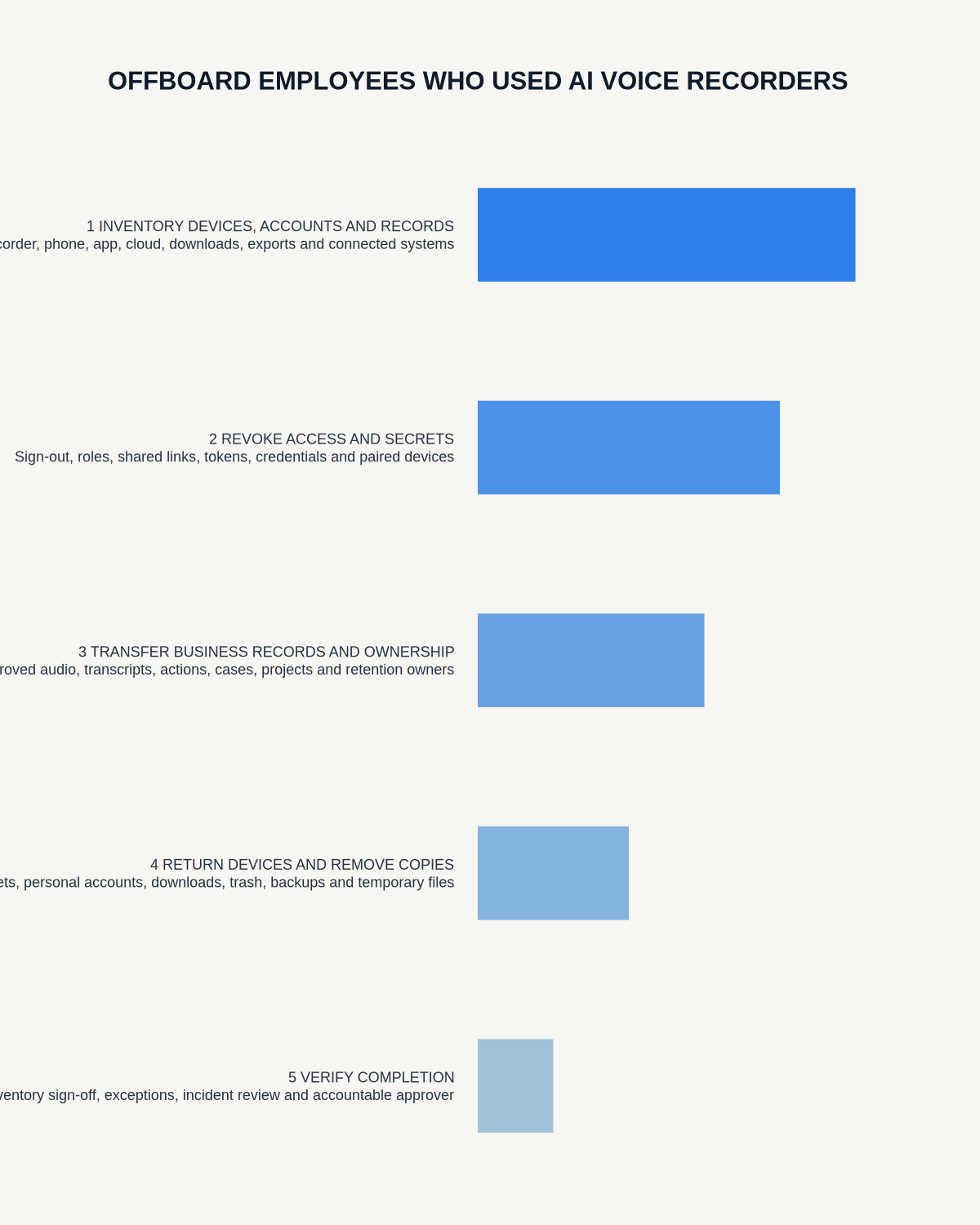
Quick answer: offboard an employee who used AI voice recorders by recovering or accounting for the hardware, transferring authoritative records, resolving draft transcripts, revoking every connected account and link, and verifying deletion of unnecessary copies. Collecting the physical recorder alone is not enough.
Decision focus: use the method below only where it produces a recoverable source, a verifiable output and a clear next action. If one of those fails, change the workflow rather than trusting a polished summary.
Evidence basis and limits
- Decision factors covered: Start with an asset and account inventory; Classify every unfinished item; Separate business records from working copies.
- Evidence rule: Claims are weighted by consequence: capture failure, changed meaning, access and recovery matter more than polished wording.
- Boundary: Examples and workflow recommendations must be tested with representative recordings, the intended users and the actual approval process before rollout.

Start with an asset and account inventory
- recorder serial number and accessories;
- paired phone and application account;
- shared workspaces and team folders;
- local downloads and exported transcripts;
- automations, API keys and integrations;
- open recordings awaiting review;
- shared links and external recipients;
- records under retention, investigation or legal hold.
Classify every unfinished item
| Item | Required action |
|---|---|
| Unprocessed recording | Assign a reviewer or delete if no justified purpose remains |
| Draft transcript | Preserve draft status and source context |
| Approved record | Confirm storage in the authoritative system |
| Shared link | Revoke, reassign or set an approved expiry |
| Personal export | Verify secure removal through the offboarding process |
Separate business records from working copies
Transfer authoritative records to the correct owner. Do not leave the only version in the departing employee's app, inbox or personal folder. Remove unnecessary duplicates only after preservation and retention requirements have been checked.
Coordinate the order of access removal
Plan device return, app sessions, email, single sign-on, shared drives, service accounts and destination systems. Removing access too early may strand records; leaving it too long may expose information. Use a dated sequence with one accountable owner.
Complete a status-based handover
Every active item should show its current status, source, next action, owner, deadline, uncertainty and destination. The incoming owner should confirm that they can access and understand the material before the old account is closed.
Revoke secondary access
Check shared links, exported files, email attachments, collaboration tools, browser sessions, cached downloads and integrations. The main app account can be disabled while secondary copies remain accessible.
Inspect the device before reissue
Quarantine the returned recorder. Verify transfer of required files, remove residual content, reset or reconfigure it through the approved process and record the new custodian and configuration.
Handle missing hardware as an incident
If the recorder cannot be recovered, trigger How to Handle a Lost or Stolen AI Voice Recorder rather than treating it as a routine asset write-off.
Keep evidence of completion
Record the asset or account checked, action taken, responsible person, completion time, evidence retained and any exception awaiting closure. Do not certify completion while an exception has no owner or deadline.
Workflow choice matrix for How to Offboard Employees Who Used AI Voice Recorders
Choose the method that protects the source and reduces downstream correction. The table makes the non-hardware options explicit.
| Condition | Preferred route | Why |
|---|---|---|
| Repeatable remote work with approved integrations | Cloud software | Automation and central collaboration may outweigh device independence. |
| In-person, mobile or unreliable-connectivity work | Dedicated recorder | Independent capture and a recoverable local source are usually more resilient. |
| Recording is refused, prohibited or unnecessary | Manual notes / no recording | Respecting the boundary is the correct workflow, not a product failure. |
| High-risk or mixed work | Governed hybrid | Separate capture, review, approval and retention rather than trusting one tool. |
Frequently asked questions
Should the app account be disabled immediately?
Coordinate timing so required records are preserved and access is removed without unnecessary delay.
Can unfinished transcripts be transferred as final records?
No. Preserve their draft status, source reference and required review.
What if the departing employee used personal downloads?
Identify them and verify secure removal through the approved HR, security and records process.
Who should approve the handover?
The incoming record or process owner should confirm access, status and outstanding work.
Can the returned device be given directly to another employee?
No. It should be inspected, cleared and reconfigured through the approved process first.
Authoritative guidance and related reading
- ICO accountability and governance guidance
- How to Assign Ownership for Recordings, Transcripts and Summaries
- How to Audit AI Voice Recorder Access and Sharing
Final offboarding checklist
- Hardware recovered or incident raised
- Accounts disabled or reassigned
- Open work transferred with status
- Authoritative records preserved
- Unnecessary copies and links removed
- Device controlled before reissue
- Completion evidence retained
On this page
Related guides
See whether Halo fits this workflow
Review the NERALVO Halo specifications, included services, delivery information and current offer only after completing the guide.
Found an error or an out-of-date claim? Email support@neralvo.com with the article address and a supporting source.