The 60-second verdict
Quick answer: podcast transcription works best when the final edited audio becomes the controlling source, the transcript is corrected for names, claims, speakers and meaning, and each derivative output—captions, show notes, chapters, articles and promotional clips—is released through its own quality and rights check.
Decision focus: use the method below only where it produces a recoverable source, a verifiable output and a clear next action. If one of those fails, change the workflow rather than trusting a polished summary.
Evidence basis and limits
- Decision factors covered: Decide which written outputs the episode needs; Agree guest and contributor terms before recording; Correct the transcript in a defined order.
- Evidence rule: The decision is based on the complete capture-to-action workflow, not a single feature or marketing accuracy percentage.
- Boundary: Examples and workflow recommendations must be tested with representative recordings, the intended users and the actual approval process before rollout.

AI can make an episode searchable and reduce repetitive production work, but a transcript is not automatically publication-ready. Speech recognition may alter names, figures, negative wording, speaker attribution and the context of a quotation. The editorial team remains responsible for accuracy, accessibility, permissions and every published claim.
Decide which written outputs the episode needs
| Output | Primary purpose | Required control |
|---|---|---|
| Production transcript | Editing, navigation and internal review | Timestamped and clearly marked as working material |
| Publication transcript | Readable episode access and search | Corrected against final audio and formatted for readers |
| Captions | Synchronised access for video or social clips | Timing, speaker changes and sound information checked |
| Show notes | Episode summary, sources and calls to action | Claims, links, names and sponsor wording verified |
| Chapters | Navigation and topic discovery | Timestamps tied to the released master |
| Article or newsletter | Standalone editorial content | Rewritten and fact-checked rather than copied blindly |
| Promotional clips | Discovery and distribution | Quotation, context, rights and caption accuracy checked |
One raw transcript should not be published unchanged across every channel. Each output has a different audience, format and risk.
Start from the final edited audio
The publication transcript should normally follow the exact released episode, not the unedited interview. Otherwise the written version may include removed material, confidential discussion, repeated takes or statements that no longer appear in the programme.
Use a clear source chain:
- Original recording and backup.
- Editing project and edit decisions.
- Approved final audio master.
- Transcript generated or conformed to that master.
- Corrected publication transcript.
- Captions, show notes, chapters and derivative assets.
Keep stable episode and version identifiers so every output can be traced to the correct master.
Agree guest and contributor terms before recording
Confirm the intended recording, editing and publication process before the interview. Depending on the production, document:
- audio and video capture;
- the planned episode and distribution channels;
- editing and promotional quotation rights;
- off-record or restricted sections;
- whether factual or full-edit review is offered;
- use of photographs, biography and supplied materials;
- handling of allegations, confidential information and third-party material;
- retention of raw audio, transcripts and unused material.
Recording permission does not automatically settle every publication, clip, archive or reuse question. Follow the production’s release and editorial process.
Improve the source before relying on transcription
Transcript quality begins with audio quality. Use appropriate microphones, monitor levels and reduce echo, background noise and speaker overlap where practical. For remote interviews, separate local tracks or an approved platform recording may provide better control than one mixed room feed.
During recording:
- ask speakers to spell names and specialist terms;
- repeat critical dates, figures and web addresses clearly;
- mark restarts and false beginnings;
- identify claims requiring verification;
- preserve a note of any off-record section;
- record room tone where useful for editing.
A portable recorder such as View Halo specifications against the evidence checklist may support approved interviews, field notes and backup capture. It does not replace monitored production sound, multitrack recording, guest releases or project backup.
Correct the transcript in a defined order
Begin with errors that can change identity, meaning or factual accuracy:
- Episode and speaker identity.
- Guest, organisation, product and place names.
- Dates, figures, percentages and units.
- Negative, conditional and uncertain wording.
- Technical, medical, legal or specialist terms.
- Speaker changes and overlapping speech.
- Quotations intended for publication or promotion.
- Links, book titles, research and other references.
- Paragraphing, punctuation and readability.
Listen to the source whenever wording is consequential or unclear. Do not guess at an inaudible passage merely to create smooth prose.
Use an error-priority model
| Priority | Example | Action |
|---|---|---|
| Critical | Wrong speaker, reversed meaning, false allegation or private material included | Stop release and correct against the source |
| High | Wrong name, statistic, date, quotation or specialist term | Verify before publication |
| Medium | Missing punctuation or paragraphing that affects interpretation | Correct during editorial review |
| Low | Cosmetic difference with no effect on meaning | Standardise according to house style |
This prevents teams spending time on minor filler words while a wrong number or speaker remains in the transcript.
Create an accessible publication transcript
A public transcript should be easy to navigate and understand. Use meaningful headings, clear speaker labels, readable paragraphs and descriptive links. Identify relevant non-speech information where it contributes to meaning. Avoid walls of text and unexplained production notation.
Accessibility should be assessed against the actual publishing platform and current organisational standards. A downloadable document, webpage transcript and timed caption file may each need different formatting and checks.
Do not confuse transcripts with captions
A transcript is a readable text record. Captions are synchronised with audio or video and may need timing, line-length, speaker and sound-cue controls. A corrected transcript can support caption creation, but it does not automatically become a valid caption file.
Check captions for:
- accurate timing;
- speaker changes;
- names and specialist language;
- significant music or sound cues;
- readable line breaks;
- placement that does not obscure essential visuals;
- consistency with the final released edit.
Improve readability without rewriting the guest
Publication transcripts often remove repeated false starts, obvious transcription artefacts and limited verbal clutter. The edit must not make the guest sound more certain, polished or categorical than the recording.
Preserve:
- qualifications and uncertainty;
- meaningful pauses or interruptions where relevant;
- the distinction between fact, opinion and recollection;
- the context of sensitive or controversial statements;
- language that materially reflects the speaker’s position.
Where extensive rewriting is required, publish a clearly labelled article or edited summary rather than presenting it as a transcript.
Fact-check before repurposing
A recording proves that a statement was made; it does not prove the statement is true. Verify names, claims, dates, research, quotations and statistics before placing them in titles, show notes, articles or promotional clips.
Use a fact-check ledger containing:
- the exact claim or checked paraphrase;
- speaker and source timestamp;
- evidence required;
- verification status;
- approved final wording;
- owner and completion date.
Unsupported material should be removed, qualified or attributed according to the editorial decision.
Control derivative content
| Derivative asset | Main risk | Release check |
|---|---|---|
| Episode title | Overstating a minor or uncertain claim | Matches the approved episode and evidence |
| Show notes | Incorrect names, links or promises | Sources and calls to action verified |
| Article | Presenting guest opinion as established fact | Independent fact-check and clear attribution |
| Social quotation | Removing surrounding qualification | Checked against the full source passage |
| Short video clip | Misleading edit or inaccurate captions | Context, rights, edit and captions approved |
| Newsletter | Introducing claims absent from the episode | Editorial review against source and evidence |
AI can suggest headings, chapters and clips, but every public asset must remain faithful to the approved source.
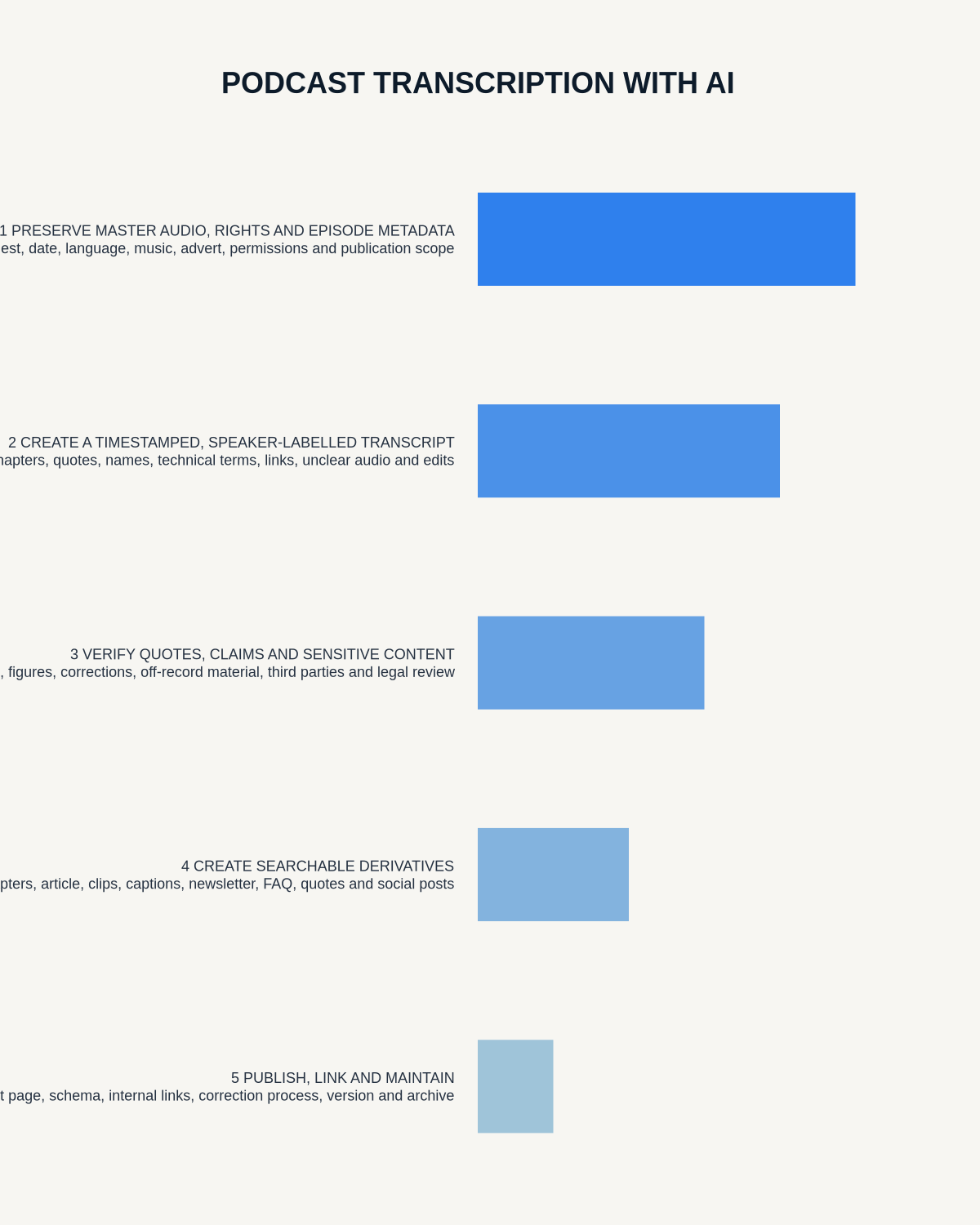
Use a complete episode-to-content workflow
- Confirm guest terms, recording purpose and rights.
- Capture and back up the source audio.
- Edit the episode and approve the final master.
- Generate a transcript aligned to that master.
- Correct identities, figures, terms, quotations and meaning.
- Complete fact, privacy and rights checks.
- Create the readable publication transcript.
- Create and test captions separately where required.
- Build chapters from final-master timestamps.
- Draft show notes with verified links and sources.
- Create derivative articles, newsletters and clips.
- Complete editorial, accessibility and release approval.
- Publish with a correction and retention process.
Support search visibility without keyword stuffing
Use the language listeners and readers genuinely use. A useful transcript page may include:
- a descriptive episode title;
- a concise summary;
- guest and topic information;
- clear section headings;
- chapters and timestamps;
- relevant internal links;
- verified external sources;
- a readable transcript;
- appropriate structured metadata supported by the site.
Do not repeat target phrases unnaturally or create thin pages from every minor transcript fragment. The page should help a reader understand and navigate the episode.
Publish a correction process
Define how listeners, guests and staff can report errors. When a material correction is made, update the transcript, captions, show notes and affected derivative assets. Record the change where transparency or organisational policy requires it.
Do not silently alter a disputed quotation without checking the audio and preserving the relevant editorial record.
How NERALVO Halo fits podcast production
NERALVO Halo includes NOTE mode, supported CALL mode, 64GB local storage, up to 35 hours of recording and Bluetooth sync with DOWAY. DOWAY can produce transcripts, summaries, speaker-separated notes, templates, translations, mind maps and exportable files, with one year of DOWAY Max included from activation.
Test the actual microphone placement, phone or calling route and room before important work. Keep professional source backups where the recording is irreplaceable. Halo and DOWAY assist capture and organisation; the final audio, corrected transcript, rights records and editorial approval remain controlling.
Workflow choice matrix for Podcast Transcription with AI
Choose the method that protects the source and reduces downstream correction. The table makes the non-hardware options explicit.
| Condition | Preferred route | Why |
|---|---|---|
| High-risk or mixed work | Governed hybrid | Separate capture, review, approval and retention rather than trusting one tool. |
| Recording is refused, prohibited or unnecessary | Manual notes / no recording | Respecting the boundary is the correct workflow, not a product failure. |
| In-person, mobile or unreliable-connectivity work | Dedicated recorder | Independent capture and a recoverable local source are usually more resilient. |
| Repeatable remote work with approved integrations | Cloud software | Automation and central collaboration may outweigh device independence. |
Frequently asked questions
Should the transcript follow the raw interview or final episode?
The public transcript should normally follow the final released episode. Preserve the original recording separately under the production’s retention and access rules.
Can AI publish a transcript without human review?
Not reliably. Names, figures, speaker labels, quotations, sensitive passages and meaning require source-based review.
Is a transcript enough for video accessibility?
Not always. Timed captions and other accessibility requirements may also apply to the platform and content.
Can filler words be removed?
Yes, where the house style allows it and meaning, personality and certainty are not changed.
Can a podcast quotation be used automatically in an advert?
No. Check the guest terms, context, accuracy and any advertising or sponsor approval requirements.
Should every transcript be indexed by search engines?
Not necessarily. Consider privacy, rights, duplication, quality and whether the page provides genuine value.
Useful resources
- W3C guidance on transcripts
- W3C guidance on captions
- AI Voice Recorder for Podcasters
- Interview Transcription with AI
- Research Transcription with AI
- View Halo specifications against the evidence checklist
Final publication checklist
- Guest and contributor terms recorded.
- Final audio master approved.
- Transcript aligned to the released edit.
- Names, figures, terms and quotations checked.
- Fact, privacy and rights review complete.
- Transcript structured for reading and navigation.
- Captions checked separately.
- Show notes, chapters and links verified.
- Derivative assets preserve context.
- Accessibility and release checks complete.
- Corrections and retention processes defined.
Podcast publication and search toolkit
Source-to-publication chain
| Layer | Required reference | Status |
|---|---|---|
| Original recording | Episode ID, guest, date and file checksum where required | Restricted source |
| Edited master | Exact released audio version | Publication authority |
| Corrected transcript | Reviewer, date, conventions and known limitations | Approved text source |
| Captions | Final-master timing and caption QA | Platform-ready |
| Show notes and chapters | Verified links, sources and timestamps | Editorially approved |
| Articles and clips | Source quotation, rights and fact-check status | Derivative release |
Three-pass quality review
- Accuracy pass: speakers, names, figures, quotations, specialist terms and meaning.
- Publication pass: readability, headings, links, chapters, captions and house style.
- Risk pass: privacy, allegations, rights, sponsors, confidential material and misleading excerpts.
Search-content map
Connect the episode page to genuinely relevant topic guides, guest resources and product information. Use descriptive anchor text and avoid creating many near-duplicate pages from the same transcript.
Correction policy
Record who can approve corrections, how source audio is checked, which derivative assets must be updated and when a visible correction note is appropriate.
Guest-rights checklist
- Recording and publication understood.
- Editing and promotional reuse defined.
- Off-record process clear.
- Review commitments recorded accurately.
- Third-party material and sensitive claims identified.
- Retention and future reuse addressed.
NERALVO Halo workflow
Use approved NOTE or supported CALL capture, verify the source file, create the working transcript through DOWAY, and transfer the checked content into the production repository. Keep the final edited master, not the AI transcript, as the controlling publication source.
Release gate
- Does the transcript match the final audio?
- Can every public quotation be traced to a timestamp?
- Are facts and links verified?
- Are captions synchronised and readable?
- Do titles and clips preserve the episode’s meaning?
- Are rights, privacy and guest commitments satisfied?
- Is there a clear correction and retention route?
Bottom line: AI transcription can turn one podcast episode into accessible, searchable and reusable content, but only when the final audio remains authoritative and every written or promotional output is corrected, verified and released deliberately.
On this page
Related guides
See whether Halo fits this workflow
Review the NERALVO Halo specifications, included services, delivery information and current offer only after completing the guide.
Found an error or an out-of-date claim? Email support@neralvo.com with the article address and a supporting source.