The 60-second verdict
Quick answer: record and organise business ideas by capturing the customer, problem, current alternative, evidence, assumptions and smallest useful test, then moving the note into a visible pipeline with an owner, review date and deliberate pursue, park or reject decision.
Decision focus: use the method below only where it produces a recoverable source, a verifiable output and a clear next action. If one of those fails, change the workflow rather than trusting a polished summary.
Evidence basis and limits
- Decision factors covered: Use an eight-part idea note; Separate evidence, assumption, hypothesis and decision; Use a visible idea pipeline.
- Evidence rule: A claim earns weight only when the source, date, configuration and limitation are clear enough for a reader to check.
- Boundary: Examples and workflow recommendations must be tested with representative recordings, the intended users and the actual approval process before rollout.
Voice capture preserves the spark, but an idea is not evidence and a captured note is not an approved project. The workflow should reduce uncertainty before significant time or money is committed.

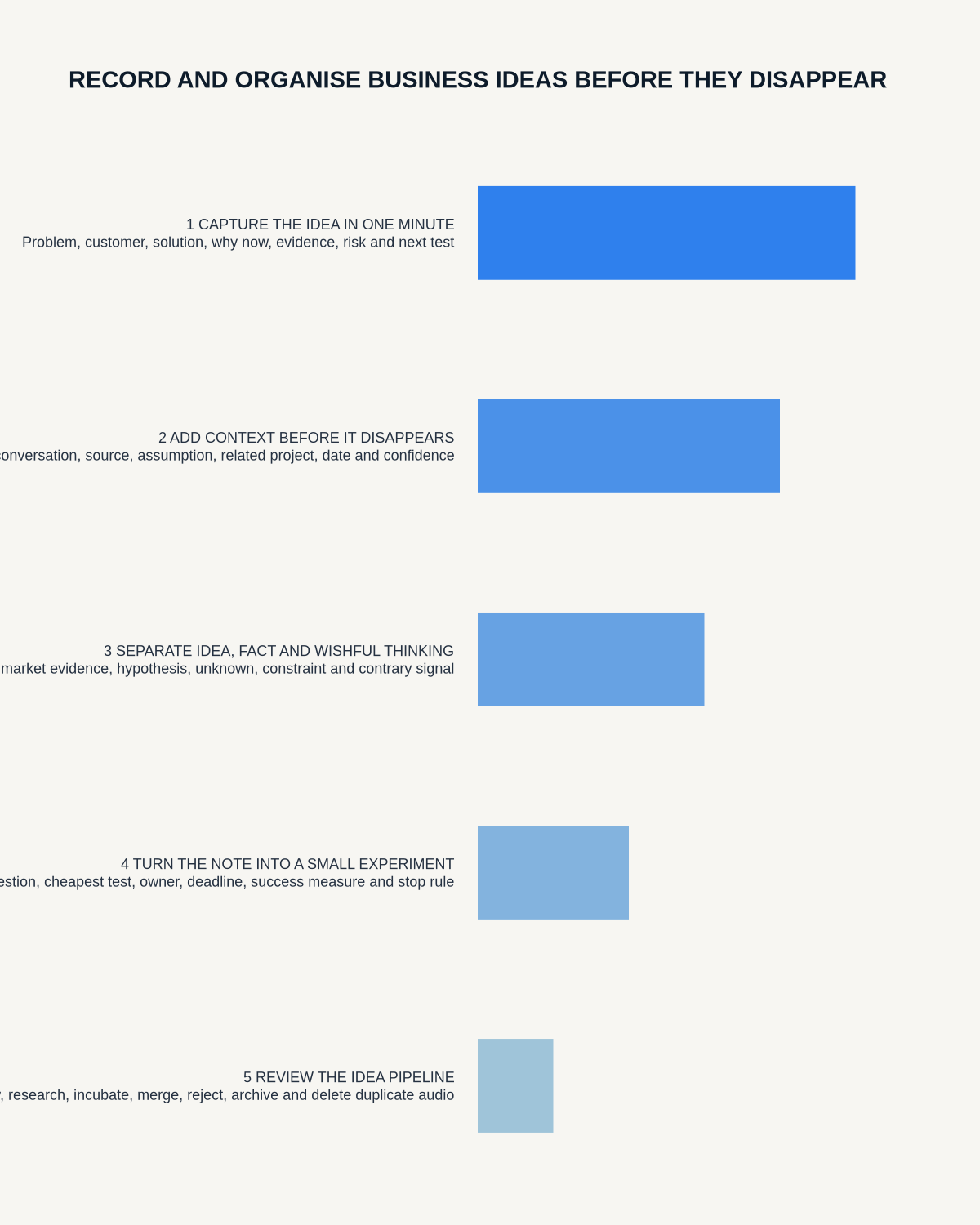
Use an eight-part idea note
- Customer or user: who experiences the problem?
- Problem: what are they trying and failing to do?
- Trigger: what caused you to notice it now?
- Current alternative: how is the problem handled today?
- Evidence: what observations, data or conversations support it?
- Solution hypothesis: what might improve the situation?
- Assumptions: what must be true for the idea to work?
- Next test: what is the cheapest credible way to learn more?
Most notes should take one to three minutes. Split longer strategic thinking into problem, evidence, route to market, delivery and risk so each part can be assessed separately.
Separate evidence, assumption, hypothesis and decision
| Category | Example |
|---|---|
| Evidence | Five customers described the same follow-up delay. |
| Assumption | They will pay for a dedicated device. |
| Hypothesis | A recorder and structured AI summary will reduce enough admin to justify the cost. |
| Idea | Create a professional workflow bundle. |
| Decision | Run ten structured customer interviews before building it. |
Also label personal opinion, competitor evidence, AI-generated suggestions and unknown information. Do not let enthusiasm or polished AI wording become proof.
Use a visible idea pipeline
| Stage | Meaning | Required next action |
|---|---|---|
| Inbox | Captured but not assessed | Clarify or delete within the review period |
| Clarify | User, problem or evidence is incomplete | Fill the missing fields |
| Investigate | Needs research, observation or interviews | Define the evidence required |
| Test | Has a bounded experiment | Assign owner, method and review date |
| Pursue | Approved for active work | Move into the project system |
| Park | Potentially useful but not now | State the reason and next review date |
| Reject | Deliberately closed | Record the evidence and lesson |
Every idea needs one current status. “Parked” must not mean “kept forever,” and “captured” must never mean “approved.”
Process the note within a day
- Delete accidental, empty or unusable recordings.
- Give the idea a clear name.
- Write the one-sentence problem and user.
- Separate evidence from assumptions.
- Search existing ideas and projects.
- Merge duplicates.
- Identify the riskiest assumption.
- Choose the smallest useful test.
- Assign an owner and review date.
- Move the record into the idea or project system.
- Delete unnecessary source copies.
Score ideas consistently—but do not pretend the score is truth
Use a simple low, medium and high rating or a consistent 1–5 scale for:
- Problem severity and frequency
- Evidence strength
- Audience value or size
- Customer access
- Willingness to pay or expected impact
- Strategic fit
- Ability to deliver and support
- Cost and effort
- Legal, operational and reputational risk
- Speed of learning
The score should expose why an idea receives attention and help select the next test. It does not predict market success.
Test the assumption that could kill the idea
Common high-risk assumptions include:
- The problem occurs often enough to matter.
- The target user can approve or influence the purchase.
- The price is acceptable.
- The technology works in the real environment.
- The data workflow meets professional or organisational requirements.
- The audience can be reached affordably.
- The benefit is large enough to change behaviour.
Do not test the feature that is easiest to demonstrate when another assumption could invalidate the entire idea.
Design the smallest credible experiment
| Question | Possible test |
|---|---|
| Does the problem exist? | Structured interviews and workflow observation |
| Will people engage? | Landing page or advert with a defined intent measure |
| Will they pay? | Pre-order, deposit, paid pilot or direct offer |
| Can it work? | Prototype or controlled workflow pilot |
| Can the business deliver it? | Supplier, margin, fulfilment and support test |
Before running the experiment, define the result that would support, weaken or reject the idea.
Separate business opportunities from adjacent idea types
Classify whether the note is:
- Content
- Marketing angle
- Product feature
- Process improvement
- New business
- Partnership
- Research question
A topic can attract attention without supporting a viable product or service.
Park and reject ideas deliberately
Useful reasons include:
- Problem not validated
- Existing solution already sufficient
- Audience too expensive to reach
- Willingness to pay not demonstrated
- Margin or delivery model inadequate
- Strategic mismatch
- Unacceptable legal, operational or reputational risk
- Timing or team capacity unsuitable
A recorded reason prevents the same weak proposal returning without new evidence. Parked ideas should state what future event or evidence would justify reopening them.
Use a copy-ready idea record
Idea: [short title]
User and problem: [who and what]
Current alternative: [how it is handled today]
Evidence: [observations, data or interviews]
Solution hypothesis: [possible response]
Riskiest assumption: [what could invalidate it]
Next test: [method, success threshold, owner and date]
Status: [investigate, test, pursue, park or reject]
Decision log: [what changed and why]
Run a weekly idea review
- Clear the capture inbox.
- Merge duplicates.
- Clarify missing fields.
- Review evidence from active experiments.
- Promote evidence-backed ideas.
- Stop weak or stalled experiments.
- Park or reject the remainder deliberately.
- Limit the number of active ideas.
- Record lessons from closed tests.
Measure the workflow
- Ideas processed, merged and deleted
- Experiments started and completed
- Evidence gained
- Ideas promoted to projects
- Time from capture to first test
- Parked ideas without review dates
- Source files retained without a purpose
Protect confidential information
Avoid recording customer names, unpublished strategy, credentials, personal data or regulated information in public places or unapproved systems. Use neutral project codes, approved accounts, role-based access and deliberate retention.
Where NERALVO Halo fits
Apply this guide before assessing NERALVO Halo can capture short spoken ideas to 64GB local storage and synchronise recordings to DOWAY for transcripts, summaries, templates and mind maps. One year of DOWAY Max is included from activation.
Use NOTE mode to speak the structured fields, correct names, figures, evidence and assumptions, then move the finished record into the idea pipeline. Delete temporary copies when they are no longer required.
Workflow choice matrix for How to Record and Organise Business Ideas Before They Disappear
Choose the method that protects the source and reduces downstream correction. The table makes the non-hardware options explicit.
| Condition | Preferred route | Why |
|---|---|---|
| High-risk or mixed work | Governed hybrid | Separate capture, review, approval and retention rather than trusting one tool. |
| Recording is refused, prohibited or unnecessary | Manual notes / no recording | Respecting the boundary is the correct workflow, not a product failure. |
| In-person, mobile or unreliable-connectivity work | Dedicated recorder | Independent capture and a recoverable local source are usually more resilient. |
| Repeatable remote work with approved integrations | Cloud software | Automation and central collaboration may outweigh device independence. |
Frequently asked questions
Should every idea become a project?
No. Most should be clarified, merged, tested, parked or rejected before resources are committed.
Can AI score market potential?
It can organise criteria, but real customer, delivery and market evidence is required.
How long should a voice note be?
Usually one to three minutes using the structured prompt.
What is the strongest next step?
The smallest credible test of the assumption most likely to invalidate the idea.
Final checklist
- User, problem and current alternative defined
- Evidence separated from assumptions
- Solution labelled as a hypothesis
- Duplicate ideas searched
- Pipeline stage assigned
- Riskiest assumption identified
- Smallest test and thresholds defined
- Owner and review date assigned
- Park or reject reason recorded
- Confidential information protected
- Test results update the decision log
Related AI voice recorder guides
On this page
More in this topic: Ideas, planning and reusable processes
Show 6 closely related guides
- How to Capture Ideas While Walking with an AI Voice Recorder
- How to Turn Recorded Ideas into Practical Project Plans
- How to Create SOPs from Recorded Process Walkthroughs
- How to Capture Competitor Analysis Notes with an AI Voice Recorder
- How Wedding Planners Can Capture Couple Decisions and Supplier Actions
- How to Use an AI Voice Recorder for Brain Dumps Without Creating More Chaos
Related guides
See whether Halo fits this workflow
Review the NERALVO Halo specifications, included services, delivery information and current offer only after completing the guide.
Found an error or an out-of-date claim? Email support@neralvo.com with the article address and a supporting source.