The 60-second verdict
Quick answer: recording an adult who may need support requires a defined purpose, decision-specific capacity assessment where relevant, accessible information, the least intrusive method, dignity, secure handling and immediate safeguarding action.
Decision focus: use the method below only where it produces a recoverable source, a verifiable output and a clear next action. If one of those fails, change the workflow rather than trusting a polished summary.
Evidence basis and limits
- Decision factors covered: Start with dignity and the person’s own voice; Define the exact decision; Presume capacity and provide support.
- Evidence rule: Claims are weighted by consequence: capture failure, changed meaning, access and recovery matter more than polished wording.
- Boundary: Examples and workflow recommendations must be tested with representative recordings, the intended users and the actual approval process before rollout.

Recording an adult who may need care, support or protection can sometimes improve accuracy, but it can also intrude on dignity, intensify a power imbalance and create a highly sensitive record of health, capacity, finances, living arrangements or alleged abuse.
This guide uses the language “adult at risk” or “person who may need support” where possible rather than treating “vulnerable adult” as a fixed legal label. It is general information, not legal, clinical, social-care or safeguarding advice. Mental-capacity law and safeguarding systems differ across the UK.
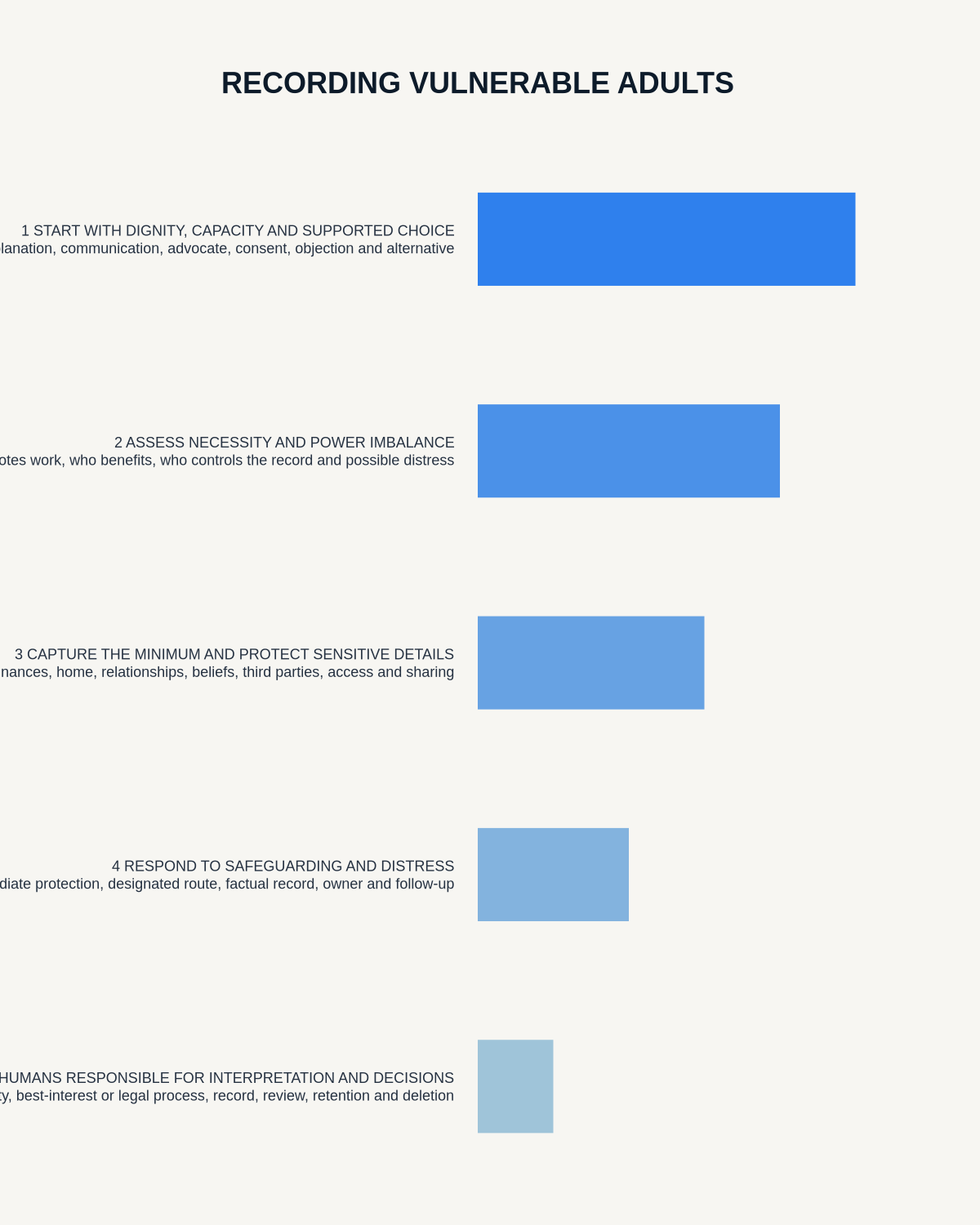
Start with dignity and the person’s own voice
The person should remain central to the decision. Ask how recording affects their comfort, communication, trust and control. Do not assume that a relative, carer or professional’s convenience outweighs the person’s wishes.
Define the exact decision
Capacity is assessed in relation to a particular decision at the time it must be made. A person may be able to decide whether a conversation is recorded even if they need support with another complex decision.
For England and Wales, see the official Mental Capacity Act guidance for health and social care workers.
Presume capacity and provide support
Do not begin from incapacity. Give information in the format, language and pace the person can understand. Consider:
- Easy-read or visual explanations.
- Interpreters or communication aids.
- Hearing support.
- A familiar trusted person.
- Shorter conversations with breaks.
- A quieter location.
- More time to decide.
An unwise choice is not by itself evidence of incapacity.
Explain the complete recording workflow
The person should be told, as far as possible:
- What will be recorded.
- Why audio is necessary.
- Whether AI will create text or summaries.
- Who can hear or read it.
- Where it will be stored.
- How long it will remain.
- Whether it will be shared.
- How to ask for a pause, stop or correction.
Do not assume a relative’s agreement is sufficient
A spouse, child, friend or informal carer does not automatically have legal authority to consent on another adult’s behalf. Check whether there is a relevant attorney, deputy, statutory power or professional process, and obtain qualified advice where authority is uncertain.
Where capacity is lacking, follow the lawful decision process
For England and Wales, any decision made for a person who lacks capacity must follow the Mental Capacity Act framework, including best-interests decision-making and the least restrictive option. The correct decision-maker and consultation process depend on the circumstances.
Recording should not be justified merely because it helps the organisation. Consider whether written notes, an advocate or another less intrusive method can achieve the purpose.
Involve advocates and representatives appropriately
An independent advocate, legal representative or authorised supporter may be required or helpful. Their role should support the person’s participation, not replace it unnecessarily.
Respect distress, objection and fluctuating capacity
Capacity and wellbeing may change. Pause or stop when the person becomes distressed, confused or objects. Consider rearranging for a time when they can participate more fully.
Do not use a discreet recorder to continue after refusal.
Prepare for safeguarding concerns
Conversations may reveal abuse, neglect, coercion, financial exploitation or immediate danger. Staff should know the safeguarding route before recording begins. Act on urgent concerns without waiting for AI transcription.
Do not promise absolute confidentiality when information may need to be shared to protect the person or others.
Minimise private and household information
- Record only the relevant section.
- Avoid bystanders, carers and other residents unless necessary.
- Do not leave the recorder running during personal care.
- Exclude passwords, bank security details and unnecessary finances.
- Pause during private consultations.
- Avoid recording unrelated household conversation.
Use approved organisational systems
Care providers, local authorities, healthcare bodies, charities and legal professionals should not rely on personal accounts or unmanaged recorders. Assess the supplier, lawful basis, Article 9 condition, security, access, transfers and retention.
Separate the person’s words from professional assessment
| Information type | Control |
|---|---|
| Person’s direct account | Preserve attribution and important wording |
| Family or supporter report | Label the source and avoid presenting it as established fact |
| Practitioner observation | Describe objectively |
| Professional concern | Keep distinct from proven fact |
| Assessment or decision | Record the authorised human rationale and process |
| Uncertainty | Keep visible rather than allowing AI to resolve it |
Do not automate capacity or credibility decisions
Speech speed, pauses, accent, disability or distress should not be converted into an AI capacity, truthfulness, risk or emotion score. Capacity assessment and safeguarding decisions require lawful human judgement and evidence.
Use proportionate access and retention
Raw audio may be substantially more intrusive than the approved care or case note. Restrict it to people who genuinely need verification access and delete it when the justified purpose ends, subject to safeguarding, legal and professional retention requirements.
Using NERALVO Halo in care or support settings
Check whether NERALVO Halo fits this workflow provides NOTE mode, supported CALL mode, 64GB local storage, up to 35 hours of recording and Bluetooth connection to DOWAY for transcripts, summaries, templates, translations, mind maps and exports. One year of DOWAY Max is included.
Organisations must assess whether the complete Halo and DOWAY workflow is approved for the person’s information and setting. The device does not establish capacity, best interests, lawful authority or safeguarding compliance.
Workflow choice matrix for Recording Vulnerable Adults
Choose the method that protects the source and reduces downstream correction. The table makes the non-hardware options explicit.
| Condition | Preferred route | Why |
|---|---|---|
| High-risk or mixed work | Governed hybrid | Separate capture, review, approval and retention rather than trusting one tool. |
| Recording is refused, prohibited or unnecessary | Manual notes / no recording | Respecting the boundary is the correct workflow, not a product failure. |
| In-person, mobile or unreliable-connectivity work | Dedicated recorder | Independent capture and a recoverable local source are usually more resilient. |
| Repeatable remote work with approved integrations | Cloud software | Automation and central collaboration may outweigh device independence. |
Frequently asked questions
Does dementia mean a person cannot agree to recording?
No. Capacity cannot be assumed from a diagnosis. Assess the specific decision at the relevant time and provide support.
Can a family member secretly record care?
Covert recording raises complex privacy, safeguarding, employment and evidential issues. Obtain current specialist advice and use complaint or safeguarding routes where there are concerns.
Can AI assess capacity from the transcript?
No. It may assist with drafting but cannot replace a lawful, decision-specific professional assessment.
Should direct personal care be recorded?
Routine recording would be highly intrusive and requires exceptional justification, formal approval and strong safeguards.
Decision checklist
- Purpose and benefit to the person defined.
- Less intrusive alternatives considered.
- Decision-specific capacity addressed.
- Accessible support provided.
- Person’s wishes and distress respected.
- Correct authority identified.
- Best-interests and least-restrictive process followed where required.
- Advocate or representative considered.
- Safeguarding route ready.
- Sensitive data and supplier controls assessed.
- Human review assigned.
- Access and deletion restricted.
Bottom line: a recording is responsible only when it supports the person’s rights and safety. Where the purpose, authority or safeguards are uncertain, pause and obtain qualified advice.
Related guides
On this page
Related guides
See whether Halo fits this workflow
Review the NERALVO Halo specifications, included services, delivery information and current offer only after completing the guide.
Found an error or an out-of-date claim? Email support@neralvo.com with the article address and a supporting source.