The 60-second verdict
Quick answer: recording children and young people requires a clear and necessary purpose, age-appropriate information, the correct authority process, safeguarding controls, data minimisation and immediate action on any disclosure of harm.
Use this guide when: the recording purpose, authority, participants, access and retention can be defined. Pause when: any of those controls is unclear.
Evidence basis and limits
- Decision factors covered: Put the child’s welfare and best interests first; Define the exact purpose; Consider less intrusive alternatives.
- Evidence rule: The decision is based on the complete capture-to-action workflow, not a single feature or marketing accuracy percentage.
- Boundary: This is practical information, not legal advice. Verify current ICO guidance, sector rules, contracts and organisational policy for the real use case.

Recording a child or young person can create a detailed, enduring record of their voice, identity, experiences and relationships. It may also capture safeguarding information, health details, school concerns or disclosures involving other children and adults.
This guide applies a safeguarding-first approach to organisational recording in England, while recognising that law and procedures differ across the UK. It is general information, not legal or safeguarding advice. Follow current statutory guidance, local arrangements and the organisation’s safeguarding policy.
Put the child’s welfare and best interests first
The decision should begin with how recording benefits the child, not how much administration it saves the adult. Consider whether the recording could increase anxiety, change what the child says, create future embarrassment or expose information to people who do not need it.
For safeguarding practice in England, consult current Working Together to Safeguard Children and sector-specific guidance.
Define the exact purpose
Potential purposes might include an authorised research interview, an accessibility arrangement, a formal safeguarding interview conducted by trained professionals, approved educational content or a specific clinical process. “Keeping a record just in case” is too vague.
Write down:
- Why audio is necessary.
- Which part will be recorded.
- Who will listen or read.
- Whether AI transcription is used.
- Which final record is required.
- How long raw audio and text will remain.
Consider less intrusive alternatives
- Contemporaneous written notes.
- A trained second practitioner.
- An agreed child-friendly summary.
- An approved education or healthcare platform.
- Recording only a demonstration rather than discussion.
- A communication aid that does not retain full audio.
If an alternative can achieve the purpose safely and accurately, full recording may not be proportionate.
Use age-appropriate transparency
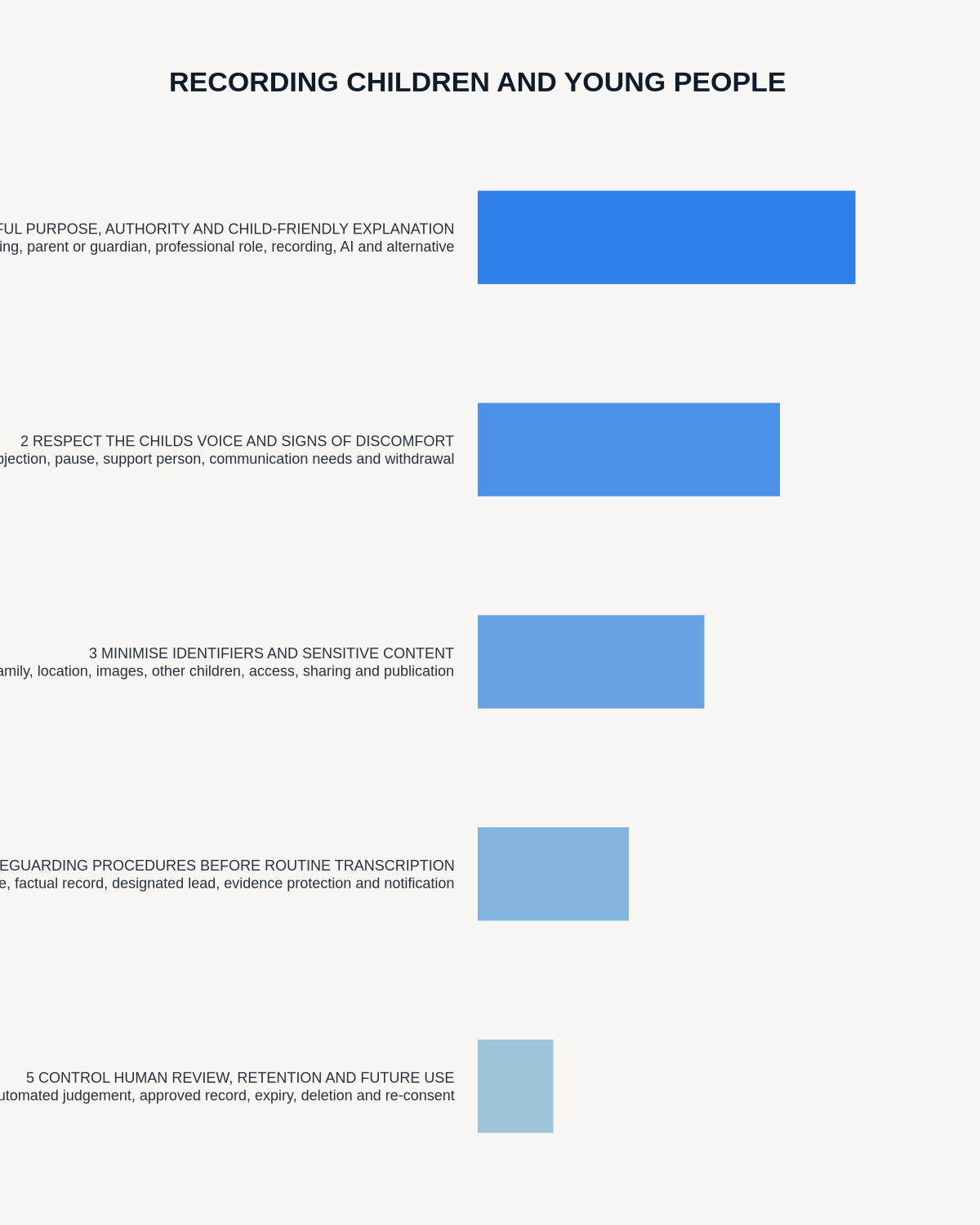
Explain the recording directly to the child in language and a format suited to their age, communication needs and development. Do not rely only on a long notice written for adults.
Explain:
- What the device will capture.
- Why the recording is being made.
- Whether a computer will turn speech into text.
- Who can hear or read it.
- Whether it will be shared or published.
- How long it will be kept.
- How the child can ask questions or say they are uncomfortable.
See the ICO’s guidance on children’s data-protection rights.
Do not use one universal consent rule
The correct authority depends on the purpose, setting, age, competence, parental responsibility, lawful basis, safeguarding duties and organisational policy. A parent’s agreement does not automatically make every use fair, and a child’s apparent agreement may not be enough for every process.
Obtain legal or safeguarding advice where the arrangement is sensitive, disputed, covert, intended for publication or likely to affect the child’s rights.
Listen to the child’s wishes
Even where an adult has legal authority, signs of discomfort, refusal or distress matter. Do not pressure the child or imply that support, education, care or participation depends on optional recording.
Where practicable, stop if the child asks or the recording is affecting the interaction.
Make the non-recorded route real
Before the meeting, decide what happens if recording is refused:
- Use written notes.
- Bring an approved note-taker.
- Record only a non-sensitive section.
- Rearrange with specialist support.
- Use an authorised accessibility adjustment.
A choice is not genuine when the alternative has not been planned.
Use trained staff and approved equipment
Teachers, coaches, youth workers, volunteers or contractors should not introduce personal recording devices or consumer accounts independently. The organisation should approve the purpose, supplier, account, access, retention and safeguarding procedure.
Respond immediately to safeguarding disclosures
If a child discloses abuse, exploitation, danger or another concern, follow safeguarding procedures without waiting for the AI transcript. Do not promise secrecy. Record and report the concern through the authorised process using the child’s words where required.
Avoid repeated or leading questions. The audio does not replace professional judgement, immediate protection or referral.
Minimise what is captured
- Use a private, suitable location.
- Avoid recording bystanders and other children.
- Start only when the relevant discussion begins.
- Stop during breaks or unrelated conversation.
- Avoid unnecessary addresses, dates of birth and identifiers.
- Do not capture passwords, login details or household conversations.
Separate the final records
| Record | Purpose |
|---|---|
| Source audio | Restricted verification material where approved |
| Working transcript | Unverified draft requiring correction |
| Professional session note | Authorised operational record |
| Safeguarding record | Restricted factual record and action route |
| Research or learning output | Minimised approved use under its own permissions |
One transcript should not be used indiscriminately for every purpose.
Control sharing and publication
Permission to create an internal note is not permission to use a child’s voice in marketing, social media, training or public research. Each new purpose needs a separate assessment and the required authority.
Distinctive quotations, school details, age, family relationships and voice may identify a child even after the name is removed.
Protect the file and derived outputs
Restrict raw audio to the smallest authorised group. Label AI transcripts as drafts, verify material details and store the approved record in the correct school, care, health or research system. Do not place recordings in personal cloud accounts, ordinary messaging apps or unmanaged devices.
Set short, purpose-based retention
Raw audio may be needed only until the approved note is verified. Research, legal or safeguarding records may have different requirements. Assign an owner and deletion trigger for the recorder, app, downloads, shared links and backups.
Using NERALVO Halo around children
Assess Halo only after the recording controls are clear provides NOTE mode, supported CALL mode, 64GB local storage, up to 35 hours of recording and Bluetooth connection to DOWAY for transcripts, summaries, templates, translations, mind maps and exports. One year of DOWAY Max is included.
Halo should be used in child-related settings only where the organisation has expressly approved the complete device-and-app workflow. Its discreet size must never be used to conceal recording.
Workflow choice matrix for Recording Children and Young People
Apply the strongest control before choosing a device. The table makes the non-hardware options explicit.
| Condition | Preferred route | Why |
|---|---|---|
| High-risk or mixed work | Governed hybrid | Separate capture, review, approval and retention rather than trusting one tool. |
| Recording is refused, prohibited or unnecessary | Manual notes / no recording | Respecting the boundary is the correct workflow, not a product failure. |
| In-person, mobile or unreliable-connectivity work | Dedicated recorder | Independent capture and a recoverable local source are usually more resilient. |
| Repeatable remote work with approved integrations | Cloud software | Automation and central collaboration may outweigh device independence. |
Frequently asked questions
Can a teacher or coach decide alone?
They should follow organisational policy and safeguarding, data-protection and professional requirements rather than making an individual technology decision.
Can AI decide whether a disclosure is credible?
No. Trained safeguarding professionals must assess and act. AI may omit context or mishear key words.
Can a child’s transcript be anonymised by removing their name?
Not necessarily. School, age, role, event, family relationships and voice may still identify them.
Should every child interview be recorded?
No. Some formal processes use specialist recording arrangements, while many ordinary conversations are better documented through approved written notes.
Safeguarding-first checklist
- Child-centred benefit identified.
- Purpose and necessity documented.
- Less intrusive alternatives considered.
- Organisational and safeguarding approval obtained.
- Lawful basis and sensitive-data conditions assessed.
- Age-appropriate explanation prepared.
- Parental-responsibility requirements checked.
- Child’s wishes and communication needs considered.
- Non-recorded route available.
- Staff trained for disclosures.
- Supplier, access and security approved.
- Retention and deletion assigned.
Bottom line: responsible recording involving children is transparent, necessary, limited, professionally governed and designed around welfare. Where those safeguards are absent, do not record.
Related guides
On this page
Related guides
Check permission, retention and access before choosing hardware
Once the policy requirements in this guide are satisfied, compare Halo’s specifications, local storage, included services and current offer against your approved workflow.
Found an error or an out-of-date claim? Email support@neralvo.com with the article address and a supporting source.