Reviewed and improved: 4 August 2026.
The 60-second verdict
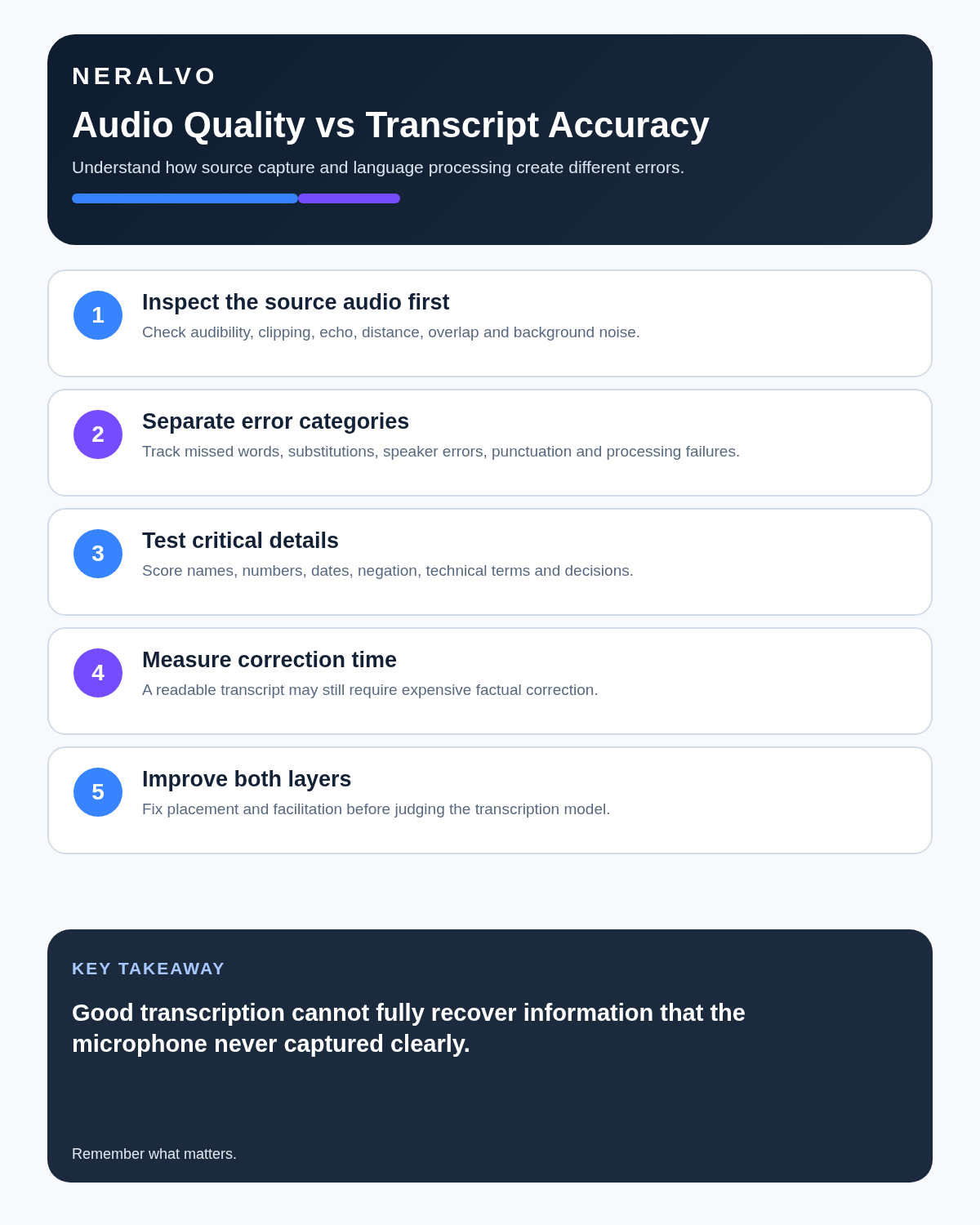
Quick answer: audio quality and transcription accuracy are not competing priorities. Audio quality determines whether the words are available to recognise; the transcription system determines how well those captured words are converted into text. In most real-world failures, fixing the source recording produces a larger improvement than switching AI models.
Best fit: choose the option that passes your capture, recovery, privacy and total-cost gates. Do not decide on: price or a single accuracy claim in isolation.

Evidence basis and limits
- Decision factors covered: The complete accuracy chain; Which matters more?; Separate five error types.
- Evidence rule: Claims are weighted by consequence: capture failure, changed meaning, access and recovery matter more than polished wording.
- Boundary: Examples and workflow recommendations must be tested with representative recordings, the intended users and the actual approval process before rollout.
NERALVO sells the Halo AI voice recorder. This guide explains how to diagnose recording and transcription quality without claiming that any recorder or AI model can guarantee perfect results.
The complete accuracy chain
- Speech production: the speaker talks clearly enough to be understood.
- Acoustic path: distance, direction, room echo and background noise affect what reaches the microphone.
- Capture: the microphone and recorder preserve the signal without clipping, obstruction or missing sections.
- Transfer: the complete file reaches the app or processing service.
- Recognition: the model interprets language, accent, vocabulary and speaker changes.
- Human verification: names, figures, commitments and other high-risk details are checked.
- Structured output: summaries and action lists preserve the verified meaning.
A failure early in this chain cannot be reliably repaired later. A model may infer a plausible phrase from context, but plausibility is not the same as evidence.
Which matters more?
Audio quality matters first. When speech is quiet, masked, clipped, reverberant or missing, every transcription system starts with incomplete evidence. Once the source audio is clearly intelligible, differences between models become more important, particularly for specialist terminology, accents, punctuation and speaker attribution.
Balanced comparison matrix
Balanced decision rule: a cloud tool should win where automation and collaboration matter most; a dedicated recorder should win where independent capture and mobility matter most; manual notes should win when recording is inappropriate.
| Situation | Priority | Reason |
|---|---|---|
| Speech is difficult for a person to hear | Improve audio capture | The words may not exist clearly in the recording |
| Speech is clear but names and jargon are wrong | Improve model or glossary | The signal is usable but recognition is weak |
| Words are correct but assigned to the wrong person | Improve turn-taking and diarisation review | Speaker attribution is a separate task |
| Transcript is accurate but summary changes meaning | Improve summary controls | The error occurred after transcription |
Separate five error types
- Capture error: speech is missing, quiet, distorted, clipped or masked.
- Recognition error: clearly audible speech becomes the wrong text.
- Segmentation error: sentences, punctuation or topic boundaries are incorrect.
- Attribution error: correct words are assigned to the wrong speaker.
- Summary error: a reasonably accurate transcript is compressed into misleading meaning.
Do not use one headline “accuracy” score to hide these different problems. Each requires a different fix.
Listen to the source before reading the transcript
Review the beginning, middle and end using ordinary headphones. Avoid reading the transcript during the first pass because the text can influence what you think you hear.
Check whether:
- every speaker is understandable without strain;
- quiet words disappear into noise;
- echo smears consonants;
- loud speech clips or crackles;
- remote and local speakers are balanced;
- papers, clothing or hands obstruct the microphone;
- the recording contains gaps or corrupted sections.
If a careful listener cannot identify a word confidently, mark it as uncertain. Reprocessing may help, but it should not be treated as a dependable recovery method.
Measure what matters, not just word accuracy
| Measure | What it reveals | Why it matters |
|---|---|---|
| Word error rate | Insertions, deletions and substitutions | Useful for controlled benchmarking |
| Critical-detail accuracy | Names, dates, prices, units, deadlines and negations | These errors create the greatest operational risk |
| Speaker accuracy | Whether statements are attributed correctly | Wrong ownership can corrupt minutes and actions |
| Coverage | Whether any section is missing | A polished transcript can still omit material discussion |
| Correction time | Minutes required to create an approved record | This determines the real administrative cost |
| Summary fidelity | Whether conclusions match the verified transcript | Accurate words can still produce an inaccurate summary |
Diagnose common symptoms
| Symptom | Likely cause | First corrective action |
|---|---|---|
| All speakers sound distant | Recorder too far away | Move centrally or closer |
| One speaker is repeatedly missing | Poor direction, obstruction or seating position | Change placement and test again |
| Remote caller is absent | Call-routing incompatibility | Test the exact phone, app and call route |
| Names are wrong but speech is clear | Vocabulary or model limitation | Use a glossary and compare models |
| Speakers are merged | Overlap or weak diarisation | Improve turn-taking and verify labels manually |
| Words crackle or lose endings | Clipping or excessive input level | Increase distance or adjust gain where available |
| Transcript invents complete phrases | Low-confidence audio interpreted too confidently | Compare against source and mark uncertainty |
| Summary reverses the decision | Negation or condition was lost | Verify the final decision wording manually |
Room acoustics can matter more than hardware price
Glass, bare walls, high ceilings and large tables create reflections that arrive after the direct voice. This reverberation reduces the clarity of consonants and makes overlapping speech especially difficult.
- Choose a smaller furnished room where possible.
- Place the recorder on a stable surface without blocking microphone openings.
- Move away from fans, projectors, coffee machines and open windows.
- Avoid placing the recorder directly beside a laptop fan or loudspeaker.
- Keep papers, sleeves and hands away from the device.
- Ask participants to speak one at a time.
Distance and placement rules
The best position is usually where the recorder has a clear, similar path to every important speaker. The centre of a small table may work better than beside the chairperson if several people need equal coverage.
Run a short test using:
- the quietest expected speaker;
- the furthest expected speaker;
- normal and soft speech;
- a brief overlap;
- the actual room and seating plan.
Replay the source audio before the real meeting begins.
Phone calls require a separate benchmark
Strong room recording does not prove that both sides of a call will be captured. Mobile calls, internet calls and business communication platforms can route audio differently.
Test the exact:
- phone model and operating system;
- call application;
- Bluetooth or wired route;
- speakerphone or handset mode;
- recording mode;
- permissions and regional restrictions.
Confirm that both voices exist in the source recording before evaluating transcription accuracy.
Run a fair matched comparison
- Create a short benchmark script containing ordinary speech, names, numbers, dates, acronyms and specialist terms.
- Use the same room, speakers and speaking order.
- Place devices at equivalent distances.
- Record quiet, normal and overlapping sections.
- Export the original audio from each device.
- Transcribe each source file with the same model to isolate capture quality.
- Then process one identical source file through several models to isolate recognition quality.
- Blind the reviewer to the device or model where practical.
- Count critical errors and correction time.
Use mandatory pass-or-fail gates
A weighted score should not allow a strong summary feature to compensate for missing audio. Define mandatory gates before scoring convenience features.
- No missing recording sections
- All required speakers intelligible
- Both sides of supported calls captured
- Source audio replayable and exportable
- Critical names and figures recoverable
- Acceptable correction time
- Clear uncertainty rather than invented certainty
Create a critical-detail error log
| Timestamp | Reference | Output | Error type | Risk | Correction time |
|---|---|---|---|---|---|
| 00:08:42 | £14,500 | £40,500 | Number substitution | High | 40 seconds |
| 00:17:10 | Not approved | Approved | Negation loss | Critical | 75 seconds |
| 00:25:03 | Owner: Maya | Owner: Liam | Attribution | High | 55 seconds |
This log is more useful than a vague impression that one transcript “looks cleaner.”
When to change the recording setup
Change placement, room or microphone strategy when multiple models fail on the same unclear sections, speakers disappear according to position, or the source audio itself requires effort to understand.
When to change the transcription system
Compare models when the source is clear but the same categories remain wrong, such as industry terminology, accents, multilingual speech, punctuation, speaker labels or formatting.
When human review remains mandatory
Human checking is essential where errors could affect legal, financial, clinical, employment, contractual, safeguarding or governance outcomes. Verify:
- names and identities;
- dates, times, values and units;
- negations and conditional wording;
- decisions and approval status;
- action owners and deadlines;
- quotations used externally;
- material uncertainty or missing sections.
Where NERALVO Halo fits
Check NERALVO Halo against this Transcription Accuracy vs Audio Quality framework provides compact NOTE recording, supported CALL capture, 64GB local storage, up to 35 hours of recording and Bluetooth transfer to DOWAY for transcripts, summaries, templates, mind maps and exports. One year of DOWAY Max is included from activation.
Halo can preserve a recoverable source recording, but results still depend on placement, acoustics, speaker behaviour, call compatibility, vocabulary and human verification. Test the complete intended workflow rather than relying on a headline accuracy claim.
Is cloud software or a physical recorder right for this workflow?
- Choose the software-led option when automated remote-meeting capture and collaboration remove more work than they add.
- Choose the dedicated-recorder option when independent in-person capture, mobility and source recovery matter more.
- Use neither when recording is not authorised or a mandatory privacy, compatibility or recovery gate fails.
How community feedback is used
Public reviews can reveal recurring friction, but an anonymous anecdote is not treated as measured proof. A pull-quote should appear only when it links to the original post, identifies the relevant product version or date and is presented as one user’s experience—not as universal fact.
Frequently asked questions
Can AI repair bad audio?
Noise reduction and enhancement may improve intelligibility, but they cannot reliably restore words that were never captured clearly.
Does a higher bitrate guarantee a better transcript?
No. A high-quality file of distant, obstructed or reverberant speech can still transcribe poorly.
Why are names, numbers and acronyms often wrong?
They provide less linguistic context and may be rare in the model’s vocabulary. They should be checked whenever they matter.
Is speaker identification part of transcription accuracy?
It is related but separate. The words may be correct while the speaker label is wrong.
Should I compare transcript percentages from different vendors?
Only when they use the same audio, reference transcript, scoring method and error rules. Otherwise the percentages are not directly comparable.
What is the best practical metric?
For business use, critical-detail accuracy plus correction time is usually more meaningful than headline word accuracy alone.
Useful resources
- How to Compare AI Transcription Systems Fairly
- Local Storage vs Cloud AI Voice Recorders
- How to Record Long Meetings Without Losing the Important Parts
- Check NERALVO Halo against this Transcription Accuracy vs Audio Quality framework
Final diagnostic checklist
- Source audio reviewed before transcript
- Capture, recognition, attribution and summary errors separated
- Room, distance and placement tested
- Exact call route tested separately
- Critical details measured
- Mandatory pass gates defined
- One variable changed at a time
- Correction time recorded
- Source audio retained long enough for verification
- High-risk outputs checked by a person
Bottom line: improve the source recording first. Once the audio is clearly intelligible, compare transcription systems using the same file and judge them by critical-detail accuracy, speaker accuracy, completeness and correction time.
On this page
Related guides
See whether Halo fits this workflow
Review the NERALVO Halo specifications, included services, delivery information and current offer only after completing the guide.
Found an error or an out-of-date claim? Email support@neralvo.com with the article address and a supporting source.