The 60-second verdict
Quick answer: turn a recorded customer conversation into a useful CRM note by correcting the source transcript, extracting only relevant verified facts, separating customer statements from sales interpretation, distinguishing proposals from commitments and creating owned follow-up tasks instead of pasting the whole transcript.
Decision focus: use the method below only where it produces a recoverable source, a verifiable output and a clear next action. If one of those fails, change the workflow rather than trusting a polished summary.
Evidence basis and limits
- Decision factors covered: Define the purpose before recording; Use a consistent CRM-note template; Correct the transcript before creating the account record.
- Evidence rule: A claim earns weight only when the source, date, configuration and limitation are clear enough for a reader to check.
- Boundary: Examples and workflow recommendations must be tested with representative recordings, the intended users and the actual approval process before rollout.
A CRM note should help the next authorised person understand the customer’s objective, evidence, constraints, commitments and next step. A recording preserves detail, but the final account record must remain concise, accurate, proportionate and controlled.

Define the purpose before recording
Recording should support a specific approved purpose such as discovery, onboarding, support, renewal or complaint handling. Before capture, establish the recording process, transparency information, lawful basis, access controls, retention period and any specialist escalation route.
| Conversation | Useful CRM output |
|---|---|
| Discovery | Objective, current process, impact, stakeholders and agreed next step |
| Demo | Requirements tested, questions, objections and follow-up evidence |
| Proposal review | Commercial concerns, approval route, conditions and decision date |
| Customer success | Adoption status, risks, support needs and outcome plan |
| Support | Issue, troubleshooting completed, result, escalation and customer communication |
| Renewal | Value achieved, unresolved risks, stakeholders and confirmed process |
Use a consistent CRM-note template
- Conversation purpose and account context
- Customer situation, objective or problem
- Business impact described by the customer
- Current process or workaround
- Decision criteria and confirmed stakeholders
- Requirements, objections and unresolved questions
- Evidence supplied or still required
- Information or proposal provided by the organisation
- Commitments made by either side
- Next action, owner and date
- Next-contact or decision date
- Source conversation and supporting documents
Correct the transcript before creating the account record
Verify:
- Customer and organisation names
- Speaker attribution and job roles
- Dates, prices, quantities and currencies
- Product, contract and technical terminology
- Conditional language, uncertainty and negation
- Which commitments were actually accepted
- Whether the customer described a fact, preference, concern, estimate or possibility
Do not let a transcription error become an authoritative customer record.
Separate fact, evidence and interpretation
| Record type | Correct treatment |
|---|---|
| Customer statement | Attribute it to the customer and preserve material wording |
| Verified fact | Link it to the account, contract, document or other source |
| Customer estimate | Label it as an estimate and retain the unit and period |
| Sales interpretation | Mark it as judgement that may still be wrong |
| Proposal | Keep it separate from anything accepted |
| Confirmed commitment | Record the owner, condition and date |
| Unknown | Leave it open instead of inventing an answer |
The ICO’s accuracy guidance says organisations should keep the source and status of personal data clear and distinguish opinion from fact. Review challenges to accuracy rather than treating an AI summary as definitive.
Do not let AI inflate opportunity status
Common errors include:
- Turning “interesting” into confirmed buying intent
- Assuming the most senior attendee is the decision-maker
- Changing a target date into a committed deadline
- Removing conditions attached to budget or approval
- Converting a price question into confirmed budget
- Classifying a complaint as a minor objection
- Creating personality, confidence or sentiment labels from ordinary conversation
Use evidence-based opportunity stages
| Stage | Minimum evidence |
|---|---|
| Exploring | Relevant problem and contact identified |
| Qualified | Need, impact, authority and realistic timing established |
| Evaluation | Decision criteria, stakeholders and next evaluation step confirmed |
| Proposal | Scope, price, conditions and decision route supplied |
| Commitment | Formal approval, order or applicable written process completed |
Opportunity stage and forecast should not change automatically from an AI summary. Confirm the organisation’s evidence rules and preserve “subject to” wording.
Verify commercial details
Check product, quantity, scope, price, currency, tax, discount authority, delivery assumptions, implementation, renewal, cancellation, validity period and any dependency. A preliminary discussion must not appear as a confirmed order or contractual commitment.
Create actual tasks and reminders
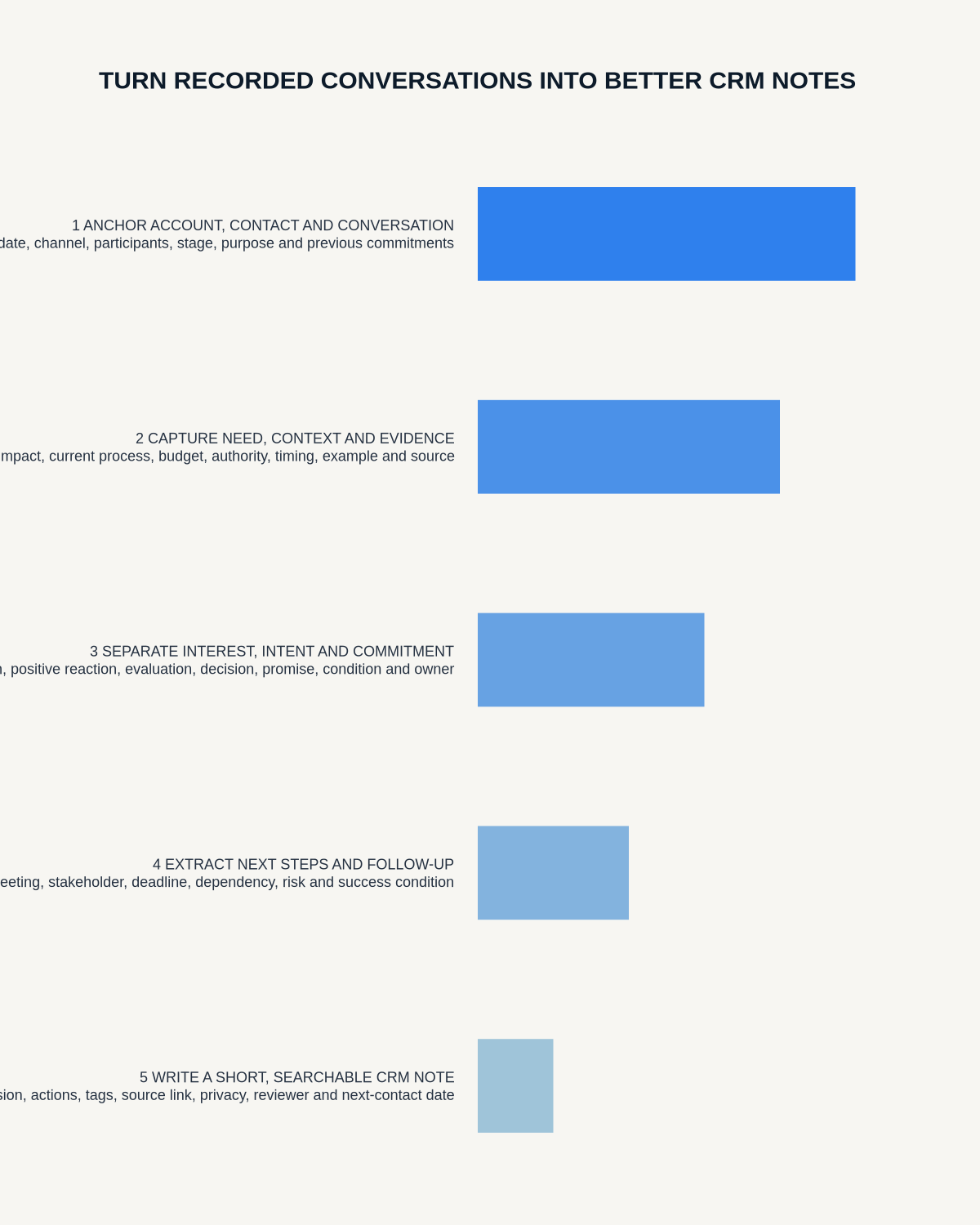
Move actions into the CRM’s task, opportunity, case or service workflow. Each action needs one owner, a deadline, a clear output and any dependency. “Follow up next week” is not sufficient.
Use a controlled CRM-update workflow
- Confirm that recording followed the approved process.
- Generate and correct the transcript.
- Extract only information relevant to the defined purpose.
- Separate statements, evidence, interpretation, proposals and commitments.
- Verify commercial and technical details.
- Update the correct account, contact, opportunity or case fields.
- Confirm stage and forecast against evidence rules.
- Create the next activity with one owner and deadline.
- Send a written customer recap where appropriate.
- Apply access and retention rules to audio, transcripts and duplicate notes.
Apply accuracy, minimisation and retention
The UK data-protection principles require personal data to be adequate, relevant and limited to what is necessary, accurate where required, kept only as long as needed and protected appropriately. One useful account record is normally preferable to a transcript copied across multiple fields, emails and personal notebooks.
Exclude unrelated personal conversation, speculative profiling, unnecessary special-category information, internal criticism and comments that do not support the stated purpose.
Handle high-stakes information separately
Complaints, vulnerability, financial difficulty, health information, safeguarding concerns or legal disputes may require a specialist authorised record, restricted access or escalation process. Do not force them into an ordinary sales-note workflow.
Keep worker monitoring separate
A customer-note workflow should not quietly become continuous staff surveillance. Where recordings are used for coaching or performance review, use a separate lawful, transparent and proportionate employment process with defined purpose, access, criteria and retention.
Where NERALVO Halo fits
Apply this guide before assessing NERALVO Halo provides NOTE recording, supported CALL capture, 64GB local storage, up to 35 hours of recording and Bluetooth sync with DOWAY. DOWAY can create transcripts, summaries, speaker-separated notes, templates, translations, mind maps and exports. One year of DOWAY Max is included from activation.
CALL compatibility varies by phone, operating system, calling app, speaker volume and case. Complete a lawful test call before relying on it, verify names and commercial details, then create a concise CRM note plus separate tasks.
Workflow choice matrix for How to Turn Recorded Conversations into Better CRM Notes
Choose the method that protects the source and reduces downstream correction. The table makes the non-hardware options explicit.
| Condition | Preferred route | Why |
|---|---|---|
| High-risk or mixed work | Governed hybrid | Separate capture, review, approval and retention rather than trusting one tool. |
| Recording is refused, prohibited or unnecessary | Manual notes / no recording | Respecting the boundary is the correct workflow, not a product failure. |
| In-person, mobile or unreliable-connectivity work | Dedicated recorder | Independent capture and a recoverable local source are usually more resilient. |
| Repeatable remote work with approved integrations | Cloud software | Automation and central collaboration may outweigh device independence. |
Frequently asked questions
Should the full transcript be pasted into the CRM?
Usually not. A concise verified note is easier to use and reduces unnecessary retention.
Can AI update the opportunity stage automatically?
It may suggest a stage, but a person should confirm that the required evidence is present.
What if the customer disputes a CRM note?
Review the source, consider the challenge and correct or qualify inaccurate or misleading information through the organisation’s rectification process.
How long should audio be kept?
Only for the defined purpose and retention period. The verified CRM record may remain after temporary audio is deleted.
CRM-note checklist
- Purpose and customer need recorded
- Facts, estimates and interpretation separated
- Commercial details verified
- Proposals and commitments distinguished
- Opportunity stage supported by evidence
- Tasks created with owners and dates
- Irrelevant personal information excluded
- High-stakes information routed correctly
- Next-contact date set
- Source audio retained deliberately
Useful resources
On this page
Related guides
See whether Halo fits this workflow
Review the NERALVO Halo specifications, included services, delivery information and current offer only after completing the guide.
Found an error or an out-of-date claim? Email support@neralvo.com with the article address and a supporting source.