The 60-second verdict
Quick answer: Gong is an enterprise revenue platform, not a simple meeting-notes subscription. Its value depends on customised licensing, platform scope, data integrations, management adoption and measurable improvement in revenue workflows. The right evaluation is a procurement, governance and ROI exercise.
Best fit: readers comparing Gong against the purchase, workflow and evidence factors below. Do not buy on: headline features alone; a failed compatibility, privacy, recovery or cost requirement should override the overall score.

Evidence basis and limits
- Decision factors covered: What the organisation is actually buying; Define the business problem before the demonstration; Model several seat scenarios.
- Evidence rule: The decision is based on the complete capture-to-action workflow, not a single feature or marketing accuracy percentage.
- Boundary: Manufacturer-controlled prices, plans, compatibility and specifications can change. Retain the article’s stated check date, verify the live supplier terms before purchase and treat community reports as leads unless the original source is linked.
What the organisation is actually buying
Gong can combine customer interactions across meetings, calls, email and connected revenue systems. Depending on the contracted applications, it may support:
- Call transcripts, summaries and search.
- Deal-risk and opportunity signals.
- Pipeline inspection and forecasting.
- Sales coaching and scorecards.
- Customer-success monitoring.
- Outreach and engagement workflows.
- Enablement and readiness.
- AI-assisted follow-up and CRM administration.
- Data export and wider revenue analysis.
That scope makes a direct comparison with a basic AI notetaker misleading. Gong should be judged by the revenue process it changes.
Define the business problem before the demonstration
| Problem | Possible Gong capability | Evidence of success |
|---|---|---|
| Managers cannot review enough calls | Search, summaries, scorecards and coaching | More documented coaching with less review time |
| CRM opportunities are stale | Interaction capture and assisted updates | Fewer missing fields and less manual administration |
| Forecasts rely on representative opinion | Deal signals and forecasting | Improved forecast accuracy against a defined baseline |
| Winning behaviour is inconsistent | Call analysis, playlists and enablement | Faster onboarding and greater method adoption |
| Customer risks appear too late | Account and conversation monitoring | Earlier intervention and fewer preventable losses |
If the organisation cannot define the before-and-after measure, it will struggle to prove return on investment.
Pricing questions to obtain in writing
Ask the proposal to separate every material cost and boundary:
- Price per user and each seat type.
- Platform fee and the user band it supports.
- Minimum number of licences.
- Included applications and optional modules.
- Implementation, onboarding and professional services.
- Contract duration and renewal uplift.
- Support tier and service commitments.
- Historical import or migration fees.
- AI-agent, credit or usage allowances.
- Termination, export and deletion terms.
Do not accept one annual total without understanding what changes when users, applications or data volumes increase.
Model several seat scenarios
Potential users include account executives, sales development, customer success, managers, enablement, RevOps and leadership. They may not require identical licences.
- Customer-facing users only.
- Customer-facing users plus managers.
- Full revenue organisation.
- Representative pilot followed by staged expansion.
- Different access for occasional reviewers and daily operators.
Compare broad visibility with real expected usage. A seat assigned without a weekly workflow is not adoption.
Audit every proposed integration
Gong becomes more powerful as more customer context is connected. That also expands the deployment and permission surface.
| Source | Questions to resolve |
|---|---|
| CRM | Which fields are read, written and treated as authoritative? |
| Calendar | Which events are eligible or excluded? |
| Meeting platforms | How are participant notice, source recording and failures handled? |
| Telephony and diallers | Which lines, countries and call types are covered? |
| Which accounts and content enter the revenue record? | |
| Engagement tools | How are duplicated actions and sequences prevented? |
| Customer-success systems | Who owns conflicting account status? |
| Warehouse or BI | What is exported, refreshed and governed downstream? |
For each integration, define the data imported, fields written back, access permissions, failure monitoring, incident route and named owner.
Recording and consent cannot be an afterthought
Automatic capture can create a more complete revenue record while collecting commercially sensitive and personal information at scale. The deployment needs clear rules for:
- Countries and jurisdictions where recording is permitted.
- Participant notice and applicable consent process.
- Meetings and calendar categories excluded from capture.
- Internal, managerial and external access.
- Employee-monitoring concerns.
- Coaching and performance-use boundaries.
- Legal holds, retention and deletion.
- Customer data requests and contract obligations.
Security features do not replace legal, employment, regulatory or professional review.
Use AI signals as prompts, not facts
A deal-risk flag, sentiment label or coaching score is an interpretation based on the data available to the system. It may miss off-platform facts, pricing changes, stakeholder dynamics or a representative’s undocumented knowledge.
Require source evidence and accountable review before a signal affects forecasting, performance management or a customer decision.
Run a representative pilot
Set a baseline
Measure current call-review time, CRM completion, forecast accuracy, onboarding speed, coaching frequency, opportunity hygiene and customer-risk detection.
Choose representative users
Include different experience levels, managers and normal operational conditions. A pilot made only of enthusiastic top performers can exaggerate adoption and value.
Limit the objectives
Test two or three outcomes, such as coaching coverage, CRM administration and deal-risk visibility, instead of trying to validate every feature.
Define the operating process
State who reviews alerts, who approves CRM updates, when managers coach, how users challenge errors and which system remains authoritative.
Measure behaviour as well as results
Check whether users search recordings, act on alerts, complete coaching and update workflows—or merely allow calls to accumulate.
Calculate full cost
Include licences, platform fees, implementation, administration, training, change management, integration support, correction time and usage-based charges.
Create an ROI scorecard
| Outcome | Baseline | Pilot measure | Decision threshold |
|---|---|---|---|
| CRM completeness | Current missing or late fields | Verified completion after pilot | Defined improvement without unacceptable errors |
| Coaching coverage | Calls reviewed per manager | Documented coaching sessions | Sustainable weekly process |
| Forecast accuracy | Current variance | Comparable pilot-period result | Material improvement after controlling for mix |
| Administrative time | Manual minutes per user | Measured time saved minus correction | Positive net time and cost |
| User adoption | Current workflow use | Active weekly use of selected functions | Broad enough for scale |
Where Gong can disappoint
- The organisation buys broad functionality but mainly uses transcripts.
- Managers do not build coaching into their working week.
- CRM, calendar and account data are poorly maintained.
- Teams feel monitored and change how they communicate.
- AI signals are treated as objective truth.
- Automated CRM updates create unverified facts.
- The contract expands faster than measurable value.
- Offboarding and data export are considered too late.
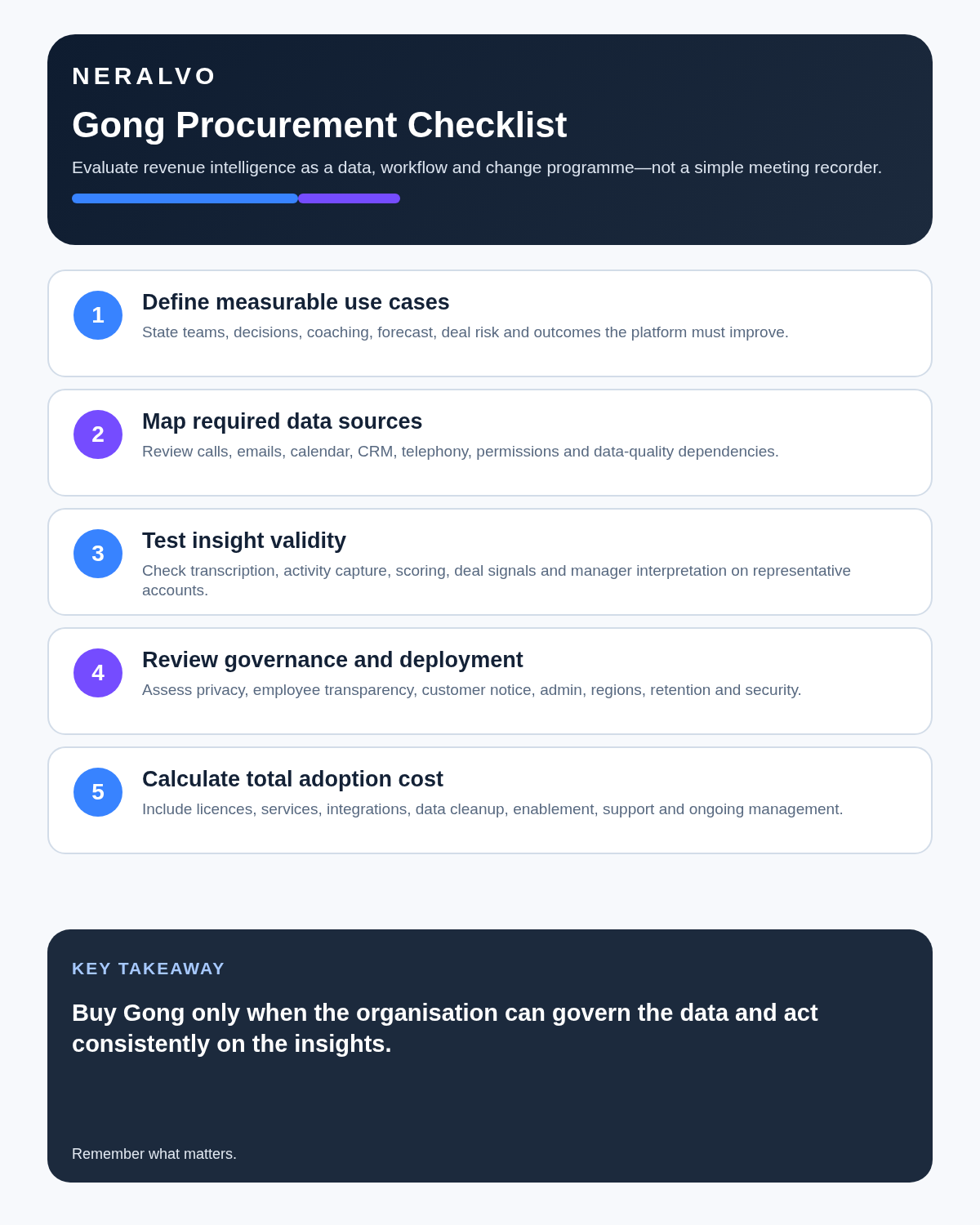
Procurement and contract checklist
- Use cases and success measures attached to the contract decision.
- Seat types and minimums documented.
- Platform and optional application fees separated.
- Implementation scope and acceptance criteria stated.
- Integration responsibilities and support defined.
- Security, subprocessors and data location reviewed.
- Recording, employee and customer governance approved.
- Renewal uplift and true-down rights understood.
- Export formats and migration assistance confirmed.
- Deletion, legal hold and termination process tested.
When Gong is probably too much
Gong may be excessive for a small sales team with few recorded calls, an immature CRM, no structured coaching process or no management capacity for forecast and deal review. A lower-cost meeting assistant may cover transcripts, summaries and CRM notes without introducing an enterprise revenue platform.
Direct comparison matrix: Gong and NERALVO Halo
How to read this matrix: it is not scored to force a Halo win. The competing option leads where its deployment, integrations, placement or ecosystem is stronger; Halo leads only where its dedicated capture workflow is the better fit.
Gong is designed for enterprise revenue intelligence, connected systems and organisational workflows. See whether Halo fits where Gong does not is a physical capture tool for meetings and supported calls, with 64GB local storage, up to 35 hours of recording and one year of DOWAY Max. It suits professionals whose immediate problem is preserving a conversation rather than analysing an enterprise pipeline.
Is cloud software or a physical recorder right for this workflow?
- Choose Gong when remote or desktop meetings, calendar automation and native workspace integrations are central—and its current plan covers the real team workload.
- Choose NERALVO Halo when in-person, mobile or offline source capture matters more than an auto-joining cloud workflow.
- Re-test after any material plan, app, operating-system or policy change.
One public user signal
“I use Gong to record and review customer calls, capture meeting notes, and share insights.”
Read the original G2 review. This is one person’s public report, not a controlled test or community consensus.
Why it matters here: That is a broad revenue-team workflow. Procurement should still assess seat scope, governance, integrations and whether the organisation will use the coaching layer.
How community feedback is used
Public reviews can reveal recurring friction, but an anonymous anecdote is not treated as measured proof. A pull-quote should appear only when it links to the original post, identifies the relevant product version or date and is presented as one user’s experience—not as universal fact.
Frequently asked questions
Why does Gong not publish simple pricing?
Enterprise scope can vary by licences, applications, platform size, services and contract terms. Obtain a complete written proposal.
Can Gong replace the CRM?
No. It can enrich and automate parts of the revenue workflow, but the organisation must define the authoritative customer and opportunity record.
Can Gong scores be used for employee decisions?
They should not be used alone. Source evidence, transparency, context and a fair human process are required.
How long should a pilot run?
Long enough to cover representative sales cycles and recurring management routines, with a baseline and defined decision thresholds.
What is the biggest buying mistake?
Purchasing broad platform scope without named workflows, adoption owners and measurable outcomes.
Official source and related reading
Final decision checklist
- Business problems and measures defined.
- Seat scenarios modelled.
- Every integration audited.
- Recording and monitoring governance approved.
- Representative pilot completed.
- AI signals require human verification.
- Full annual cost calculated.
- Contract, export and deletion terms accepted.
- Scale decision linked to measured value.
Verdict: Gong can create substantial value for a mature revenue organisation with clear objectives, clean integrations and committed management. Buy it only when the organisation can state which decisions and workflows will change, who will use the platform and how improvement will be measured.
Software-first route
Need Zoom, Teams, calendar or CRM automation?
Choose cloud software for that job. This page completes the software workflow and evidence first. NERALVO Halo remains an optional later route only when offline, in-person or phone-attached capture matters more than native integrations.
On this page
Related guides
Keep the solution aligned with your original intent
- Choose the reviewed cloud software when Zoom, Teams, calendar automation, CRM workflows or unattended bot capture are essential.
- Consider dedicated hardware later only when offline, in-person, mobile or phone-attached capture is the actual requirement.
- Use neither when permission, governance, compatibility or retention requirements cannot be met.
Check current Gong details at the official source
Verify current plans, compatibility, limits and integrations with Gong before buying. Halo remains a separate optional comparison only for offline, in-person, mobile or phone-attached capture.
Found an error or an out-of-date claim? Email support@neralvo.com with the article address and a supporting source.