The 60-second verdict
Environmental consultants collect observations in places where notebooks and laptops are awkward: active sites, riverbanks, industrial premises and stakeholder walkovers. An AI voice recorder can create a strong field diary when every note is tied to location, time, evidence and uncertainty.
Best fit: Environmental Consultants who need recoverable audio and human-verified notes in an authorised workflow. Use another method when: recording is prohibited, a participant declines or the approved process requires manual notes.
Evidence basis and limits
- Decision factors covered: Record a defensible field observation; Field-diary template; Do not mix observation and interpretation.
- Evidence rule: Claims are weighted by consequence: capture failure, changed meaning, access and recovery matter more than polished wording.
- Boundary: Examples and workflow recommendations must be tested with representative recordings, the intended users and the actual approval process before rollout.
Record a defensible field observation
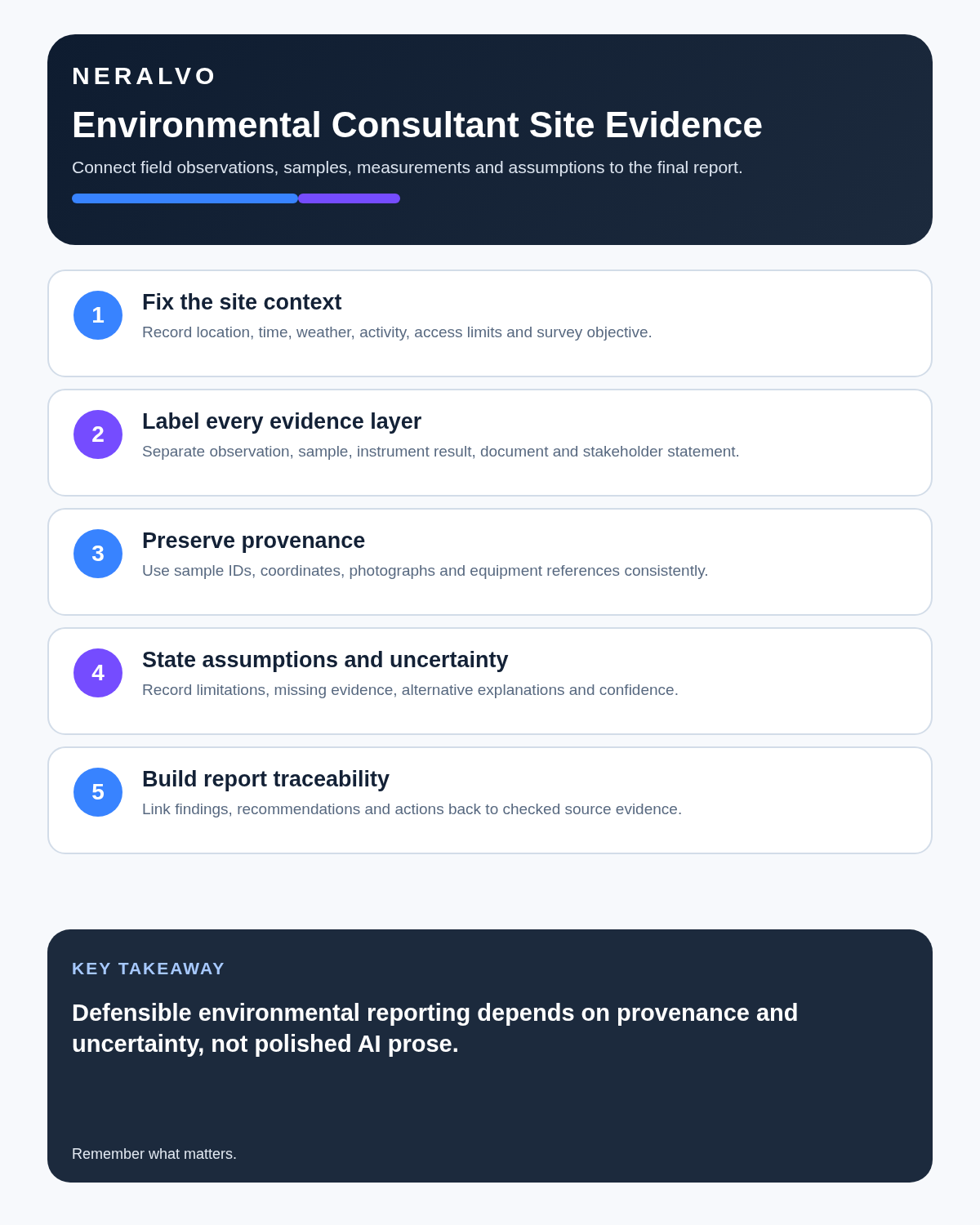
Use the sequence: location → condition → observation → evidence reference → uncertainty → next action.
Example: “Northern drainage outfall at grid reference recorded in field app; visible discolouration downstream, photograph 18; source not established; collect sample under project protocol.”
This is more useful than a general comment such as “possible pollution found.”
Field-diary template
| Field | Content |
|---|---|
| Project and location | Site, area, coordinates or feature |
| Date and conditions | Time, weather, access and relevant operating conditions |
| Observation | What is directly seen, heard or smelled |
| Evidence | Photo, sample, drawing or document reference |
| Source statement | Attributed information from staff or stakeholders |
| Limitation | Restricted access, poor visibility or unverified cause |
| Action | Sampling, document request, specialist review or return visit |
Do not mix observation and interpretation
Environmental work often requires professional interpretation, but the source note should retain the distinction. Record “odour detected near storage area” before concluding what may have caused it.
AI summaries tend to remove cautious wording. Restore terms such as “appears,” “reported,” “not confirmed” and “subject to analysis” where they accurately describe the evidence.
Stakeholder interviews
Interviews with operators, residents, landowners or regulators can provide important history. Structure the note around:
- the person’s role and basis of knowledge;
- time period discussed;
- events personally observed;
- information heard from others;
- documents or records referenced;
- changes in site operation;
- unresolved points.
Do not treat an interview account as verified site evidence without corroboration.
Link voice notes with samples and photographs
State identifiers aloud exactly as written on labels or forms. Repeat sample IDs and photograph numbers. After the visit, compare the transcript with the field sheet and media.
An AI system should not create or infer sample identity.
Noise, PPE and weather
Wind, rain, machinery and protective equipment affect audio. Use a sheltered position for critical dictation, repeat measurements in a quieter area and avoid allowing the device to interfere with safe working.
Post-visit processing
- Confirm the complete source recording.
- Rename by project, site and date.
- Generate the transcript.
- Extract a location-based observation log.
- Check coordinates, sample IDs and photo references.
- Separate observation, reported information and interpretation.
- Create an evidence-gap list.
- Draft the relevant report sections.
- Store the reviewed field note in the project system.
Community and public consultation
Where recording is appropriate and approved, AI can help identify themes and actions. The final output should not flatten minority views or present the most frequent comment as factual evidence.
Where NERALVO Halo fits
Check whether NERALVO Halo fits environmental consultants work can support field dictation, stakeholder interviews and post-site debriefs. Its current specification includes 64GB local storage, NOTE and CALL modes, up to 35 hours of recording and Bluetooth transfer to DOWAY.
DOWAY can create transcripts, summaries, speaker-separated notes, templates, translations and mind maps. Use the device within project safety, recording, information-security and evidence procedures.
Field-note quality check
- Can every observation be located?
- Are conditions and limitations recorded?
- Are sample and photo references exact?
- Is reported information attributed?
- Is interpretation separate from the source observation?
- Are evidence gaps and next actions clear?
Cloud software, a dedicated recorder or manual notes?
For Environmental Consultants, the right answer changes with the setting. This matrix deliberately gives each method a situation where it can be the strongest choice.
| Situation | Best starting point | Reason |
|---|---|---|
| scheduled remote client meetings | Cloud meeting software | Calendar automation and shared integrations are usually the strongest advantage. |
| in-person visits and travel | Dedicated recorder | Independent capture reduces reliance on an active phone or laptop. |
| a client declines or policy requires manual notes | Manual notes or an approved alternative | The boundary takes priority over convenience. |
| mixed CRM and field work | Governed hybrid | Use each method only in the setting it actually fits. |
Related guides
Bottom line
For environmental consultants, an AI recorder is valuable when it creates a location-based field diary with traceable evidence. It should preserve uncertainty and improve report drafting without replacing sampling protocols, analysis or professional judgement.
Profession workflow
Visual map for AI Voice Recorder for Environmental Consultants: Better Site Evidence and Reports
- Prepare the approved useDefine purpose, safe position, permission and the required formal record.
- Capture context firstState the case, asset, person, location or event identifier before detail.
- Human-verify evidenceCheck technical terms, units, names, dates, decisions and uncertainty.
- Complete the formal recordTransfer only verified information and apply access and retention controls.
On this page
Related guides
See whether Halo fits this workflow
Review the NERALVO Halo specifications, included services, delivery information and current offer only after completing the guide.
Found an error or an out-of-date claim? Email support@neralvo.com with the article address and a supporting source.