The 60-second verdict
Quick answer: urban designers can use an AI voice recorder during authorised site walks and consultations by tying every note to a route or node, time and environmental condition, then separating direct observation, stakeholder testimony and professional interpretation. Final design decisions should remain linked to drawings, measured evidence, trade-offs and named approval.
Best fit: Urban Designers who need recoverable audio and human-verified notes in an authorised workflow. Use another method when: recording is prohibited, a participant declines or the approved process requires manual notes.
Evidence basis and limits
- Decision factors covered: Prepare the site walk; Capture the conditions; Keep three evidence layers separate.
- Evidence rule: The decision is based on the complete capture-to-action workflow, not a single feature or marketing accuracy percentage.
- Boundary: Examples and workflow recommendations must be tested with representative recordings, the intended users and the actual approval process before rollout.
Urban-design evidence is often lost between the site and the project record. A crossing feels uncomfortable, people avoid a route or a resident describes a night-time problem, but later notes may blur place, conditions and evidence status.

Prepare the site walk
Define the question the visit should answer, such as pedestrian comfort, crossing behaviour, inactive frontage, wayfinding, night-time safety or access to public space.
Create route and node codes before leaving, such as R1 for a route and N3 for a junction. This avoids vague references such as “near the corner.”
Capture the conditions
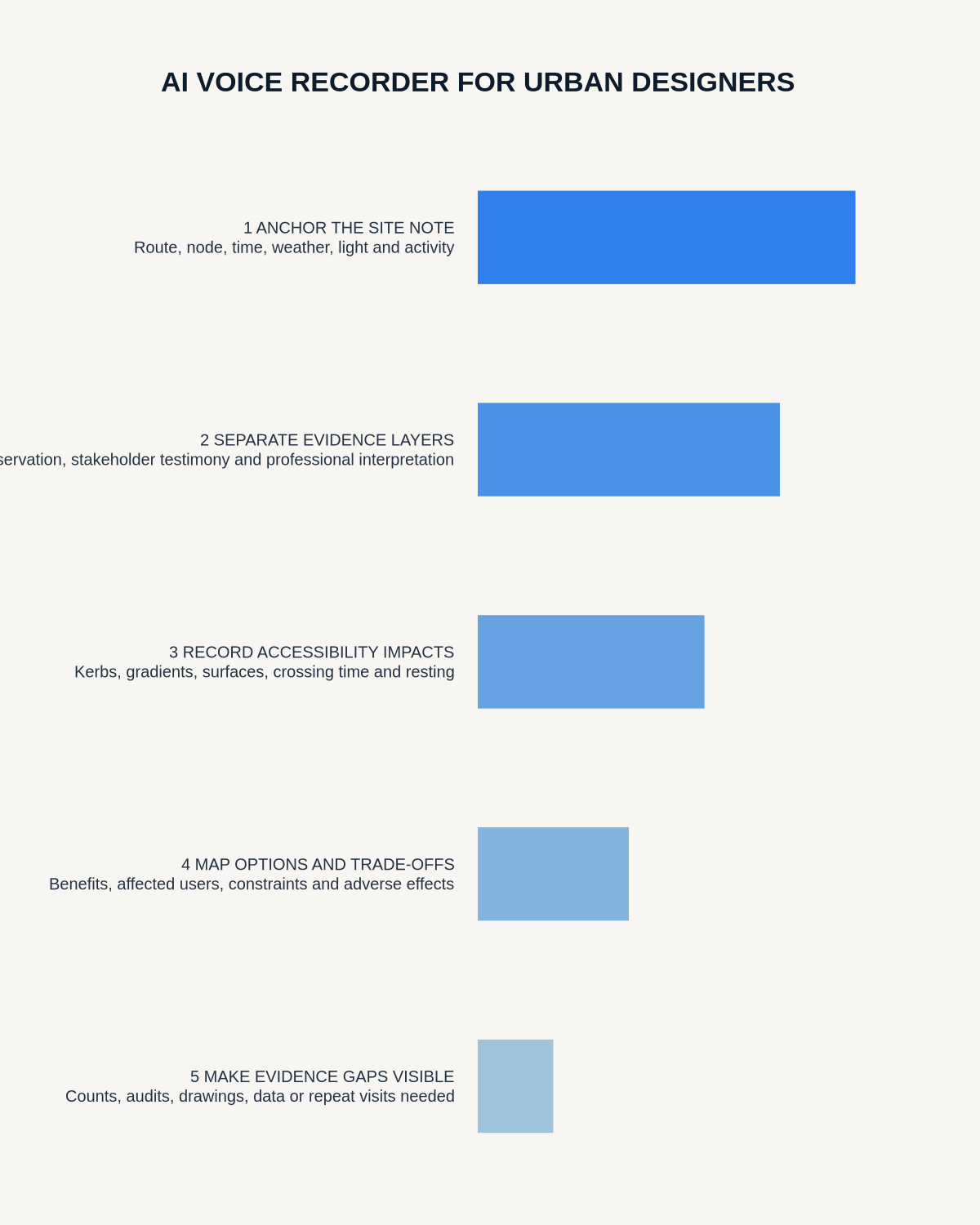
At the start of each file, state project, date, approximate time, route or node, weather, lighting and activity period. A wet weekday evening, school departure and quiet Sunday morning may reveal different conditions.
Keep three evidence layers separate
Direct observation
Describe what is visibly or audibly happening, such as repeated informal crossings, blocked sightlines, conflict between modes or people avoiding seating.
Stakeholder testimony
Record what a resident, business owner or user reports and their relationship to the place where relevant. Do not turn one comment into a general finding.
Professional interpretation
State the designer’s working explanation, hypothesis or possible design implication and label it clearly as interpretation.
Record accessibility, safety and equality impacts
Capture kerb conditions, gradients, surface changes, crossing time, clutter, lighting, resting opportunities and conflict points. Identify affected users rather than assuming one experience represents everyone.
Describe the observed condition before proposing a remedy. A place should not be labelled unsafe solely because it feels uncomfortable without supporting context and evidence.
Use consultation recordings responsibly
Explain the purpose, access and retention. Provide a non-recorded route where required. Avoid side conversations and personal information that are not needed for the design brief.
Preserve quieter and minority views rather than allowing the loudest participants to define the record.
Link evidence to options and trade-offs
For each option, record the intended benefit, evidence supporting it, affected users, constraints and potential adverse effects. For example, a wider footway may improve pedestrian comfort while affecting servicing space.
Maintain a design decision log
Record the option considered, evidence used, rejected alternatives, unresolved uncertainty, decision owner and date. Ideas and recommendations should not appear as approved design changes.
Use a site-walk-to-design workflow
- Define the question and route or node codes.
- State time, weather, light and activity conditions.
- Label observation, testimony and interpretation.
- Record affected users and accessibility implications.
- Mark uncertainty and evidence gaps.
- Correct place names, numbers and technical terms.
- Add photographs, drawings, counts and external evidence.
- Move confirmed issues and questions into the project register.
- Link options and decisions to evidence and owners.
- Delete unnecessary audio under the retention plan.
How NERALVO Halo fits urban-design work
View Halo specifications for urban designers use can support approved site walks, consultation sessions and private post-visit dictation. It includes NOTE mode, supported CALL mode, 64GB local storage, up to 35 hours of recording and Bluetooth sync with DOWAY.
DOWAY can create transcripts, summaries, speaker-separated notes, templates, translations, mind maps and exports, with one year of DOWAY Max included. AI-generated text must be checked against the audio, site evidence, drawings and controlled project records before it is used in a design decision.
Cloud software, a dedicated recorder or manual notes?
For Urban Designers, the right answer changes with the setting. This matrix deliberately gives each method a situation where it can be the strongest choice.
| Situation | Best starting point | Reason |
|---|---|---|
| scheduled remote meetings | Cloud meeting software | Native remote-meeting workflows can be more efficient here. |
| in-person or mobile work | Dedicated recorder | A separate battery and recoverable local source improve resilience. |
| recording is refused or prohibited | Manual notes or an approved alternative | Manual notes are the correct control when recording is unavailable. |
| mixed online and offline work | Governed hybrid | A hybrid can combine automation with reliable physical capture. |
Frequently asked questions
Can one site visit prove a design problem?
Usually not. It provides evidence under specific conditions and may need repeat observation, counts or other data.
Should stakeholder comments be anonymised?
Minimise personal information under the project’s process. The experience may matter more than identity.
Can AI choose the best design option?
No. AI can organise evidence, while professional judgement, technical analysis, consultation and governance determine the decision.
Can audio replace photographs or drawings?
No. It should remain linked to visual, measured and documentary evidence.
Useful resources
- GOV.UK Inclusive Mobility guidance
- AI Voice Recorder for Transport Planners
- AI Voice Recorder for Community Engagement Officers
Urban-design checklist
- Every note tied to route, node, time and conditions.
- Observation, testimony and interpretation separated.
- Accessibility and affected-user impacts considered.
- Permissions and privacy handled.
- Visual and measured evidence linked.
- Trade-offs and uncertainty visible.
- Decisions traceable to evidence and owner.
- Source audio retained appropriately.
Bottom line: an AI voice recorder can help urban designers preserve place-specific evidence, but a defensible design still depends on measured context, professional judgement, transparent trade-offs and controlled approval.
On this page
Related guides
See whether Halo fits this workflow
Review the NERALVO Halo specifications, included services, delivery information and current offer only after completing the guide.
Found an error or an out-of-date claim? Email support@neralvo.com with the article address and a supporting source.