The 60-second verdict
Quick answer: transport planners can use an AI voice recorder to capture authorised consultations and technical meetings, but the final record must keep lived experience, site observations, surveys, policy evidence, model outputs, assumptions, options and approved decisions separate. Each material issue should retain its source, place, time boundary, affected group and uncertainty.
Best fit: Transport Planners who need recoverable audio and human-verified notes in an authorised workflow. Use another method when: recording is prohibited, a participant declines or the approved process requires manual notes.
Evidence basis and limits
- Decision factors covered: Protect consultation meaning; Keep model outputs in context; Separate four layers.
- Evidence rule: A claim earns weight only when the source, date, configuration and limitation are clear enough for a reader to check.
- Boundary: Examples and workflow recommendations must be tested with representative recordings, the intended users and the actual approval process before rollout.
Transport-planning discussions combine evidence types with different strengths and limits. A resident’s experience, traffic count, collision record, policy objective and model forecast may all matter, but they are not interchangeable.

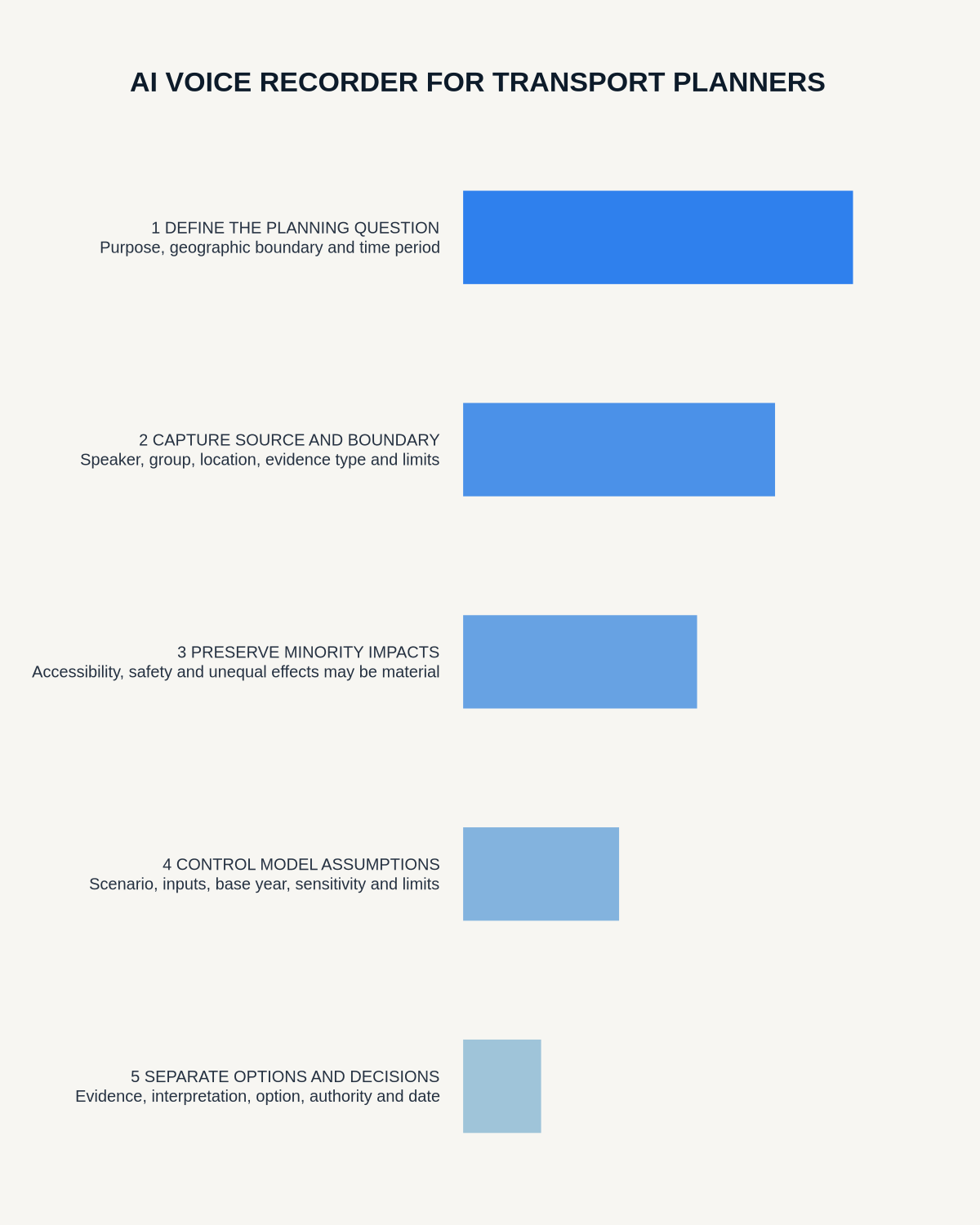
Define the planning question
State whether the session informs an option appraisal, access review, consultation response, modelling assumption, safety assessment or formal decision. A defined question prevents a broad transcript from becoming an unfocused evidence store.
Use a claim-source-boundary structure
For each material point, record:
- claim, concern or proposed outcome;
- speaker or source;
- affected user group or transport mode;
- location and time period;
- whether the evidence is reported, observed, surveyed, modelled or policy-based;
- assumption and source date;
- uncertainty or limitation;
- analysis or decision required.
Protect consultation meaning
Do not use frequency as the only measure of importance. Accessibility, safety, severance and unequal impacts can be material even when raised by fewer participants.
Preserve who is affected, under which conditions and why the concern matters. Do not turn one participant’s experience into a statistically representative conclusion.
Keep model outputs in context
For modelling discussions, record the scenario, input set, base year, forecast period, geographic boundary, sensitivity and known limitations. Model output is conditional evidence, not an observed fact.
When an assumption changes, link the change to affected options and conclusions.
Separate four layers
- Evidence: consultation, survey, count, policy, model or site observation.
- Interpretation: what the planning team believes the evidence means.
- Option: an intervention under consideration.
- Decision: the approved direction, authority and date.
AI summaries can collapse these categories and present a discussed option as agreed policy.
Record trade-offs and distributional effects
A scheme may improve journey time for one group while reducing access, safety or amenity for another. Record who benefits, who may be adversely affected, the supporting evidence and what mitigation or further testing is required.
Convert evidence gaps into actions
For every material gap, identify the analysis required, owner, decision route, response date and communication method. Replace vague actions such as “consider feedback” with a specific output.
Use a consultation-to-decision workflow
- Confirm authorised recording and privacy process.
- State the planning question and evidence scope.
- Capture source, place, time and affected group.
- Label evidence type.
- Correct names, road references, figures and speaker attribution.
- Compare discussion with current documents and datasets.
- Record uncertainty, trade-offs and minority impacts.
- Update consultation, assumption or decision records.
- Assign analysis and communication actions.
- Delete temporary audio under the retention plan.
Cloud software, a dedicated recorder or manual notes?
For Transport Planners, the right answer changes with the setting. This matrix deliberately gives each method a situation where it can be the strongest choice.
| Situation | Best starting point | Reason |
|---|---|---|
| scheduled remote meetings | Cloud meeting software | Auto-join and central collaboration can remove routine admin. |
| in-person or mobile work | Dedicated recorder | Dedicated hardware suits movement, variable rooms and offline source capture. |
| recording is refused or prohibited | Manual notes or an approved alternative | A clear alternative respects policy and participant choice. |
| mixed online and offline work | Governed hybrid | One governed process prevents gaps between desk and field work. |
Frequently asked questions
Can a transcript replace the consultation record?
No. It can support the record, but contributions, analysis, responses and decisions still require the approved process.
Should frequently repeated comments receive automatic priority?
No. Frequency is context; severity, accessibility, affected groups and evidence quality also matter.
Can AI summarise model results?
It can draft a summary, but scenario, inputs, dates, boundaries and limitations must be checked.
Can AI select the preferred option?
No. Professional analysis and formal governance determine the decision.
Useful resources
- GOV.UK Transport Analysis Guidance
- AI Voice Recorder for Urban Designers
- AI Voice Recorder for Community Engagement Officers
- Assess Halo against the transport planners workflow matrix
Planning-record checklist
- Planning question and boundaries clear
- Lived experience, surveys and model evidence separated
- Assumptions dated and sourced
- Accessibility and minority impacts preserved
- Trade-offs visible
- Options separated from decisions
- Evidence gaps have owners and routes
- Formal records updated
On this page
More in this topic: Accessible and public-facing professional work
Show 7 closely related guides
- AI Voice Recorder for Focus Groups: Consent, Speaker Attribution and Auditable Themes
- AI Voice Recorder for Professionals with Dyslexia: Spoken Capture and Accessible Notes
- AI Voice Recorder for Neurodivergent Professionals: Practical Meeting and Note-Taking Workflow
- AI Voice Recorder for Ombudsman Investigators: Evidence, Fairness and Decision Workflows
- AI Voice Recorder for Complaints Managers: Evidence, Findings, Remedies and Resolution
- AI Voice Recorder for Urban Designers: Better Site Notes and Consultation Evidence
- AI Voice Recorder for Renewable Energy Consultants: Site Surveys, Assumptions and Feasibility Notes
Related guides
See whether Halo fits this workflow
Review the NERALVO Halo specifications, included services, delivery information and current offer only after completing the guide.
Found an error or an out-of-date claim? Email support@neralvo.com with the article address and a supporting source.