The 60-second verdict
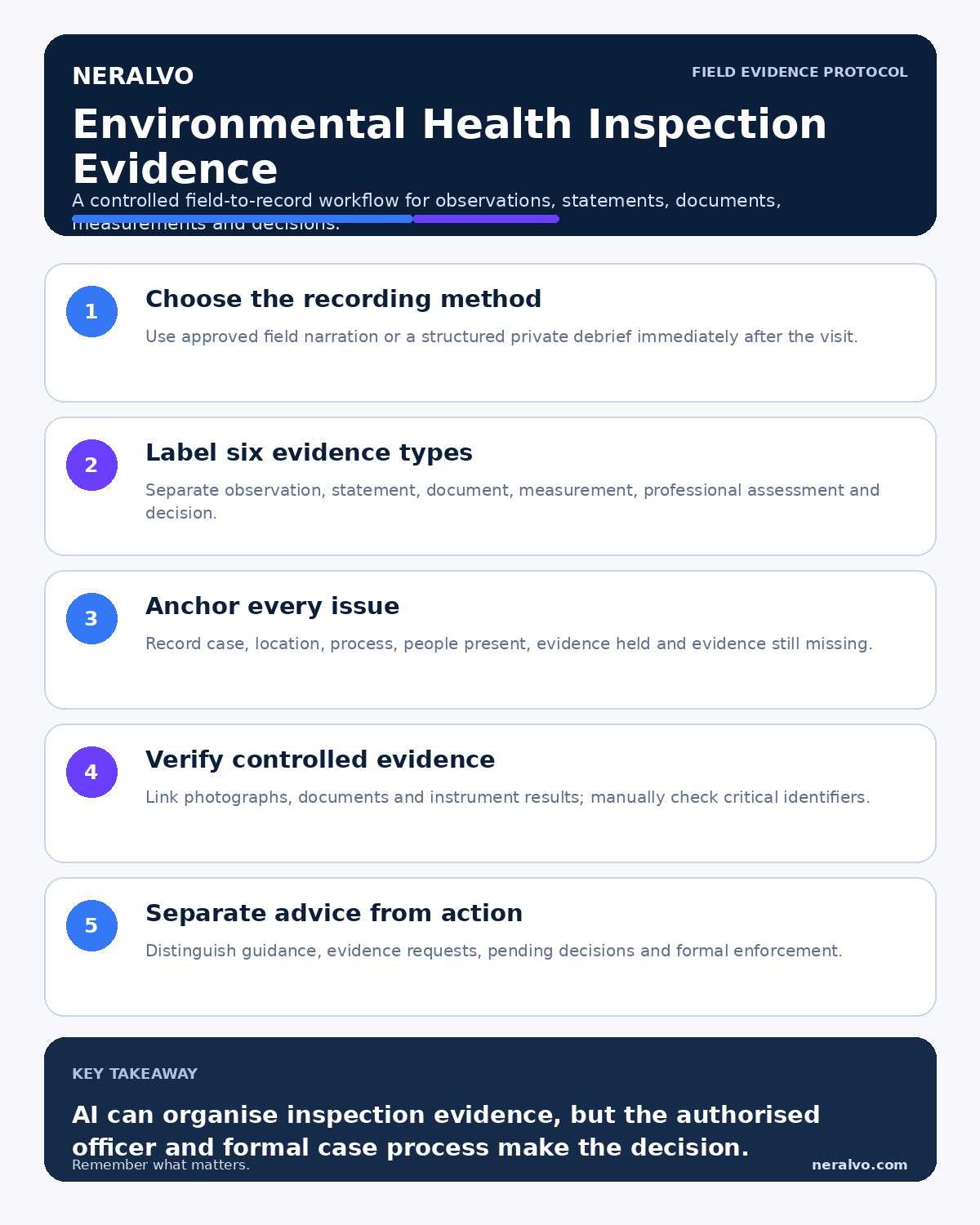
Environmental health officers gather observations, operator explanations, photographs and documents during inspections that may later support advice or enforcement. An AI voice recorder can strengthen the field diary, but the note must distinguish direct observation, statement, professional opinion and formal decision.
Best fit: Environmental Health Officers who need recoverable audio and human-verified notes in an authorised workflow. Use another method when: recording is prohibited, a participant declines or the approved process requires manual notes.
Evidence basis and limits
- Decision factors covered: Use a location-and-evidence structure; Evidence categories; Interviewing operators and staff.
- Evidence rule: A claim earns weight only when the source, date, configuration and limitation are clear enough for a reader to check.
- Boundary: Examples and workflow recommendations must be tested with representative recordings, the intended users and the actual approval process before rollout.
Use a location-and-evidence structure
Record:
- premises and visit reference
- date, time and people present
- specific area or process
- direct observation
- photograph or document reference
- operator explanation
- immediate action taken
- matter to verify
- next formal step
Evidence categories
| Category | Example |
|---|---|
| Observation | Condition directly seen by the officer |
| Statement | Explanation given by operator or witness |
| Document | Record, certificate, log or procedure reviewed |
| Sample or measurement | Collected or taken under the required method |
| Professional assessment | Officer’s reviewed interpretation |
| Decision | Action taken through authorised process |
An AI summary should not merge these categories into a finding.
Interviewing operators and staff
Ask open questions before testing detail:
- Describe the normal process.
- What happens when something goes wrong?
- Who is responsible?
- Which record is created?
- When was this last checked?
- Can you show the document or equipment?
Record the person’s role and basis of knowledge. Verify explanations against physical and documentary evidence.
Photograph and document references
State identifiers aloud: “Photograph 9, rear preparation area, sink beside cold store.” After the visit, confirm the transcript, photograph sequence and written inspection record match.
Formal action must remain separate
The recording can support drafting and chronology. Advice, notices, enforcement decisions and evidence handling must follow the authority’s authorised procedures and legal review where required.
Do not let AI select an offence, rating, risk category or sanction.
A practical inspection workflow
- Follow the authority’s approved recording process.
- State visit reference and purpose.
- Record observations by area or process.
- Reference photographs, samples and documents.
- Attribute statements.
- Complete required contemporaneous records.
- Generate a transcript and observation log.
- Check identifiers, times and source categories.
- Draft correspondence or action through normal review.
- Apply evidence and retention procedures.
Noise and public environments
Inspections may occur around machinery, customers or members of the public. Use a private post-inspection debrief where direct recording would capture unnecessary third-party conversation.
Where NERALVO Halo fits
Assess Halo against the environmental health officers workflow matrix can support approved field dictation, operator interviews and post-inspection debriefs. Its current specification includes 64GB local storage, NOTE and CALL modes, up to 35 hours of recording and Bluetooth transfer to DOWAY.
DOWAY can create transcripts, summaries, speaker-separated notes, templates, translations and mind maps. Use only within authority procedures for recording, evidence, security and retention.
Inspection-note quality check
- Is each observation tied to a location?
- Are statements attributed?
- Are photographs and documents referenced?
- Are observation, assessment and decision separated?
- Were required records completed?
- Is the evidence trail clear?
Cloud software, a dedicated recorder or manual notes?
For Environmental Health Officers, the right answer changes with the setting. This matrix deliberately gives each method a situation where it can be the strongest choice.
| Situation | Best starting point | Reason |
|---|---|---|
| scheduled remote consultations | Cloud meeting software | Auto-join and central collaboration can remove routine admin. |
| in-person consultations or ward handovers | Dedicated recorder | Dedicated hardware suits movement, variable rooms and offline source capture. |
| a patient declines or policy prohibits recording | Manual notes or an approved alternative | A clear alternative respects policy and participant choice. |
| mixed remote and clinical work | Governed hybrid | One governed process prevents gaps between desk and field work. |
Related guides
Bottom line
For environmental health officers, an AI recorder is useful when it produces a disciplined inspection diary. It should improve traceability without replacing formal records, evidence procedures or authorised professional decisions.
Profession workflow
Visual map for AI Voice Recorder for Environmental Health Officers: Better Inspections and Evidence
- Prepare the approved useDefine purpose, safe position, permission and the required formal record.
- Capture context firstState the case, asset, person, location or event identifier before detail.
- Human-verify evidenceCheck technical terms, units, names, dates, decisions and uncertainty.
- Complete the formal recordTransfer only verified information and apply access and retention controls.
On this page
More in this topic: Health, care and clinical recording
Show 9 closely related guides
- AI Voice Recorder for Care Coordinators: Person-Centred Plans and Clear Handover
- AI Voice Recorder for Radiographers: Safer Training, Debriefs and Reflection
- AI Voice Recorder for Optometrists: Clearer Consultations and Safer Clinical Notes
- AI Voice Recorder for Audiologists: Better Hearing Assessments and Follow-Up Notes
- AI Voice Recorder for Coroners’ Officers: Clearer Family Calls and Case Coordination
- AI Voice Recorder for Occupational Health Advisers: Consultations and Adjustments
- AI Voice Recorder for Food Safety Inspectors: Better Site Evidence and Follow-Up
- AI Voice Recorder for Clinical Researchers: Better Interviews and Audit Trails
- AI Voice Recorder for Lab Technicians: Better Procedures, Deviations and Handover
Related guides
See whether Halo fits this workflow
Review the NERALVO Halo specifications, included services, delivery information and current offer only after completing the guide.
Found an error or an out-of-date claim? Email support@neralvo.com with the article address and a supporting source.