
The 60-second verdict
Quick answer: fleet managers can use an AI voice recorder for vehicle defects, driver reports, maintenance planning, incidents and supplier actions, but the recording must not distract from driving or replace inspection, telematics, maintenance, compliance and return-to-service records.
Best fit: Fleet Managers who need recoverable audio and human-verified notes in an authorised workflow. Use another method when: recording is prohibited, a participant declines or the approved process requires manual notes.
Evidence basis and limits
- Decision factors covered: The five vehicle states; The road-safety boundary; Use a vehicle → condition → risk → control → action record.
- Evidence rule: Claims are weighted by consequence: capture failure, changed meaning, access and recovery matter more than polished wording.
- Boundary: Examples and workflow recommendations must be tested with representative recordings, the intended users and the actual approval process before rollout.
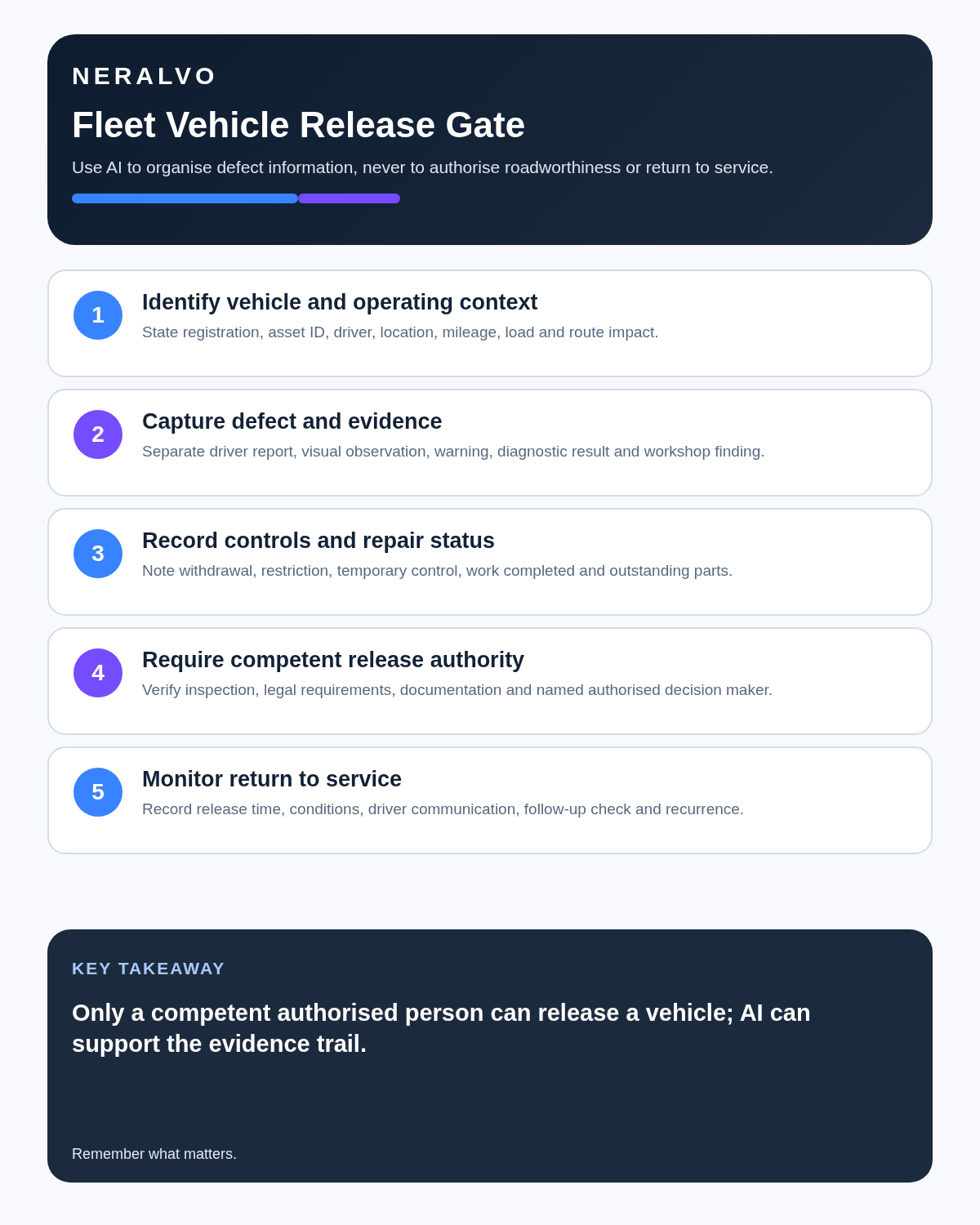
A driver’s voice note can explain a fault. It cannot make a vehicle roadworthy or authorise its return to service.
The five vehicle states
| Status | Meaning | Control |
|---|---|---|
| Available | Approved for normal operation | Fleet system under authorised process |
| Restricted | Specified use or conditions only | Competent authorised person |
| Vehicle off road | Not to be used pending inspection or repair | Fleet or maintenance control |
| Awaiting diagnosis | Symptom reported, cause unconfirmed | Maintenance process |
| Repaired awaiting clearance | Work completed, release not yet authorised | Return-to-service process |
An AI summary must never change the vehicle’s status.
The road-safety boundary
Drivers must not operate or review a recorder while driving. If a defect, warning or incident occurs, follow the organisation’s procedure and stop safely where required. Complete the formal defect or incident report first.
Use a vehicle → condition → risk → control → action record
- Vehicle: registration, fleet number, mileage and location.
- Condition: driver report, inspection finding or alert.
- Risk: safety, legality, reliability or service impact.
- Control: stop, restrict, inspect, recover, repair or monitor.
- Action: owner, deadline and return-to-service evidence.
The DRIVE note
- D — Details: registration, fleet number, mileage and driver.
- R — Road and load: operating conditions when the issue appeared.
- I — Indication: warning light, sound, smell, vibration or handling change.
- V — Vehicle action: stopped, isolated, recovered or continued under authorised instruction.
- E — Escalation: defect report, maintenance owner and next decision.
Example: “Fleet 127, AB12 CDE, mileage 184,223. Amber warning appeared at 08:42 while climbing the A38 under load, with reduced power and no smoke. Driver stopped safely at the service area. Defect report DR-992 created. Vehicle off road pending maintenance inspection and written clearance.”
Separate driver report from engineering finding
| Record type | Meaning |
|---|---|
| Driver-reported symptom | What the driver experienced |
| Telematics alert | System-generated event requiring interpretation |
| Inspection finding | Condition observed by an authorised person |
| Workshop diagnosis | Cause established through the maintenance process |
| Repair completed | Work stated as complete |
| Return-to-service decision | Authorised clearance under the fleet process |
Do not let a transcript turn “possible brake noise” into a confirmed brake defect or “repair complete” into “vehicle available.”
The debrief-to-maintenance workflow
- Confirm the vehicle is safely parked.
- Complete required defect or incident reporting.
- Record the permitted debrief or private note.
- Correct registration, mileage, time, route and symptoms.
- Compare with telematics and written evidence where authorised.
- Raise the formal maintenance action.
- Set vehicle status in the controlled fleet system.
- Require authorised inspection and clearance.
- Carry unresolved status into handover.
- Delete temporary audio under policy.
Manage maintenance through verified data
Check mileage, operating hours, service interval, inspection date, tyres, brakes, fluids, recalls and statutory requirements through the approved systems. AI should not calculate compliance from incomplete notes.
Accident chronology
After immediate safety, emergency and legal actions, separate:
- driver observation;
- third-party report;
- photograph, CCTV or telematics evidence;
- unknown facts;
- company response.
Do not coach a driver into a polished AI narrative or overwrite the original account. Preserve the earliest account and add later evidence as a dated update.
Create a controlled supplier or recovery call record
Record:
- vehicle and incident reference;
- current location and safety status;
- symptom or damage reported;
- service requested;
- attendance estimate;
- restrictions or access requirements;
- cost or approval status;
- who has authority to release or move the vehicle;
- next communication point.
Driver privacy
A defined defect debrief is different from continuous in-cab audio monitoring. Explain purpose, access and retention. Do not use voice analytics to infer attitude, fatigue, honesty or misconduct.
Telematics, health, performance and disciplinary information require appropriate access and fair use. Keep general fleet actions separate from confidential HR or medical processes.
Where NERALVO Halo fits
Check whether NERALVO Halo fits fleet managers work includes 64GB local storage, NOTE and supported CALL modes, up to 35 hours of recording and DOWAY processing. NOTE mode may support safely parked debriefs, private vehicle notes and duty handovers. CALL mode may support compatible maintenance or recovery calls. Halo must never be operated by a driver while driving.
Cloud software, a dedicated recorder or manual notes?
For Fleet Managers, the right answer changes with the setting. This matrix deliberately gives each method a situation where it can be the strongest choice.
| Situation | Best starting point | Reason |
|---|---|---|
| scheduled remote client meetings | Cloud meeting software | Calendar automation and shared integrations are usually the strongest advantage. |
| in-person visits and travel | Dedicated recorder | Independent capture reduces reliance on an active phone or laptop. |
| a client declines or policy requires manual notes | Manual notes or an approved alternative | The boundary takes priority over convenience. |
| mixed CRM and field work | Governed hybrid | Use each method only in the setting it actually fits. |
Frequently asked questions
Can a driver voice note clear a vehicle?
No. Only the authorised inspection and return-to-service process can change the vehicle status.
Can AI diagnose the fault from the driver’s description?
No. The description supports triage; competent inspection determines the cause.
Should the original accident account be replaced after new evidence appears?
No. Preserve it and add later evidence as dated, source-labelled updates.
Can speaking time or tone be used to assess driver performance?
No. Voice characteristics are not reliable performance or conduct evidence.
Final fleet-note checklist
- Vehicle safely parked before recording.
- Correct asset, mileage, time and location identified.
- Driver report separated from diagnosis.
- Immediate restriction and vehicle status are clear.
- Maintenance data is verified.
- Repair status is separate from release authority.
- Accident evidence remains source-labelled.
- Driver privacy is protected.
- The fleet system is updated.
Bottom line: use voice recording to preserve the conditions behind a defect, then move the evidence into the official fleet process. AI can organise the report; only an authorised roadworthiness process can clear the vehicle.
Related AI voice recorder guides
On this page
Related guides
See whether Halo fits this workflow
Review the NERALVO Halo specifications, included services, delivery information and current offer only after completing the guide.
Found an error or an out-of-date claim? Email support@neralvo.com with the article address and a supporting source.