The 60-second verdict
Probate research often begins with a person who knows only part of the family story. They may remember an uncle’s nickname, a move to another city, a second marriage or a relative who “never had children”. Those details can unlock the case, but they are leads until the relationship is proved through records.
Best fit: Probate Researchers who need recoverable audio and human-verified notes in an authorised workflow. Use another method when: recording is prohibited, a participant declines or the approved process requires manual notes.
Evidence basis and limits
- Decision factors covered: Start with the interviewee’s place in the tree; Use a relationship statement, not a loose name list; Apply an evidence status to every family claim.
- Evidence rule: A claim earns weight only when the source, date, configuration and limitation are clear enough for a reader to check.
- Boundary: Examples and workflow recommendations must be tested with representative recordings, the intended users and the actual approval process before rollout.
An AI voice recorder for probate researchers can preserve authorised family interviews before names and connections are lost. The core discipline is simple: testimony generates research questions; documentary evidence supports the heir conclusion.
Start with the interviewee’s place in the tree
Before discussing the wider family, establish:
- full name and previous names
- date and place of birth where relevant
- relationship to the deceased
- which relatives they knew personally
- periods and places they can speak about directly
- documents or photographs in their possession
- other relatives likely to know more
This shows the basis of knowledge. A person may know their siblings directly but know an earlier generation only through family stories.
Use a relationship statement, not a loose name list
For every person mentioned, record a complete relationship statement:
“Eleanor May Price, believed born around 1932 in Cardiff, described by the interviewee as their mother’s older half-sister.”
Capture:
- full and alternative names
- maiden or previous surnames
- approximate or exact dates
- places
- relationship path
- marriage or partnership information
- children or reported absence of children
- source of the claim
Terms such as half-sibling, step-sibling, adopted child and cousin should be clarified rather than assumed.
Apply an evidence status to every family claim
| Status | Meaning |
|---|---|
| Certificate or official-record supported | The relationship or event is backed by a reviewed record |
| Documentary lead | A notice, will, register entry or other document suggests the connection |
| First-hand family testimony | The interviewee knew the person or event directly |
| Second-hand family account | The interviewee was told by another relative |
| Researcher inference | A working connection based on names, dates or locations |
| Contradicted / unresolved | Sources disagree or the relationship remains unclear |
Do not allow an AI summary to present all six statuses as equivalent facts.
Preserve contradictions instead of resolving them automatically
Family accounts often conflict. One person remembers a brother; another says he was a cousin. A surname may belong to a stepfather rather than a birth parent. A reported child may have died young or used a different name.
For each contradiction, record:
- version A and its source
- version B and its source
- dates and places connected to each account
- documents that could resolve it
- current working hypothesis
- what must remain unclaimed until proof is found
Contradiction is not noise. It often identifies the next record to obtain.
Names need a variant register
Speech recognition is weak with uncommon surnames, local accents and historical place names. Build a variant list:
- phonetic spelling
- maiden and married surnames
- middle names and initials
- nicknames
- anglicised or alternative spellings
- transcription errors to search deliberately
- addresses and parishes associated with the name
Spell names aloud and ask the interviewee whether they have seen the name written on a document.
Turn the interview into a lead register
After the call, extract each material claim into a research table:
- claim
- person and relationship involved
- source
- current evidence status
- record required
- likely repository or index
- priority
- result when searched
This prevents useful leads from remaining buried in a long transcript.
Questions that expose missing branches
Ask systematically:
- Did each relevant person marry or form another partnership?
- Were there children, including children who died young?
- Were there half-siblings from earlier or later relationships?
- Did anyone emigrate, serve overseas or use another surname?
- Was anyone adopted, informally raised elsewhere or estranged?
- Who attended funerals, weddings or family gatherings?
- Which relative held photographs, certificates or the family Bible?
- Did heir tracers, solicitors or public bodies contact the family previously?
The answers remain leads until corroborated.
Living people’s information requires restraint
Probate interviews may reveal addresses, phone numbers, health, family disputes and financial circumstances. Collect only what is needed to identify, contact or establish the relevant relationship. Restrict raw transcripts and avoid circulating one relative’s private comments to the wider family.
Where a concise verified family-tree note is sufficient, do not retain unnecessary audio indefinitely.
A family-interview workflow
- Explain the purpose and intended use of the recording.
- Confirm the interviewee’s identity and relationship path.
- Work one generation or branch at a time.
- Spell names and repeat approximate dates and places.
- Ask how the interviewee knows each important fact.
- Reference documents and photographs.
- Generate and correct the transcript.
- Create the relationship, variant and lead registers.
- Verify claims through appropriate civil, probate and archival records.
- Update the evidential family tree with source references.
The final tree must show the proof route
A defensible heir conclusion should allow another reviewer to follow each generation through the supporting records. The transcript can explain why a search was undertaken, but it should not be cited as proof where an official document is required.
Keep family testimony visible as context, especially where it explains name changes or missing records, while separating it from the certificates and other evidence that establish entitlement.
How NERALVO Halo may support family interviews
Assess Halo against the probate researchers workflow matrix provides portable NOTE recording, supported CALL capture, 64GB local storage and DOWAY transcription and structured-note tools. It may support authorised family interviews and researcher debriefs.
Test surnames, addresses and historical place names carefully. Researchers conducting broader family-history work can also use the related genealogist guide, while archive interviews are covered in the archivist guide.
Proof-chain review
- Is the interviewee’s basis of knowledge clear?
- Are relationships stated precisely?
- Does every claim have an evidence status?
- Are contradictions preserved?
- Are name variants searchable?
- Has each material lead been assigned a record to check?
- Can the final family tree be followed through documentary sources?
An AI voice recorder can help probate researchers retain family knowledge before it disappears. It earns its place in the workflow when the conversation becomes a disciplined lead register and every heir conclusion remains traceable to evidence.
Cloud software, a dedicated recorder or manual notes?
For Probate Researchers, the right answer changes with the setting. This matrix deliberately gives each method a situation where it can be the strongest choice.
| Situation | Best starting point | Reason |
|---|---|---|
| scheduled remote meetings | Cloud meeting software | Auto-join and central collaboration can remove routine admin. |
| in-person or mobile work | Dedicated recorder | Dedicated hardware suits movement, variable rooms and offline source capture. |
| recording is refused or prohibited | Manual notes or an approved alternative | A clear alternative respects policy and participant choice. |
| mixed online and offline work | Governed hybrid | One governed process prevents gaps between desk and field work. |
Related guides
Profession workflow
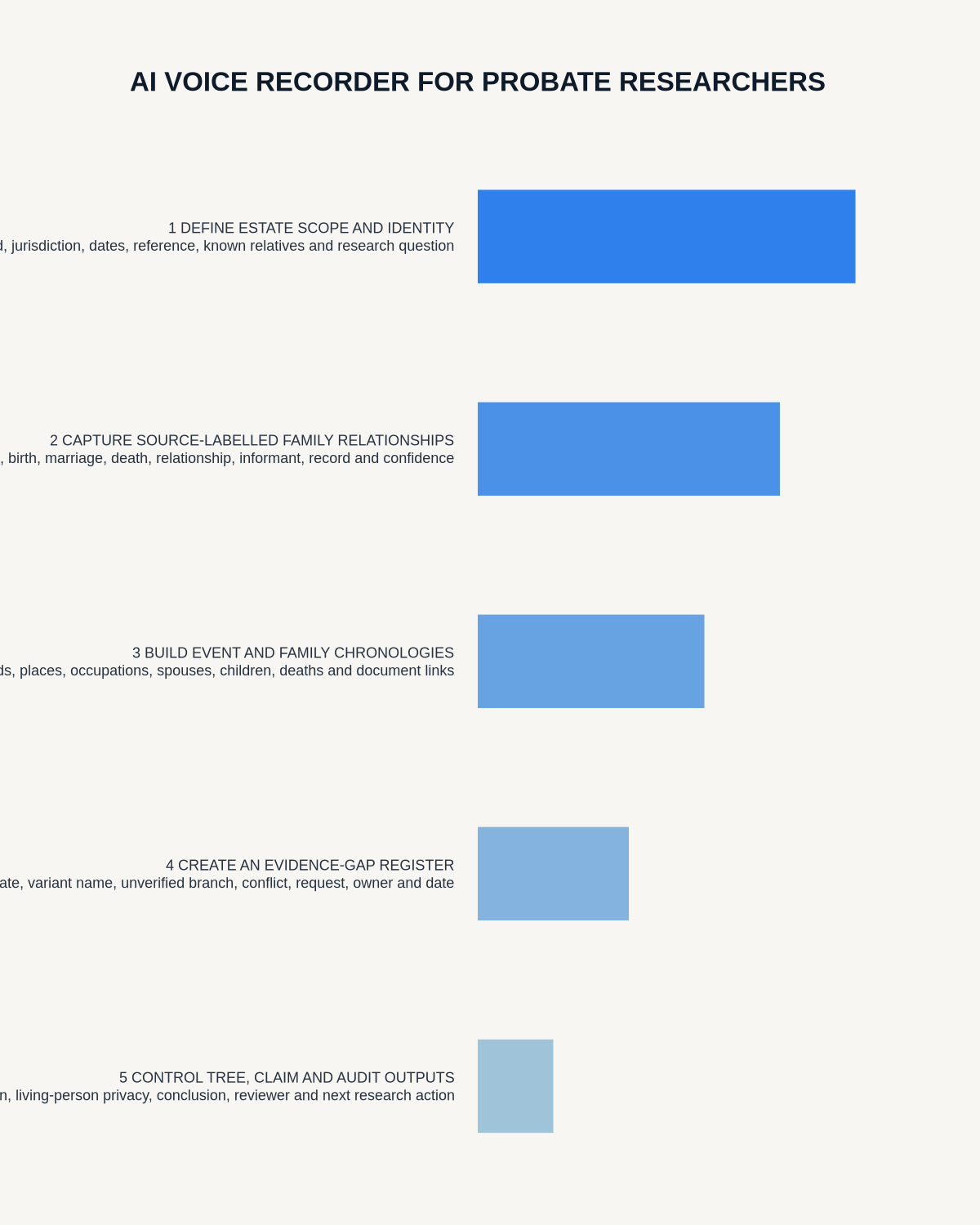
Visual map for AI Voice Recorder for Probate Researchers: Better Family Interviews and Evidence Chronologies
- Prepare the approved useDefine purpose, safe position, permission and the required formal record.
- Capture context firstState the case, asset, person, location or event identifier before detail.
- Human-verify evidenceCheck technical terms, units, names, dates, decisions and uncertainty.
- Complete the formal recordTransfer only verified information and apply access and retention controls.
On this page
Related guides
See whether Halo fits this workflow
Review the NERALVO Halo specifications, included services, delivery information and current offer only after completing the guide.
Found an error or an out-of-date claim? Email support@neralvo.com with the article address and a supporting source.