The 60-second verdict
Quick answer: librarians should use an AI voice recorder only for authorised, complex consultations where a checked transcript materially improves the research process. The strongest output is not a permanent verbatim record; it is a focused question, reproducible search log, sourced answer and proportionate follow-up note.
Best fit: Librarians who need recoverable audio and human-verified notes in an authorised workflow. Use another method when: recording is prohibited, a participant declines or the approved process requires manual notes.
Evidence basis and limits
- Decision factors covered: When recording is genuinely useful; Build a query map instead of one long summary; Preserve uncertainty rather than correcting it too early.
- Evidence rule: Claims are weighted by consequence: capture failure, changed meaning, access and recovery matter more than polished wording.
- Boundary: Examples and workflow recommendations must be tested with representative recordings, the intended users and the actual approval process before rollout.

Library conversations range from simple directions to research enquiries involving uncertain names, family history, health, housing, law or personal circumstances. Recording can preserve nuance, but it also collects more information than ordinary notes. The decision to record should therefore be deliberate, explained and limited to a defined purpose.
When recording is genuinely useful
- A planned research consultation involving several names, dates or source types.
- An authorised oral-history or community-memory project.
- A permitted event or talk requiring an accessible transcript.
- A private staff debrief after a difficult enquiry, preferably de-identified.
- A multi-session enquiry where another librarian may need to continue the work.
Routine reference-desk questions rarely need recording. Use ordinary notes where they achieve the same purpose with less intrusion.
Turn the patron’s story into a research question
People often explain the background before they can state what they need. Capture the desired outcome, subject, known names and dates, places, sources already tried, access constraints, acceptable alternatives and what would count as a useful answer.
Build a query map instead of one long summary
| Component | What to record |
|---|---|
| Core subject | Person, event, organisation, work or topic |
| Variants | Alternative spellings, initials, former names and pseudonyms |
| Time and place | Exact or approximate period and geographic scope |
| Likely sources | Books, newspapers, archives, databases, registers or audiovisual material |
| Constraints | Language, format, accessibility, time and remote-access needs |
Preserve uncertainty rather than correcting it too early
Use labels such as exact spelling confirmed, phonetic spelling, possible variant, approximate quotation, uncertain date range and source remembered but not identified. Automatic transcription can select one familiar word and hide the ambiguity that would have led to a better search.
Create a reproducible source log
For every catalogue, database or collection searched, record the query, filters, date range, result, relevance, access restriction, citation and next search route. An unsuccessful search is not proof that no source exists; document what was not searched and why.
Separate information support from professional advice
For legal, medical, financial or welfare enquiries, identify reliable information and suitable services without converting the conversation into personalised professional advice. Record the information requested, sources supplied, limitations explained, referral offered and follow-up agreed.
Protect patron privacy
- Do not record account credentials or unnecessary identifiers.
- Exclude unrelated third-party names and personal history.
- Use approved accounts and storage.
- Share a concise checked note rather than a raw transcript.
- Delete source audio when the approved purpose and retention period end.
Handle events and community recordings separately
Permission to speak at an event does not automatically authorise unrestricted publication. Define contributor permission, audience capture, copyright, accessibility, intended reuse, access restrictions and retention before recording.
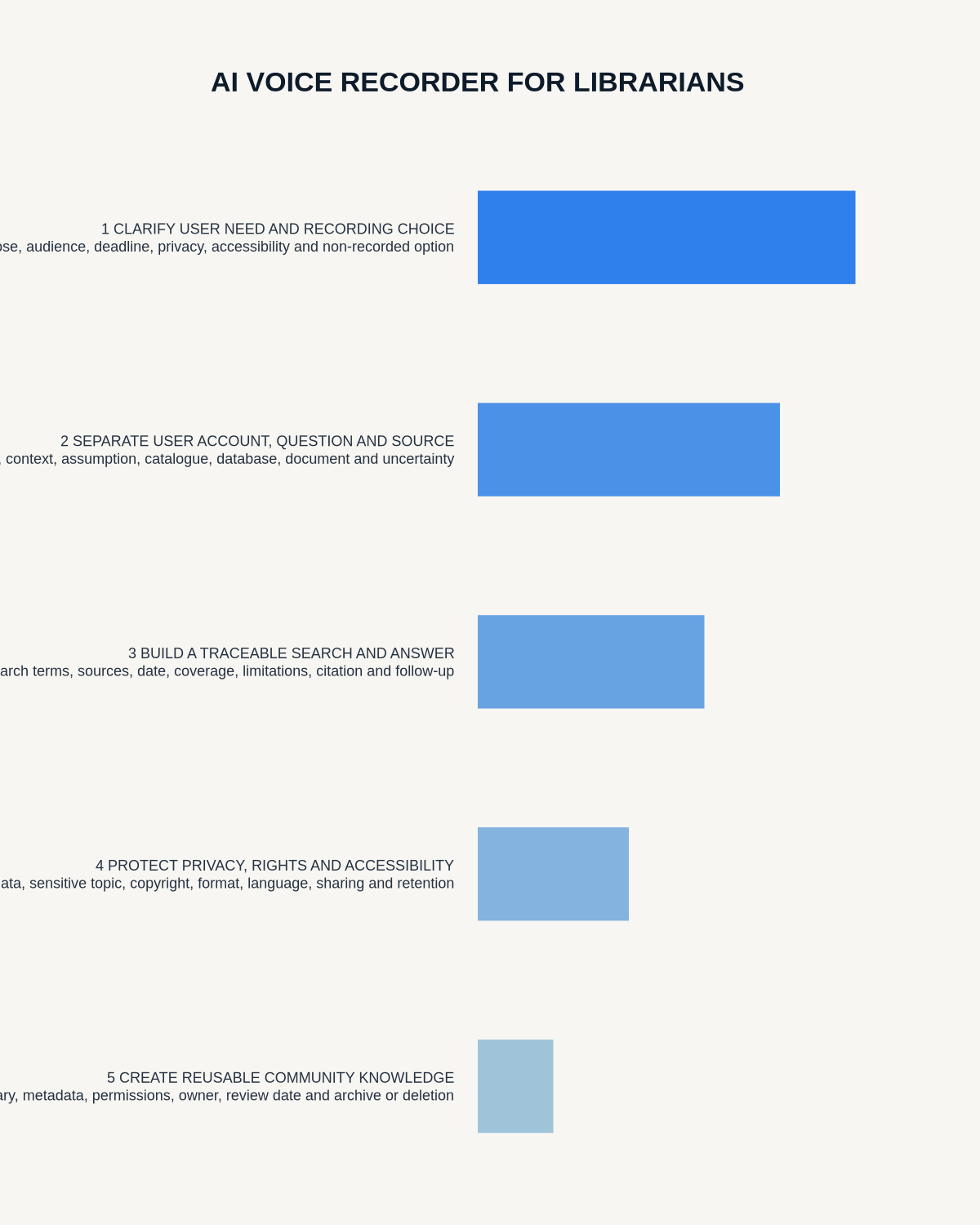
Use a complete consultation workflow
- Decide whether recording is necessary and permitted.
- Explain purpose, access and retention.
- Define the question and scope.
- Capture variants and uncertainty.
- Identify sources already checked.
- Generate and correct the transcript.
- Create the query map and source log.
- Remove unnecessary personal information.
- Send a concise answer with citations and limitations.
- Apply the library’s retention process.
Where NERALVO Halo fits
Check whether NERALVO Halo fits librarians work can support approved complex consultations, event capture and private staff debriefs with NOTE mode, 64GB local storage and structured DOWAY outputs. Libraries remain responsible for approving the device, processing route, access and deletion.
Cloud software, a dedicated recorder or manual notes?
For Librarians, the right answer changes with the setting. This matrix deliberately gives each method a situation where it can be the strongest choice.
| Situation | Best starting point | Reason |
|---|---|---|
| scheduled remote meetings | Cloud meeting software | Calendar automation and shared integrations are usually the strongest advantage. |
| in-person or mobile work | Dedicated recorder | Independent capture reduces reliance on an active phone or laptop. |
| recording is refused or prohibited | Manual notes or an approved alternative | The boundary takes priority over convenience. |
| mixed online and offline work | Governed hybrid | Use each method only in the setting it actually fits. |
Frequently asked questions
Should ordinary reference-desk conversations be recorded?
Usually not. Recording should be necessary and proportionate.
Can AI decide which source is authoritative?
No. A librarian must assess relevance, provenance, quality and limitations.
Can a recorded event be published automatically?
No. Contributor rights, audience capture and intended reuse require separate review.
Does no search result prove that no source exists?
No. Record the search scope and remaining gaps.
Can the full transcript be retained for convenience?
Only where justified. A concise service note and source log will often meet the purpose with less personal data.
Authoritative guidance and related reading
- CILIP professional resources
- ICO UK GDPR guidance
- AI Voice Recorder for Archivists
- AI Voice Recorder for Genealogists
Final quality checklist
- Actual information need is clear
- Uncertainty and variants remain visible
- Search strategy is reproducible
- Sources and limitations are documented
- Personal data is minimised
- Another librarian can continue the work
On this page
Related guides
See whether Halo fits this workflow
Review the NERALVO Halo specifications, included services, delivery information and current offer only after completing the guide.
Found an error or an out-of-date claim? Email support@neralvo.com with the article address and a supporting source.