The 60-second verdict
A domestic energy assessment is a data-collection exercise with a strict evidence problem. The assessor moves through a property identifying construction, dimensions, heating, controls, glazing, insulation and renewable systems. Some inputs are directly visible, some are supported by documents, some are permitted defaults and some remain unknown.
Best fit: Domestic Energy Assessors who need recoverable audio and human-verified notes in an authorised workflow. Use another method when: recording is prohibited, a participant declines or the approved process requires manual notes.
Evidence basis and limits
- Decision factors covered: Every survey input needs an evidence status; Use a fixed property route; Create an element record, not a descriptive paragraph.
- Evidence rule: Claims are weighted by consequence: capture failure, changed meaning, access and recovery matter more than polished wording.
- Boundary: Examples and workflow recommendations must be tested with representative recordings, the intended users and the actual approval process before rollout.
An AI voice recorder for domestic energy assessors can reduce repetitive typing during the visit, but its main purpose should be preserving provenance: where each input came from and how confidently it can be used. A transcript must never turn an assumption into an observation or invent a missing value.
Every survey input needs an evidence status
Use one of four labels as you dictate:
| Status | Meaning | Example |
|---|---|---|
| Observed | Directly visible or measured during the survey | Double-glazed unit and frame type visible |
| Documented | Supported by acceptable evidence reviewed by the assessor | Installation certificate or approved specification |
| Methodology default | A prescribed default used because better evidence is unavailable | Age-band or construction assumption applied under the method |
| Unknown / to verify | Not visible and not adequately evidenced | Insulation behind inaccessible finish |
This simple discipline prevents a fluent AI summary from upgrading “owner says loft was insulated” into “loft insulation verified”.
Use a fixed property route
A consistent survey route makes the transcript easier to map into the assessment software and reduces missed elements. One workable order is:
- external elevations and property form
- dimensions and exposed perimeter
- roof and loft
- ground and intermediate floors
- walls and extensions
- windows, doors and glazing
- main heating system
- secondary heating
- hot water
- controls
- lighting
- renewable or low-carbon technologies
- ventilation and relevant fixed systems
- documents and evidence supplied
Announce the new zone before dictating. “Rear extension, kitchen, south wall” is more useful than a long recording that requires the reviewer to infer where the observation belongs.
Create an element record, not a descriptive paragraph
For each significant element, capture:
- element type
- location or extent
- age or construction band where relevant
- observation
- measurement or document reference
- evidence status
- photograph reference
- uncertainty or access limitation
- software field or follow-up action
“Rear single-storey extension, flat roof. Construction date reported as 2018; completion document not reviewed. Internal ceiling prevents insulation observation. Photograph 19. Evidence status: reported only; verify documentation or apply permitted methodology input.”
Measurements must live in a controlled second record
Speech recognition can confuse decimal points, units and similar values. Repeat dimensions clearly, but record them simultaneously in the approved survey sheet, laser-measurement workflow or assessment tool.
“Front width five point eight four metres, measurement logged separately as dimension F1.”
The transcript supplies the location and context. The verified measurement record supplies the number used in the assessment.
Do not let AI infer hidden construction
Properties contain concealed and altered elements. A recorder or transcription system cannot determine cavity insulation, roof build-up, floor construction or system efficiency from a spoken description alone.
When the evidence is incomplete:
- state what is visible
- state what the occupier or owner reports
- record documents offered
- identify what is not visible
- apply the approved methodology rather than an AI guess
Do not use phrases such as “probably insulated” in the final input unless the methodology explicitly supports the way that judgement is made.
Heating systems need model-level accuracy
Boiler, heat-pump, cylinder and control information may depend on exact manufacturer and model details. Transcription can easily alter letters and digits.
Use photographs and source labels. Record:
- system type
- manufacturer and model as photographed
- fuel
- location
- control types
- distribution system
- hot-water arrangement
- document or database check required
The transcript should create a verification task, not select performance data automatically.
Evidence packs should be designed during the visit
Do not wait until the office to discover that a photograph cannot be matched to an input. Read photograph references into the voice note and use an evidence checklist:
- front, rear and relevant side elevations
- extensions and different construction types
- roof or loft evidence
- heating and controls
- hot-water system
- glazing and doors
- renewable systems
- document identifiers
- measurements and sketches
- limitations and inaccessible areas
The owner’s explanation is useful—but it has a label
Occupiers may know when work was done, where insulation was installed or how the heating operates. Capture the information with attribution and ask whether supporting evidence exists.
“Owner reports cavity insulation installed before purchase; no certificate available during survey.”
That statement may guide a document request. It does not necessarily establish the assessment input.
A survey-to-software workflow
- Confirm that recording is appropriate in the home and explain the purpose.
- Use a property reference rather than unnecessary personal information.
- Follow the same survey route on every property.
- Apply evidence-status labels while dictating.
- Record dimensions and identifiers in approved parallel systems.
- Reference photographs and documents aloud.
- Generate the transcript after leaving the property.
- Extract an element-and-evidence checklist.
- Verify all values before entering the assessment software.
- Review warnings, defaults and recommendations through the normal quality process.
Privacy inside occupied homes
A home visit can expose family conversation, correspondence, screens, medical equipment and other information unrelated to the assessment. Record only what the survey requires. Pause or use a post-visit debrief where direct recording would capture unnecessary personal information.
The audio should not become a permanent archive of the visit once the approved survey record and evidence pack are complete, unless a defined policy requires retention.
How NERALVO Halo may support a survey route
Check whether NERALVO Halo fits domestic energy assessors work offers portable NOTE recording, 64GB local storage and DOWAY transcription and structured notes. It may help an assessor dictate location-led observations while keeping measurements, photographs and software entries in their established tools.
Test model numbers, dimensions, property terminology and room transitions before use. A trial survey should confirm that the output saves review time rather than creating another record that must be reconciled.
Data-integrity check before lodgement
- Does every important input have an evidence status?
- Are measurements verified from the controlled record?
- Are photographs linked to the correct elements?
- Are owner statements attributed?
- Are concealed and inaccessible features treated correctly?
- Are heating-system identifiers checked?
- Has AI avoided filling any evidence gap?
- Does the final assessment follow the approved methodology?
An AI voice recorder can make domestic energy surveys easier to document. Its strongest contribution is not prediction; it is preserving the origin, location and uncertainty of the data the assessor must verify.
Cloud software, a dedicated recorder or manual notes?
For Domestic Energy Assessors, the right answer changes with the setting. This matrix deliberately gives each method a situation where it can be the strongest choice.
| Situation | Best starting point | Reason |
|---|---|---|
| scheduled remote meetings | Cloud meeting software | Calendar automation and shared integrations are usually the strongest advantage. |
| in-person or mobile work | Dedicated recorder | Independent capture reduces reliance on an active phone or laptop. |
| recording is refused or prohibited | Manual notes or an approved alternative | The boundary takes priority over convenience. |
| mixed online and offline work | Governed hybrid | Use each method only in the setting it actually fits. |
Related guides
Profession workflow
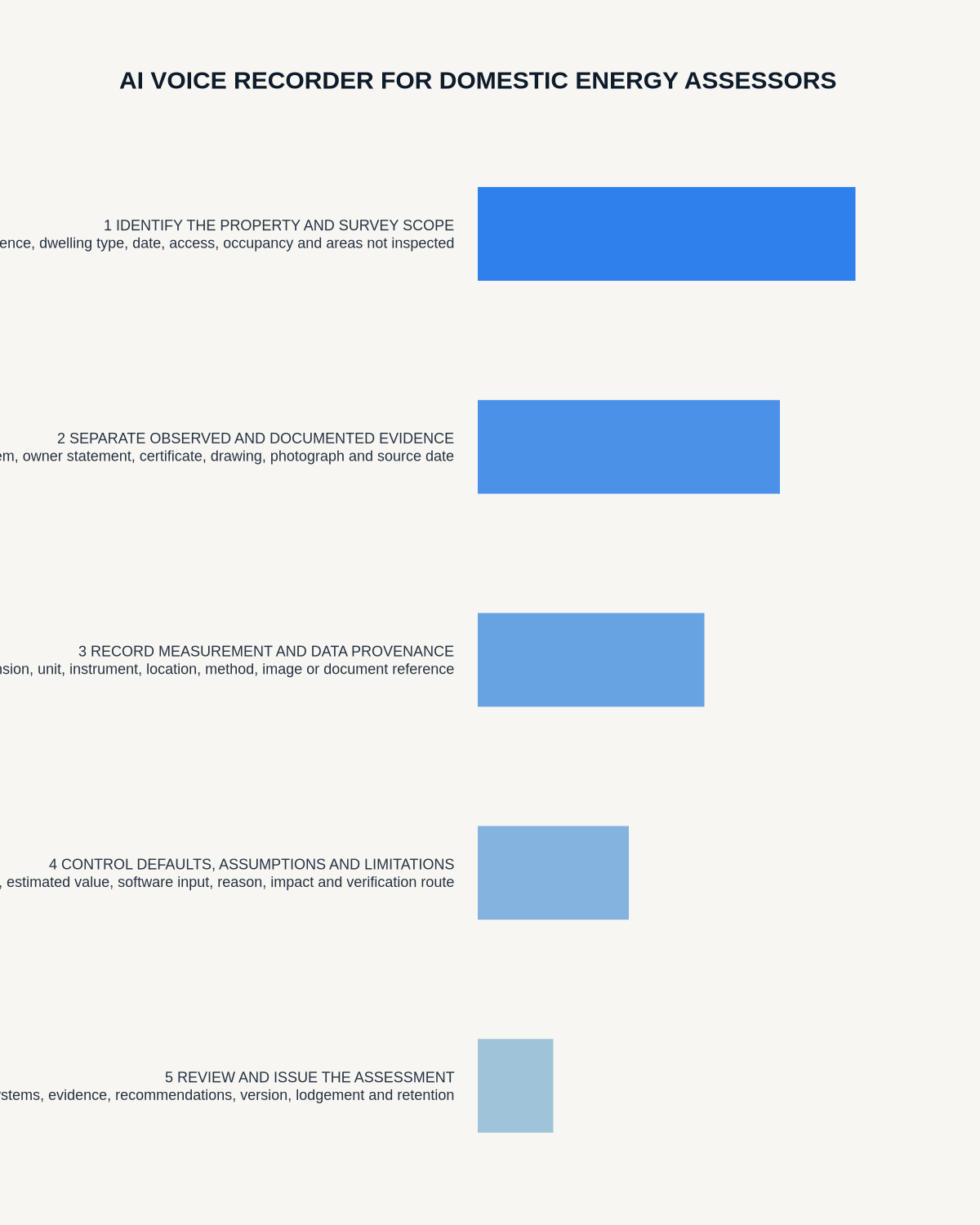
Visual map for AI Voice Recorder for Domestic Energy Assessors: Better Survey Evidence and Data Provenance
- Prepare the approved useDefine purpose, safe position, permission and the required formal record.
- Capture context firstState the case, asset, person, location or event identifier before detail.
- Human-verify evidenceCheck technical terms, units, names, dates, decisions and uncertainty.
- Complete the formal recordTransfer only verified information and apply access and retention controls.
On this page
More in this topic: Property, inspections and investigations
Show 7 closely related guides
- AI Voice Recorder for Fire Investigators: Stronger Scene Notes, Interviews and Evidence
- AI Voice Recorder for Building Control Inspectors: Better Site Evidence and Clearer Decisions
- AI Voice Recorder for Property Developers: Better Decision Logs and Project Handover
- AI Voice Recorder for Auctioneers: Better Lot Notes, Provenance and Seller Instructions
- AI Voice Recorder for Private Investigators: Better Interviews, Chronologies and Evidence Control
- AI Voice Recorder for Fire Risk Assessors: Better Evidence, Actions and Review
- AI Voice Recorder for Loss Adjusters: Better Site Evidence and Damage Notes
Related guides
See whether Halo fits this workflow
Review the NERALVO Halo specifications, included services, delivery information and current offer only after completing the guide.
Found an error or an out-of-date claim? Email support@neralvo.com with the article address and a supporting source.