The 60-second verdict
Quick answer: emergency planners can use an authorised AI voice recorder for exercise control, observer notes and debriefs, but the record must preserve what each participant knew at the time. Controller-only information, later hindsight and participant assumptions must remain separate.
Best fit: Emergency Planners who need recoverable audio and human-verified notes in an authorised workflow. Use another method when: recording is prohibited, a participant declines or the approved process requires manual notes.
Evidence basis and limits
- Decision factors covered: Build the record on exercise time; Use four information-status labels; Separate observation from interpretation.
- Evidence rule: Claims are weighted by consequence: capture failure, changed meaning, access and recovery matter more than polished wording.
- Boundary: Examples and workflow recommendations must be tested with representative recordings, the intended users and the actual approval process before rollout.

Exercises generate several simultaneous versions of events: controllers know the full scenario, participants know only released information, observers see selected activity and debrief participants interpret the result with hindsight. A trustworthy review keeps those perspectives traceable.
Build the record on exercise time
For each material event, capture the inject or event reference, time issued or observed, recipient, information available, decision or action, reason, dependency and outcome. Link it to control logs, communications and system records.
Use four information-status labels
| Status | Meaning |
|---|---|
| Simulated | Scenario information created for the exercise |
| Confirmed in exercise | Information available to participants at that time |
| Assumed by participant | A working belief not yet confirmed |
| Known to control only | Scenario detail not yet released |
Separate observation from interpretation
Record what happened before explaining why. “The request had no named owner for thirteen minutes” is an observation. “Responsibilities were unclear” is an interpretation that needs evidence and participant explanation.
Debrief by capability rather than speaking order
- Command and control.
- Situational awareness.
- Communications and warning.
- Resource coordination.
- Evacuation, shelter and vulnerable people.
- Business continuity and recovery.
- Multi-agency working.
Within each capability, record what worked, what did not, evidence, consequence and proposed improvement.
Judge decisions using information available then
Ask what was known, what remained uncertain, which procedure or experience was used, what constraint applied, which option was rejected and when the decision should have been reviewed. This produces learning rather than blame.
Preserve inter-agency disagreement
Record each organisation’s position, procedure or evidence cited, operational effect, owner for resolution and plan requiring change. Do not let an AI summary create false consensus.
Create testable improvement actions
| Field | Requirement |
|---|---|
| Problem | Specific issue supported by evidence |
| Change | Defined corrective action |
| Owner and date | Single accountable owner and deadline |
| Closure evidence | Proof that the change was implemented |
| Effectiveness test | Future exercise, audit or review |
Agree multi-agency recording controls in advance
Define the controller of the recording, participant notification, classification, access, processing route, redaction, distribution, retention, deletion and which document becomes the official record. Some sessions should use controlled written notes instead.
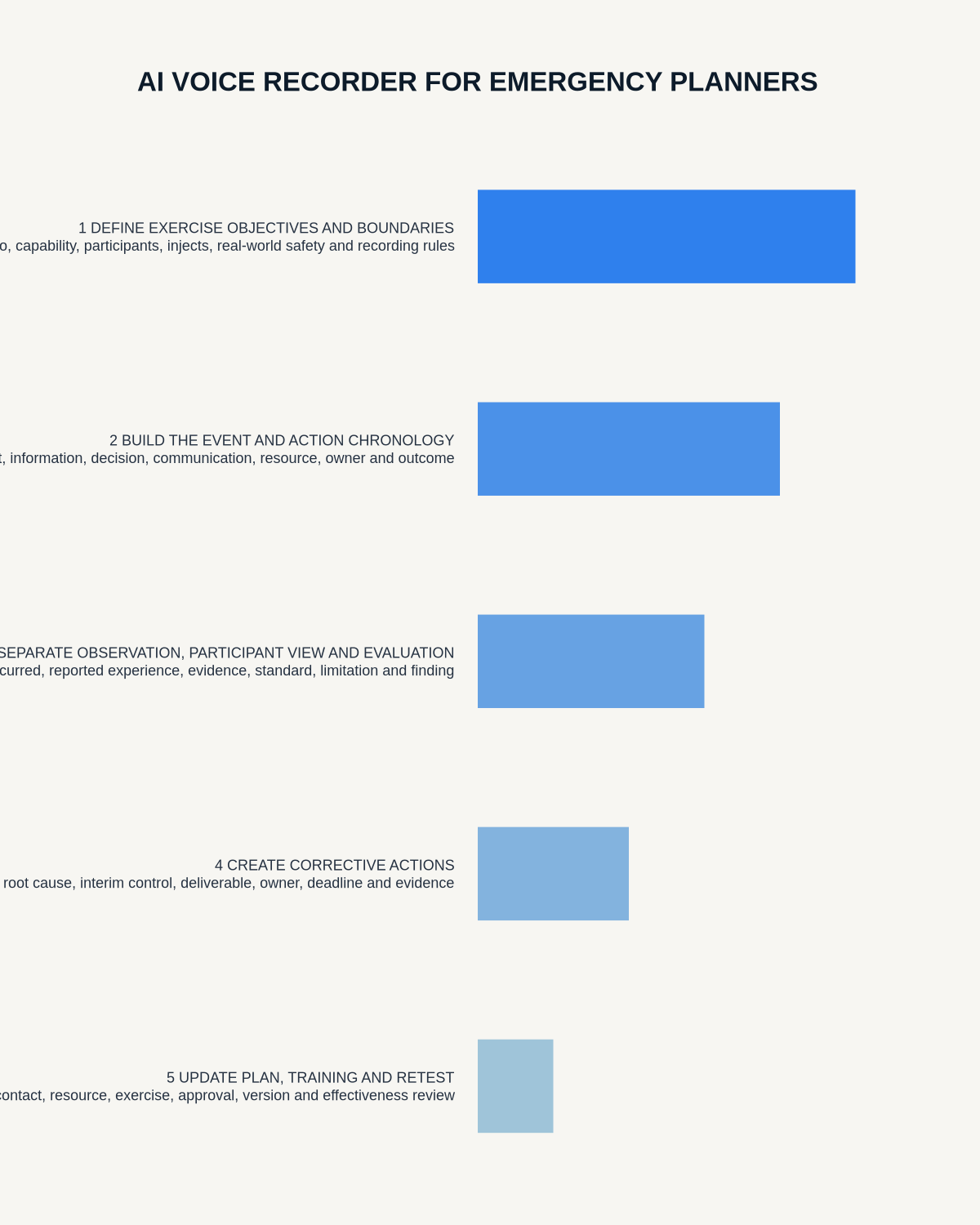
Use a complete exercise-to-improvement workflow
- Define recording in the exercise plan.
- Use event, inject and capability references.
- Keep controller-only information separate.
- Record timestamped observations.
- Run a hot debrief.
- Generate and correct transcripts.
- Build a verified chronology from multiple sources.
- Group findings by capability.
- Assign actions with closure evidence and test dates.
- Approve and distribute the final report securely.
Real incidents require stricter boundaries
Operational command, safety and required logs take priority. Do not introduce recording spontaneously if it distracts responders or creates an uncontrolled sensitive record. Compare post-incident recollection with logs, messages and system data.
Where NERALVO Halo fits
Check whether NERALVO Halo fits emergency planners work can support approved controller notes, observer debriefs and lessons sessions with NOTE mode, 64GB local storage and DOWAY structured outputs. Classification and file transfer must be approved before use.
Cloud software, a dedicated recorder or manual notes?
For Emergency Planners, the right answer changes with the setting. This matrix deliberately gives each method a situation where it can be the strongest choice.
| Situation | Best starting point | Reason |
|---|---|---|
| scheduled remote meetings | Cloud meeting software | Calendar automation and shared integrations are usually the strongest advantage. |
| in-person or mobile work | Dedicated recorder | Independent capture reduces reliance on an active phone or laptop. |
| recording is refused or prohibited | Manual notes or an approved alternative | The boundary takes priority over convenience. |
| mixed online and offline work | Governed hybrid | Use each method only in the setting it actually fits. |
Frequently asked questions
Can AI write the final lessons report?
It can draft structure, but findings and actions require human verification.
Should controller-only information affect participant findings?
Not as information participants were expected to know.
What closes an improvement action?
Evidence that the change works, ideally through a future test.
Should every exercise room be recorded?
No. Recording should match purpose, classification and participant arrangements.
Can a hot debrief replace the formal review?
No. It provides immediate observations that need verification and consolidation.
Authoritative guidance and related reading
- UK Emergency Preparedness guidance
- Emergency Response and Recovery guidance
- AI Voice Recorder for Risk Managers
Final learning-record checklist
- Every event tied to the correct time
- Information status clearly labelled
- Observation separated from interpretation
- Agency disagreement preserved
- Decisions judged using available information
- Actions have closure evidence and future tests
Related AI voice recorder guides
On this page
More in this topic: Finance, audit and risk roles
Show 4 closely related guides
- AI Voice Recorder for Payroll Managers: Better Change Logs and Approval Control
- AI Voice Recorder for Auditors: Better Walkthroughs and Evidence Trails
- AI Voice Recorder for Underwriters: Better Risk Interviews and Assumption Registers
- AI Voice Recorder for Tax Advisers: Better Fact Patterns and Advice Notes
Related guides
See whether Halo fits this workflow
Review the NERALVO Halo specifications, included services, delivery information and current offer only after completing the guide.
Found an error or an out-of-date claim? Email support@neralvo.com with the article address and a supporting source.