The 60-second verdict
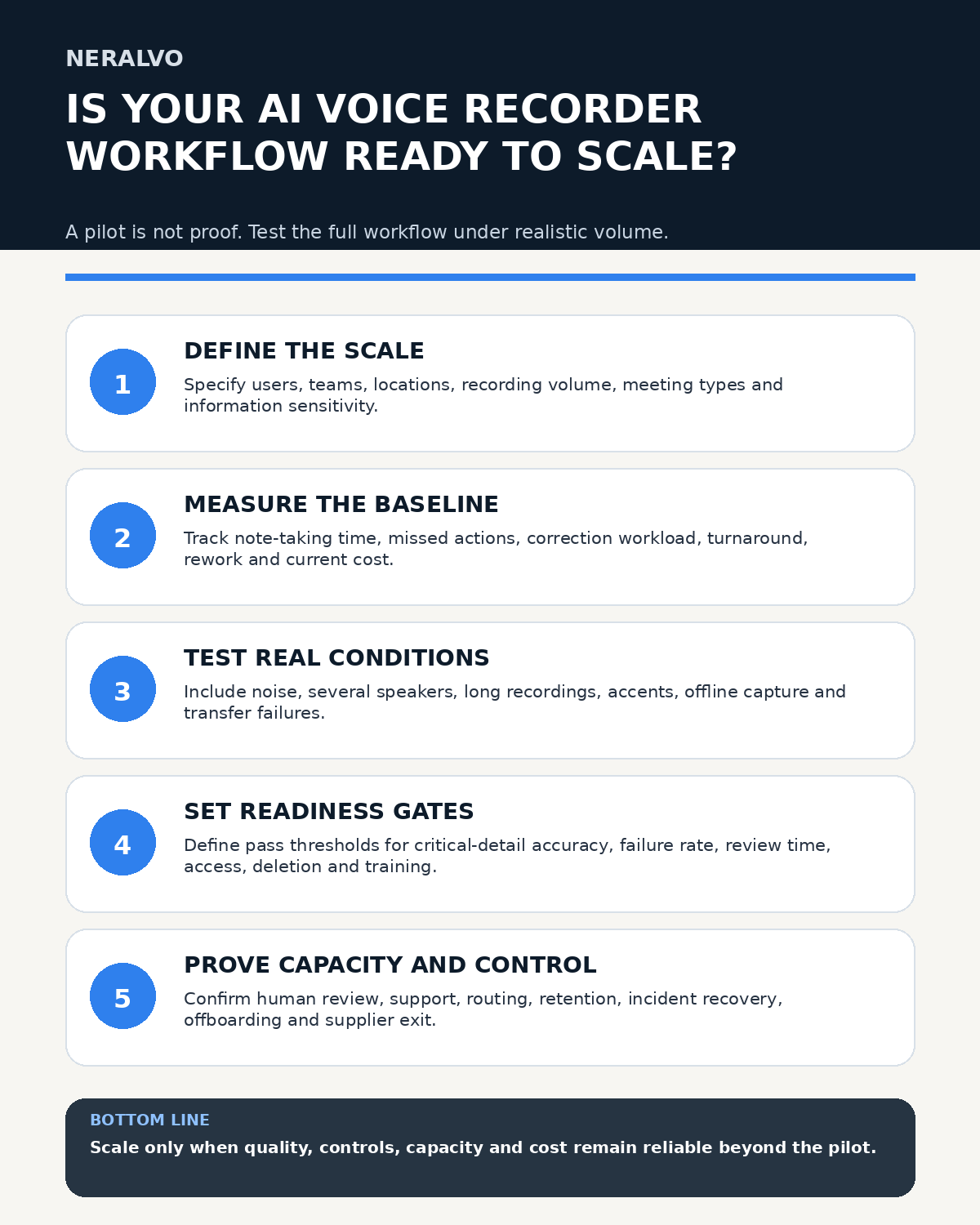
Quick answer: an AI voice-recording workflow is ready to scale only when representative pilot evidence proves that capture, transcription, human review, routing, access, retention, deletion, support and recovery remain reliable at the proposed volume. Scale in controlled stages with predefined quality, risk, backlog and cost gates.
Decision focus: use the method below only where it produces a recoverable source, a verifiable output and a clear next action. If one of those fails, change the workflow rather than trusting a polished summary.
Evidence basis and limits
- Decision factors covered: Define what “scale” means; Measure the current baseline; Confirm the pilot was representative.
- Evidence rule: A claim earns weight only when the source, date, configuration and limitation are clear enough for a reader to check.
- Boundary: Examples and workflow recommendations must be tested with representative recordings, the intended users and the actual approval process before rollout.
A successful demonstration is not a scale decision. Expansion introduces more users, devices, recordings, sensitive information, support demand and unmanaged copies. The organisation must prove that the complete process remains accurate, safe, supportable and economically worthwhile.
Define what “scale” means
State the proposed increase in users, teams, locations, recording hours, meeting types, information sensitivity and integrations. Scaling five trained users to fifty routine users is different from adding regulated work, customer calls or several countries.
Define the intended outcome, such as reducing drafting time, improving action capture or creating searchable field notes. Avoid goals such as “use more AI.”
Measure the current baseline
Before judging the pilot, measure the process it is meant to replace:
- manual note-taking or transcription time;
- missed and late actions;
- correction and quality-assurance workload;
- turnaround time;
- complaints, errors and rework;
- current software, supplier and labour cost;
- participant and staff experience.
Compare outputs at the same quality level. An unchecked AI draft should not be compared with a fully approved human record.
Confirm the pilot was representative
The pilot should include the environments expected after rollout:
- quiet and noisy rooms;
- single and multiple speakers;
- short and long recordings;
- in-person, remote and hybrid meetings;
- real accents, languages and specialist vocabulary;
- supported devices, operating systems and application versions;
- offline capture, failed transfer and recovery;
- participant objections and non-recorded alternatives;
- users with different levels of experience.
Report sample size, audio minutes, exclusions, failures and condition-level results. Easy internal meetings cannot justify expansion into more difficult or sensitive uses.
Set readiness thresholds before the decision
Define acceptable limits for:
- critical-detail accuracy;
- omitted actions and unsupported additions;
- capture and processing failures;
- correction and quality-assurance time;
- participant objections and complaints;
- security or privacy incidents;
- training completion and knowledge checks;
- processing backlog and average age;
- failed or overdue deletion;
- support response and defect resolution;
- total recurring cost.
Serious failures may be automatic stop conditions even when average performance appears strong.
Test the complete operating workflow
- Authorised capture and participant explanation
- Secure transfer to the correct account
- Transcript and structured-output generation
- Human correction of critical details
- Approval of formal records
- Routing actions and decisions into business systems
- Access, retention and deletion
- Incident detection and recovery
- Offboarding, export and supplier exit
If important work remains trapped inside the recording application, the process is not operationally complete.
Assess participant and privacy controls
Confirm that larger numbers of staff can explain purpose, AI processing, access, sharing, retention and alternatives consistently. Test refusal, partial recording, late arrivals, hybrid attendance and accessibility needs.
Expansion should not rely on people feeling unable to object. Alternatives must be practical rather than theoretical.
Assess security and administration
Check organisation-managed accounts, administrator roles, strong authentication, leaver removal, device registers, lost-device response, access reviews and incident escalation. Estimate the effort required to identify personal accounts, duplicate exports and orphan files.
Controls maintained informally for a small pilot may fail at wider scale.
Assess retention and deletion capacity
Follow sample files across recorder, phone, app, workspace, downloads, email, shared drives and connected systems. Test deletion evidence and approved exceptions. Available storage must not determine retention.
Assess human-review capacity
Calculate the time needed to check names, dates, amounts, technical terms, negations, decisions, owners and deadlines. Include quality assurance, approval and rework.
Increasing capture faster than review capacity creates a backlog of fluent but unreliable records. Define which outputs need full review, risk-based review or are unsuitable for professional reliance.
Assess workflow integration
Identify where verified decisions, actions, customer notes, inspection evidence and reference material will live. Test exports and integrations at the expected volume. Assign ownership for failed routing and duplicates.
The recording application should not become a parallel task manager or permanent document repository.
Assess training and support
Provide role-specific training for users, managers, administrators, reviewers and support staff. Include practical scenarios for refusal, wrong-account transfer, transcript error, accidental recording, deletion and device loss.
Estimate onboarding, refresher and help-desk demand. A process that depends on one knowledgeable person is not ready for broad rollout.
Calculate the total cost of ownership
Include:
- devices, accessories and replacements;
- software or processing allowances;
- setup, administration and integrations;
- training and refresher time;
- active correction and quality assurance;
- support and incident handling;
- storage, retention and deletion administration;
- supplier management and exit planning;
- failure and rework contingency.
Separate one-off rollout costs from recurring cost. Gross time saved is not net value after correction, approval and routing.
Assess benefits conservatively
Use measured pilot results rather than general productivity claims. Record whether saved time becomes useful work. Include supported non-financial benefits, such as traceability or accessibility, and negative effects such as backlog, participant discomfort or extra administration.
Review supplier and technology resilience
Document hardware, firmware, phone, operating-system, app and processing versions. Review compatibility, exports, support, service outages, supplier changes and the ability to retrieve data if the service changes.
Essential work needs an approved fallback. Do not scale a process that stops entirely when one device, application or account is unavailable.
Identify scale blockers
- Repeated high-risk transcript or summary errors
- Unresolved participant or privacy complaints
- Inability to prove deletion
- Personal accounts or uncontrolled exports
- Growing processing backlog
- No tested incident response
- Unsupported devices or call configurations
- Insufficient review or support capacity
- Unclear supplier exit
- Benefits that disappear after full cost
Every blocker needs an owner, containment action, evidence requirement and retest date.
Choose a formal readiness decision
- Ready to scale: thresholds are met, controls are repeatable and capacity is funded.
- Ready for staged scale: expansion is limited by team, use case or volume while evidence continues.
- Conditional hold: rollout waits for specified remediation or evidence.
- Not ready: quality, risk, value or capacity does not support expansion.
- Retire or redesign: the process should stop or change materially.
Record the evidence, residual risk, approver and effective date.
Use staged rollout gates
Define each wave by users, teams, meeting types and volume. Set entry criteria, monitoring frequency, exit criteria and automatic stop conditions. Do not begin the next wave until quality, support, backlog, security and deletion metrics remain within tolerance for the agreed period.
Monitor after rollout
Run an early-life review and then move into regular governance. Continue measuring the same thresholds used for approval. Trigger immediate review after a serious incident, material supplier or model change, repeated critical errors, uncontrolled use or significant compatibility change.
Workflow choice matrix for Is Your AI Voice Recorder Workflow Ready to Scale
Choose the method that protects the source and reduces downstream correction. The table makes the non-hardware options explicit.
| Condition | Preferred route | Why |
|---|---|---|
| High-risk or mixed work | Governed hybrid | Separate capture, review, approval and retention rather than trusting one tool. |
| Recording is refused, prohibited or unnecessary | Manual notes / no recording | Respecting the boundary is the correct workflow, not a product failure. |
| In-person, mobile or unreliable-connectivity work | Dedicated recorder | Independent capture and a recoverable local source are usually more resilient. |
| Repeatable remote work with approved integrations | Cloud software | Automation and central collaboration may outweigh device independence. |
Frequently asked questions
How large should a pilot be?
Large enough to represent the users, environments, information and failure conditions expected after rollout. Representativeness matters more than a universal participant number.
What is the biggest scaling risk?
Increasing recording volume faster than review, support, action routing and deletion capacity.
Should rollout happen all at once?
Usually not. Staged expansion makes defects easier to detect and contain.
What proves that a corrective action worked?
Evidence that the relevant failure rate, behaviour or risk improved—not merely that a policy changed or training was delivered.
Useful resources
- NIST AI Risk Management Framework
- ICO AI and data-protection guidance
- Apply this guide before assessing NERALVO Halo
Scale-readiness checklist
- Scale and business outcome defined
- Baseline and representative pilot completed
- Quality and risk thresholds met
- Participant controls tested
- Administration, security and deletion capacity funded
- Human-review and support capacity confirmed
- Integrations and fallback tested
- Total cost supports the benefit
- Formal staged decision approved
- Post-rollout monitoring scheduled
Related AI voice recorder guides
Workflow map
Visual map for Is Your AI Voice Recorder Workflow Ready to Scale?
- Define the decisionState the question, required output and acceptance rule.
- Capture the sourceUse the approved route and preserve context, identity and limitations.
- Verify material detailsReplay or check names, numbers, negatives, decisions and actions.
- Move into the real recordAssign an owner, retain evidence and apply the deletion rule.
On this page
Related guides
See whether Halo fits this workflow
Review the NERALVO Halo specifications, included services, delivery information and current offer only after completing the guide.
Found an error or an out-of-date claim? Email support@neralvo.com with the article address and a supporting source.