The 60-second verdict
Research interviews create more than audio. They create participant data, an account of consent, a transcript, analytical decisions and eventually research claims. The recording device should fit that approved chain rather than define it.
Decision focus: use the method below only where it produces a recoverable source, a verifiable output and a clear next action. If one of those fails, change the workflow rather than trusting a polished summary.
Evidence basis and limits
- Decision factors covered: The purpose → permission → capture → verify → analyse workflow; Stage 1: Define why audio is necessary; Stage 2: Approve the complete data route.
- Evidence rule: The decision is based on the complete capture-to-action workflow, not a single feature or marketing accuracy percentage.
- Boundary: Examples and workflow recommendations must be tested with representative recordings, the intended users and the actual approval process before rollout.
An AI voice recorder for research interviews can reduce first-pass transcription work and make long interviews easier to navigate. It cannot decide whether collection is ethical, whether consent is valid or whether an automated summary represents the participant fairly.
The purpose → permission → capture → verify → analyse workflow
| Stage | Research question | Required output |
|---|---|---|
| Purpose | Why is audio necessary and what will it support? | Defined research use |
| Permission | Which ethics, consent and organisational conditions apply? | Approved data route |
| Capture | How will the interview preserve meaning without unnecessary data? | Secure source audio |
| Verify | How will speakers, wording and context be checked? | Traceable transcript |
| Analyse | How will interpretations remain connected to evidence? | Defensible research findings |
This workflow makes the recorder one controlled component of the research method.
Stage 1: Define why audio is necessary
State what recording adds that contemporaneous notes cannot provide. Possible reasons include:
- Preserving the participant’s exact wording.
- Supporting discourse, narrative or interaction analysis.
- Allowing the interviewer to listen more fully.
- Creating a checked transcript for coding.
- Documenting oral consent where the approved design requires it.
Do not collect a richer dataset merely because storage is available. The planned use should determine what is recorded, retained and shared.
Stage 2: Approve the complete data route
The ethics application and data-management plan should cover the hardware, connected app, transcription process, storage, transfer, access and deletion—not just the interview questions.
UKRI ethics-review guidance expects researchers to address informed consent, risks, disclosures of concern, data security, transfers, confidentiality and data management. See the current UKRI ethics-review guidance.
Confirm:
- Which device and account are approved.
- Where audio and transcripts are processed.
- Whether sub-processors or international transfers are involved.
- Who can access identifiable data.
- How incidents and safeguarding disclosures are handled.
- Whether changing the tool requires an amendment.
Classify the likely interview data
| Data characteristic | Possible control |
|---|---|
| Ordinary personal information | Lawful basis, transparency and restricted access |
| Special-category information | Additional condition and stronger safeguards |
| Criminal-offence information | Appropriate authority or condition |
| Confidential organisational material | Contract and disclosure controls |
| Safeguarding or serious-risk disclosure | Predefined escalation route |
| Third-party information | Minimisation and careful redaction |
The ICO’s current lawful-basis guidance says organisations should determine and document the basis before processing begins and provide appropriate privacy information. See the ICO guide to lawful basis.
Make participant information specific
The participant should understand:
- Why the interview is recorded.
- How transcription or automated processing works.
- Who receives the audio, transcript and extracts.
- Whether quotations may be used.
- How identity will be protected.
- How long each version is kept.
- How withdrawal works and where its limits begin.
- What confidentiality cannot cover.
UKRI notes that written consent is not always necessary or safest, and some approved studies may document verbal consent. The method must match the ethics decision. See UKRI’s consent guidance.
Preserve the version of consent
Keep a traceable record of what the participant was told, when agreement was obtained and which information sheet or consent wording applied. Do not rely on a generic note that “consent was given.”
Stage 3: Prepare the interview environment
- Use the study identifier rather than unnecessary names in filenames.
- Check battery, storage and approved account access.
- Test placement and room acoustics.
- Reduce background speech and interruptions.
- Prepare a non-recording fallback.
- Know how to pause or stop for distress or excluded material.
- Confirm the participant is ready before substantive questions begin.
Technical preparation reduces missing data, but it does not replace interviewer skill.
Interview actively
Recording should increase attention, not encourage passive questioning. The researcher still needs to notice:
- Uncertainty and qualification.
- Contradiction.
- Emotion and distress.
- Potential follow-up questions.
- Statements based on direct experience versus hearsay.
- Information that falls outside the approved scope.
Do not allow the existence of a transcript to weaken listening or field notes.
Secure the source immediately
After the interview:
- Confirm the file is complete.
- Transfer or sync it through the approved route.
- Record the interview code, date and transfer status.
- Restrict access.
- Remove temporary copies only when the approved process allows it.
- Document any deviation or failure.
Avoid ordinary email, consumer messaging and personal cloud storage unless those routes are explicitly approved.
Stage 4: Verify the transcript
Automatic transcription quality varies with accents, overlapping speech, emotion, room noise and specialist terminology. A fluent transcript can still alter meaning.
Check:
- Speaker labels.
- Names and technical terms.
- Negation and qualification.
- Numbers and dates.
- Quotations selected for publication.
- Inaudible or uncertain passages.
- Pauses or non-verbal features where methodologically relevant.
Use transparent conventions such as “[inaudible]” or “[uncertain]” instead of guessing.
Keep participant language separate from researcher interpretation
The checked transcript should distinguish:
- Participant words.
- Interviewer prompts.
- Field observations.
- Transcript corrections.
- Analytical memos.
- Later interpretations.
An AI summary often blends these layers. Do not quote from a summary or treat it as source data.
Anonymisation is a risk assessment
Replacing a name with a code is usually pseudonymisation. A participant may still be identifiable through voice, role, location, rare experience or combined context.
Follow the approved approach to:
- Store the identity key separately.
- Redact direct and indirect identifiers.
- Review distinctive quotations.
- Control access to audio.
- Decide which version may be shared or archived.
Stage 5: Analyse through a visible method
Whether the study uses thematic analysis, framework analysis, grounded theory, discourse analysis or another approach, preserve the chain from source to claim.
- Document coding or interpretive decisions.
- Keep extracts linked to the checked transcript and audio where required.
- Retain contradictory and negative cases.
- Record changes to themes or categories.
- Separate participant meaning from researcher inference.
- Describe any permitted AI assistance honestly.
Automated themes can be prompts for human review; they are not findings until tested through the approved method.
Plan withdrawal and deletion before collection
State how withdrawal operates before and after transcription, anonymisation, analysis or publication. Audio, identifiable transcripts, de-identified transcripts and research outputs may have different retention rules.
Deletion should address the recorder, app, local storage, backups and any transcription service, subject to institutional controls.
How NERALVO Halo can support an approved interview study
View Halo specifications against the evidence checklist provides NOTE recording, supported CALL capture, 64GB local storage, up to 35 hours of recording and Bluetooth sync with DOWAY.
DOWAY can create transcripts, summaries, speaker-separated notes, templates, translations, mind maps and exports. One year of DOWAY Max is included from activation.
These capabilities do not establish ethical or institutional approval. The research organisation must assess the device, account, DOWAY processing and complete data flow before participant use.
Research-interview quality check
- Is audio necessary for the approved research purpose?
- Does the protocol name the device and processing route?
- Was consent informed, specific and documented?
- Were sensitive and third-party data risks considered?
- Was the interview actively conducted rather than passively recorded?
- Was the transcript checked against the source audio?
- Are uncertainty and participant meaning preserved?
- Is analysis traceable from data to claim?
- Are withdrawal, retention and deletion rules operational?
A strong research-interview workflow protects the participant from recruitment to deletion and preserves a defensible connection between spoken experience and published analysis.
Workflow choice matrix for How to Use an AI Voice Recorder for Research Interviews
Choose the method that protects the source and reduces downstream correction. The table makes the non-hardware options explicit.
| Condition | Preferred route | Why |
|---|---|---|
| High-risk or mixed work | Governed hybrid | Separate capture, review, approval and retention rather than trusting one tool. |
| Recording is refused, prohibited or unnecessary | Manual notes / no recording | Respecting the boundary is the correct workflow, not a product failure. |
| In-person, mobile or unreliable-connectivity work | Dedicated recorder | Independent capture and a recoverable local source are usually more resilient. |
| Repeatable remote work with approved integrations | Cloud software | Automation and central collaboration may outweigh device independence. |
Related AI voice recorder guides
See the guides for researchers, PhD students, journalists and psychology students.
Related guides
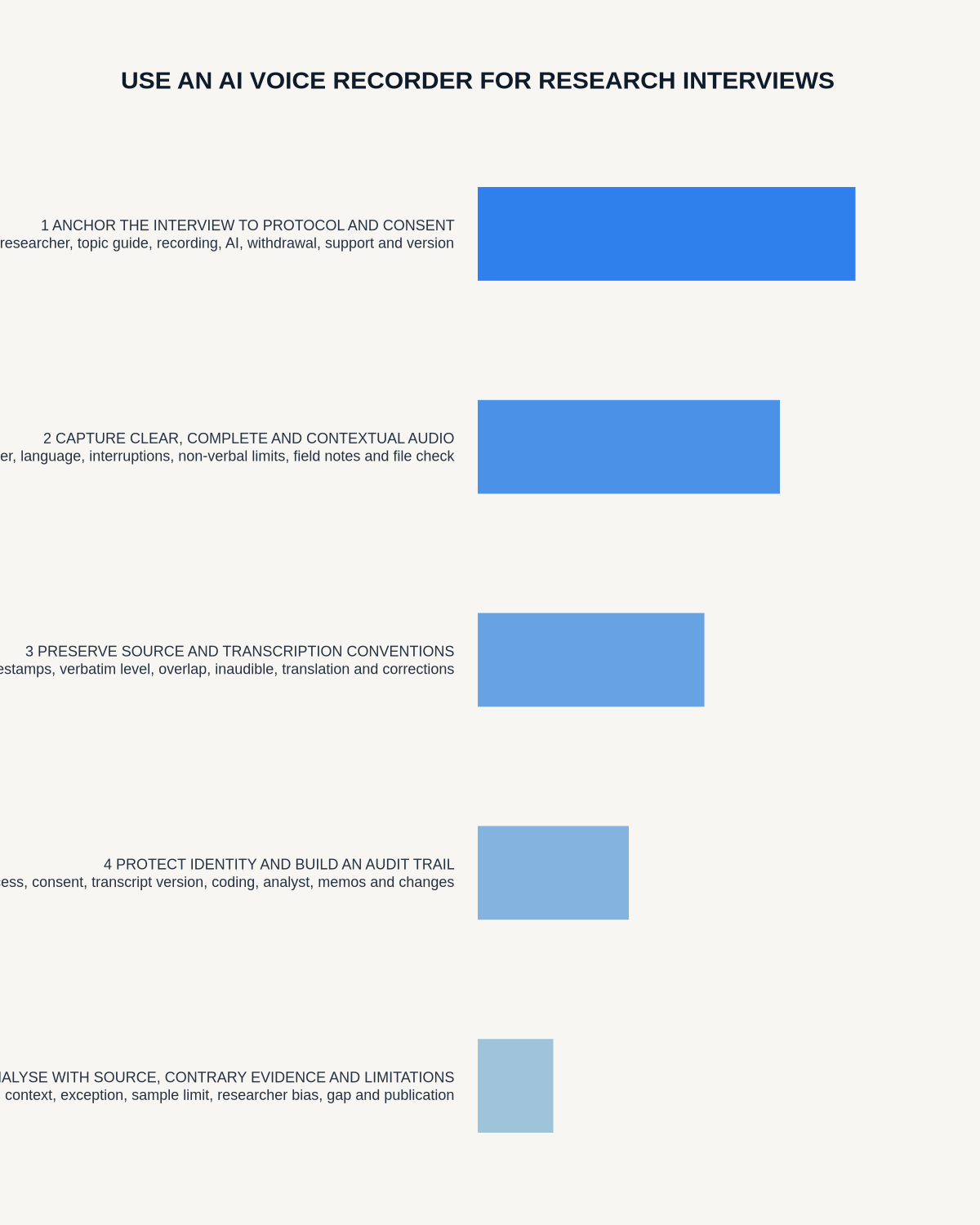
Workflow map
Visual map for How to Use an AI Voice Recorder for Research Interviews
- Define the decisionState the question, required output and acceptance rule.
- Capture the sourceUse the approved route and preserve context, identity and limitations.
- Verify material detailsReplay or check names, numbers, negatives, decisions and actions.
- Move into the real recordAssign an owner, retain evidence and apply the deletion rule.
On this page
Related guides
See whether Halo fits this workflow
Review the NERALVO Halo specifications, included services, delivery information and current offer only after completing the guide.
Found an error or an out-of-date claim? Email support@neralvo.com with the article address and a supporting source.