The 60-second verdict
Exam revision works when students practise producing accurate answers without relying on the source material. Recording a polished explanation can feel productive while hiding the fact that the explanation was read, prompted or generated.
Decision focus: use the method below only where it produces a recoverable source, a verifiable output and a clear next action. If one of those fails, change the workflow rather than trusting a polished summary.
Evidence basis and limits
- Decision factors covered: The syllabus → diagnose → retrieve → correct → simulate workflow; Stage 1: Build the revision map from official requirements; Separate knowledge from performance.
- Evidence rule: The decision is based on the complete capture-to-action workflow, not a single feature or marketing accuracy percentage.
- Boundary: Examples and workflow recommendations must be tested with representative recordings, the intended users and the actual approval process before rollout.
An AI voice recorder for exam revision can make spoken recall searchable, expose missing steps and create focused review tasks. It cannot decide what the syllabus requires, verify every answer or replace timed practice.
The syllabus → diagnose → retrieve → correct → simulate workflow
| Stage | Revision question | Useful output |
|---|---|---|
| Syllabus | What knowledge and skill can actually be assessed? | Bounded revision map |
| Diagnose | What can the student currently explain or solve without help? | Evidence-based gap list |
| Retrieve | Can the answer be produced from memory? | Raw recall attempt |
| Correct | Which missing or inaccurate parts need targeted work? | Verified repair task |
| Simulate | Can the knowledge be used under realistic exam conditions? | Performance evidence |
This workflow uses voice to test memory and reasoning, not to create more passive notes.
Stage 1: Build the revision map from official requirements
Use:
- Learning outcomes.
- Module or specification content.
- Assessment format.
- Past papers or sample questions where authorised.
- Marking criteria.
- Lecturer or awarding-body guidance.
Divide the material into assessable topics and skills. Do not ask AI to invent likely exam content or treat frequency in past papers as a guarantee.
Separate knowledge from performance
| Requirement | Possible evidence |
|---|---|
| Recall a fact or definition | Accurate spoken answer without notes |
| Explain a concept | Logical explanation with example and limitation |
| Apply a method | New problem completed with workings |
| Evaluate an argument | Evidence, counterargument and reasoned conclusion |
| Analyse a source | Relevant inference tied to the source |
| Perform a practical skill | Authorised observation—not a voice note alone |
A fluent recording may demonstrate explanation but not calculation accuracy, visual analysis or practical competence.
Stage 2: Diagnose before rereading
Choose a topic and record a cold attempt with all notes closed. Use prompts such as:
- What is the central idea?
- Which terms must be defined precisely?
- What process or argument connects them?
- Which example or evidence supports the answer?
- What limitation, exception or counterargument matters?
- How would this appear in an exam question?
Do not stop the recording to search for missing information. The hesitation and gap are the useful evidence.
Classify the gap correctly
| Gap type | What it looks like | Best next action |
|---|---|---|
| Recall gap | The student understands when prompted but cannot retrieve | Short spaced retrieval |
| Conceptual gap | Explanation contains a wrong relationship | Rebuild from source and examples |
| Procedural gap | Method order or calculation breaks down | Worked practice with fading support |
| Evidence gap | Claim lacks example, source or data | Attach verified evidence |
| Question-reading gap | Answer does not address the command or scope | Annotate and plan questions |
| Time-management gap | Knowledge is adequate but output is incomplete | Timed simulation |
Do not respond to every weak answer by creating more notes. Match the repair to the cause.
Stage 3: Use short spoken retrieval
Keep each attempt focused:
- One definition in 20 seconds.
- One process in 60 seconds.
- One comparison in 90 seconds.
- One essay plan in three minutes.
- One case or problem explanation with explicit steps.
State the question at the start. This makes the recording searchable and prevents an unfocused revision monologue.
Do not memorise an AI-polished answer
An AI summary may:
- Add missing logic the student did not know.
- Remove uncertainty.
- Introduce an unsupported example.
- Change technical language.
- Turn a partial answer into a complete one.
Keep the original recall attempt. Compare it with verified sources, then create a correction list rather than replacing it with polished prose.
Stage 4: Correct from authoritative material
Use a three-column repair note:
| Original attempt | Verified correction | Next retrieval prompt |
|---|---|---|
| What the student said | Correct fact, step or qualification | A new question that tests the repair |
Check names, dates, figures, equations, quotations, legal or clinical details and source attribution carefully. The transcript is not a reliable authority.
Turn corrections into spaced prompts
Schedule another attempt after a delay rather than replaying the answer repeatedly. A useful sequence may be:
- Immediate corrected explanation.
- Short retrieval later the same day.
- New question after several days.
- Mixed-topic retrieval the following week.
- Timed application before the exam.
The exact schedule should reflect the course, time available and difficulty. Avoid creating more prompts than can realistically be reviewed.
Use interleaving to expose false confidence
Mix similar topics, methods or cases so the student must decide which approach applies. For example:
- Compare two theories without being told which is stronger.
- Choose the correct equation from several possible methods.
- Distinguish two conditions with overlapping features.
- Apply a rule to a changed factual scenario.
- Explain why a familiar method does not apply.
A topic often feels easy when the correct method is already signposted.
Stage 5: Simulate the real assessment
Match the conditions that matter:
- Question format.
- Time limit.
- Permitted materials.
- Expected answer length.
- Calculation or planning method.
- Submission or oral-response format.
Use the recorder after the timed attempt to explain:
- What the question required.
- Which plan was used.
- Where time was lost.
- Which knowledge failed.
- What one change would improve the next attempt.
Use voice differently for different subjects
| Subject type | Useful voice task |
|---|---|
| Essay-based | Thesis, evidence, counterargument and structure |
| Quantitative | Explain method choice and check written workings |
| Languages | Spontaneous response, vocabulary in context and pronunciation |
| Law | Proposition, authority, application and competing argument |
| Health sciences | Approved scenario reasoning with safety-critical verification |
| Practical subjects | Post-practice reflection alongside authorised observation |
Keep revision within academic-integrity rules
Do not use AI to obtain or reconstruct restricted examination content, produce prohibited assessed answers or fabricate sources. Follow the course rules for generative AI, collaboration and permitted materials.
QAA provides current resources on academic integrity and generative AI in higher education.
Create a daily revision closeout
Record a 30-second final note:
- Topic tested.
- Strongest evidence of learning.
- One material gap.
- Correction source.
- Next retrieval date.
- Timed practice still required.
Transfer the next action into the calendar or task system. Do not leave the revision plan buried inside audio.
How NERALVO Halo can support exam revision
View Halo specifications against the evidence checklist provides NOTE recording, supported CALL capture, 64GB local storage, up to 35 hours of recording and Bluetooth sync with DOWAY.
DOWAY can create transcripts, summaries, speaker-separated notes, templates, translations, mind maps and exports. One year of DOWAY Max is included from activation.
Halo can support spoken recall and review. It does not know the current syllabus, marking requirements or whether an answer is academically or technically correct.
Exam-revision quality check
- Was the revision map built from official requirements?
- Did the student attempt retrieval before reviewing notes?
- Was the gap classified correctly?
- Was the original answer preserved before AI polishing?
- Were corrections verified against authoritative sources?
- Was the repaired knowledge tested after a delay?
- Did practice include new and mixed questions?
- Were realistic timed conditions used?
- Did every session end with a specific next action?
A strong AI voice-revision workflow records what the student can produce now, repairs the exact gap and tests the knowledge again under conditions that resemble the exam.
Workflow choice matrix for How to Use an AI Voice Recorder for Exam Revision
Choose the method that protects the source and reduces downstream correction. The table makes the non-hardware options explicit.
| Condition | Preferred route | Why |
|---|---|---|
| Repeatable remote work with approved integrations | Cloud software | Automation and central collaboration may outweigh device independence. |
| In-person, mobile or unreliable-connectivity work | Dedicated recorder | Independent capture and a recoverable local source are usually more resilient. |
| Recording is refused, prohibited or unnecessary | Manual notes / no recording | Respecting the boundary is the correct workflow, not a product failure. |
| High-risk or mixed work | Governed hybrid | Separate capture, review, approval and retention rather than trusting one tool. |
Related study guides
See lecture recording and study notes, accessible learning workflows and the guide for distance learners.
Related guides
Workflow map
Visual map for How to Use an AI Voice Recorder for Exam Revision
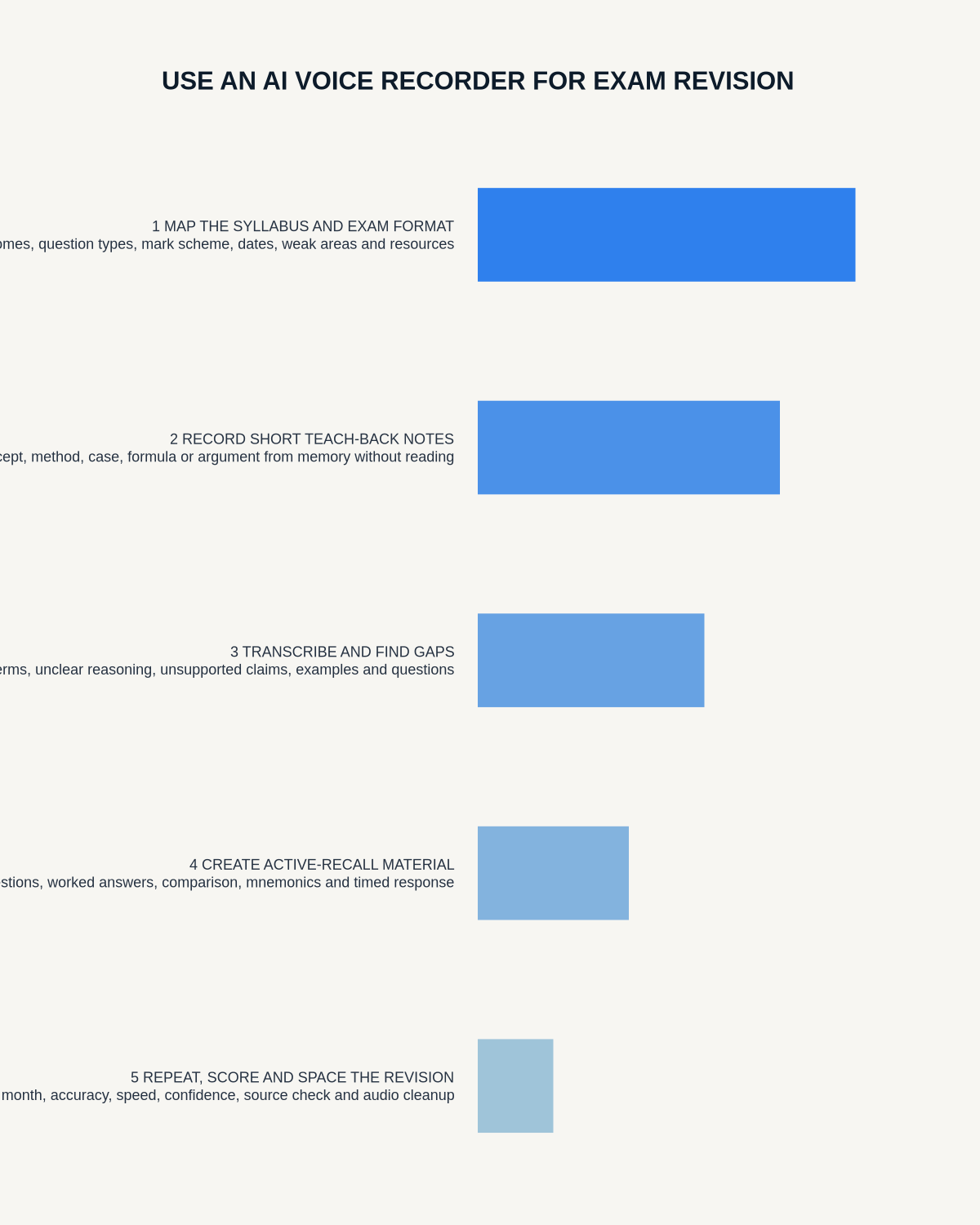
- Define the decisionState the question, required output and acceptance rule.
- Capture the sourceUse the approved route and preserve context, identity and limitations.
- Verify material detailsReplay or check names, numbers, negatives, decisions and actions.
- Move into the real recordAssign an owner, retain evidence and apply the deletion rule.
On this page
Related guides
See whether Halo fits long-form study capture
After checking permission and your institution’s rules, compare Halo’s stated battery, storage and export workflow with the way you actually study.
Found an error or an out-of-date claim? Email support@neralvo.com with the article address and a supporting source.