The 60-second verdict
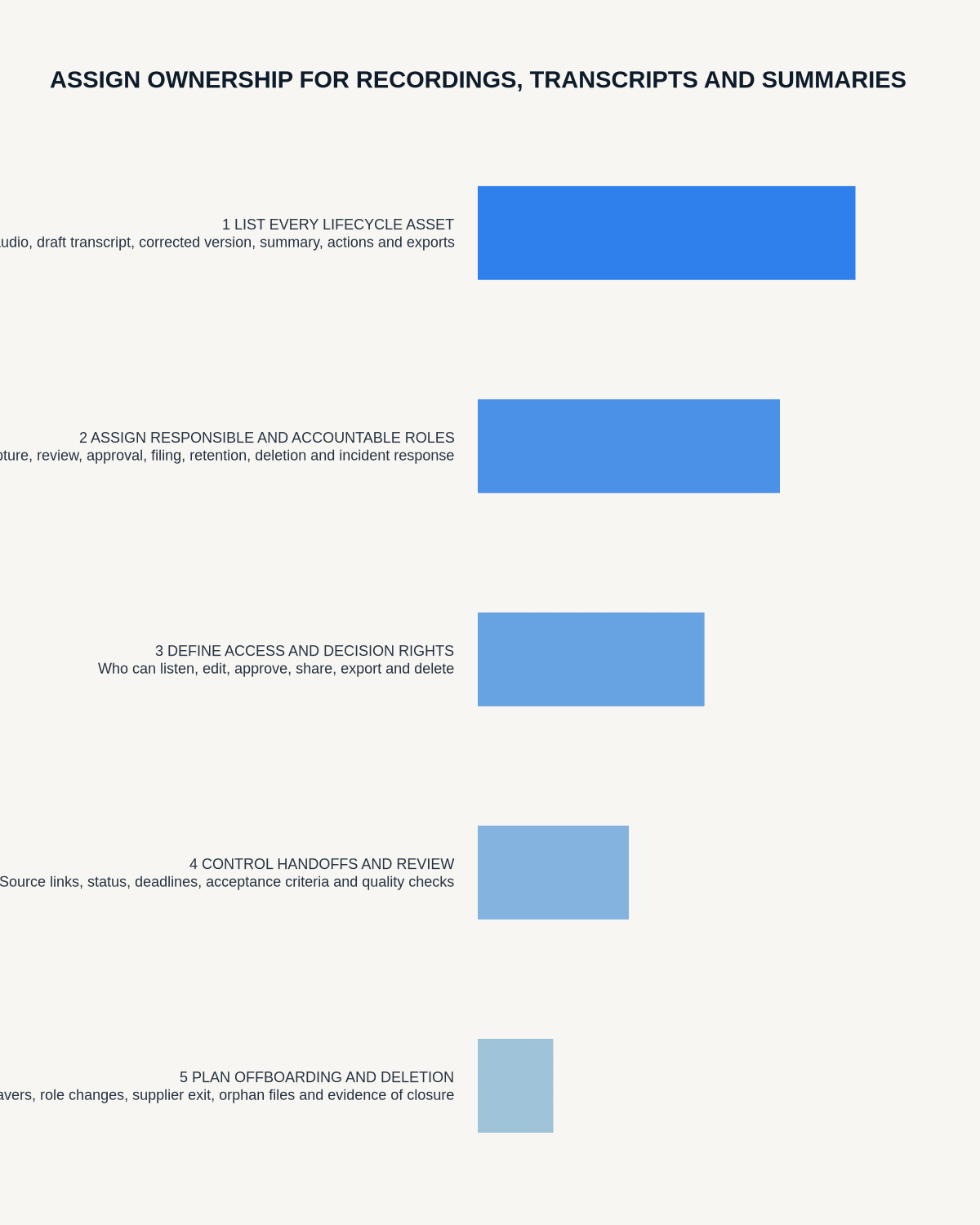
Quick answer: assign ownership across the whole recording lifecycle, not only the physical device. Name one accountable role for purpose, capture, data access, transcript review, final-record approval, system administration and retention, with clear handoff evidence and deputies.
Decision focus: use the method below only where it produces a recoverable source, a verifiable output and a clear next action. If one of those fails, change the workflow rather than trusting a polished summary.
Evidence basis and limits
- Decision factors covered: Map the seven ownership points; Separate responsibility from accountability; Define handoff evidence.
- Evidence rule: A claim earns weight only when the source, date, configuration and limitation are clear enough for a reader to check.
- Boundary: Examples and workflow recommendations must be tested with representative recordings, the intended users and the actual approval process before rollout.
Recording workflows fail when everyone assumes somebody else owns the next step. “The team” is not an accountable owner.

Map the seven ownership points
- Purpose owner: decides why recording is needed and defines its boundary.
- Capture owner: operates the approved device and labels the source.
- Data owner: determines acceptable use, sensitivity and access.
- Review owner: checks transcript and summary accuracy.
- Record owner: approves the authoritative business output.
- System owner: controls accounts, exports, integrations and settings.
- Retention owner: applies deletion, holds and exceptions.
Separate responsibility from accountability
Several people may perform work, but one role should remain accountable for each outcome.
| Asset or outcome | Responsible person | Accountable role |
|---|---|---|
| Source audio | Recorder user | Process or data owner |
| Corrected transcript | Reviewer | Record owner |
| Approved summary | Drafting user | Decision or meeting owner |
| Deletion | Administrator | Retention owner |
Define handoff evidence
Every transfer between people or systems should show the file or record identifier, current status, person accepting responsibility, deadline, known uncertainty, restriction, destination and next action. This prevents a draft AI summary from being mistaken for approved minutes.
Name the authoritative record
Specify whether the final record is approved minutes, a case note, CRM entry, report, decision brief or corrected transcript. Source audio and AI-generated drafts should not become competing official records by accident.
Include suppliers and external participants
Clarify what the organisation controls, what the supplier processes, who authorises external sharing and who responds to access, correction, export or deletion requests. Supplier administration does not remove the organisation's accountability.
Plan for absence, leavers and outages
Name deputies and escalation routes for leave, staff departure, unavailable accounts, lost hardware and supplier outages. No critical record should depend on one person's inbox or app account.
Link ownership to access control
The data owner approves roles; the system owner implements them; the access reviewer checks them. Use How to Audit AI Voice Recorder Access and Sharing to verify that permissions match the documented model.
Run a missing-owner test
Select a recent recording and ask who can authorise access, who knows whether the transcript is correct, who approved the final output, who will delete temporary audio and who acts if the supplier is unavailable. Any unanswered question is a control gap.
Workflow choice matrix for How to Assign Ownership for Recordings, Transcripts and Summaries
Choose the method that protects the source and reduces downstream correction. The table makes the non-hardware options explicit.
| Condition | Preferred route | Why |
|---|---|---|
| Repeatable remote work with approved integrations | Cloud software | Automation and central collaboration may outweigh device independence. |
| In-person, mobile or unreliable-connectivity work | Dedicated recorder | Independent capture and a recoverable local source are usually more resilient. |
| Recording is refused, prohibited or unnecessary | Manual notes / no recording | Respecting the boundary is the correct workflow, not a product failure. |
| High-risk or mixed work | Governed hybrid | Separate capture, review, approval and retention rather than trusting one tool. |
Frequently asked questions
Can one person hold several roles?
Yes, where appropriate, but each accountability must remain explicit and conflicts should be managed.
Who owns an exported transcript?
The organisation should assign a business owner and destination-record owner; export does not remove accountability.
Is the device administrator the data owner?
Not automatically. Technical administration and business accountability are different roles.
Who approves deletion?
The retention or records owner should define the rule, while an administrator may perform and evidence the deletion.
What happens when an owner leaves?
Transfer records, approvals and system ownership before access is removed, then verify the handover.
Authoritative guidance and related reading
- The National Archives information-management guidance
- How to Offboard Employees Who Used AI Voice Recorders
- How to Review AI Transcripts Before They Enter Business Systems
Final ownership checklist
- All lifecycle stages assigned
- One accountable role named per outcome
- Handoffs evidenced
- Authoritative record defined
- Supplier responsibilities clear
- Deputies and escalation routes defined
- Retention and deletion ownership verified
On this page
Related guides
See whether Halo fits this workflow
Review the NERALVO Halo specifications, included services, delivery information and current offer only after completing the guide.
Found an error or an out-of-date claim? Email support@neralvo.com with the article address and a supporting source.