The 60-second verdict
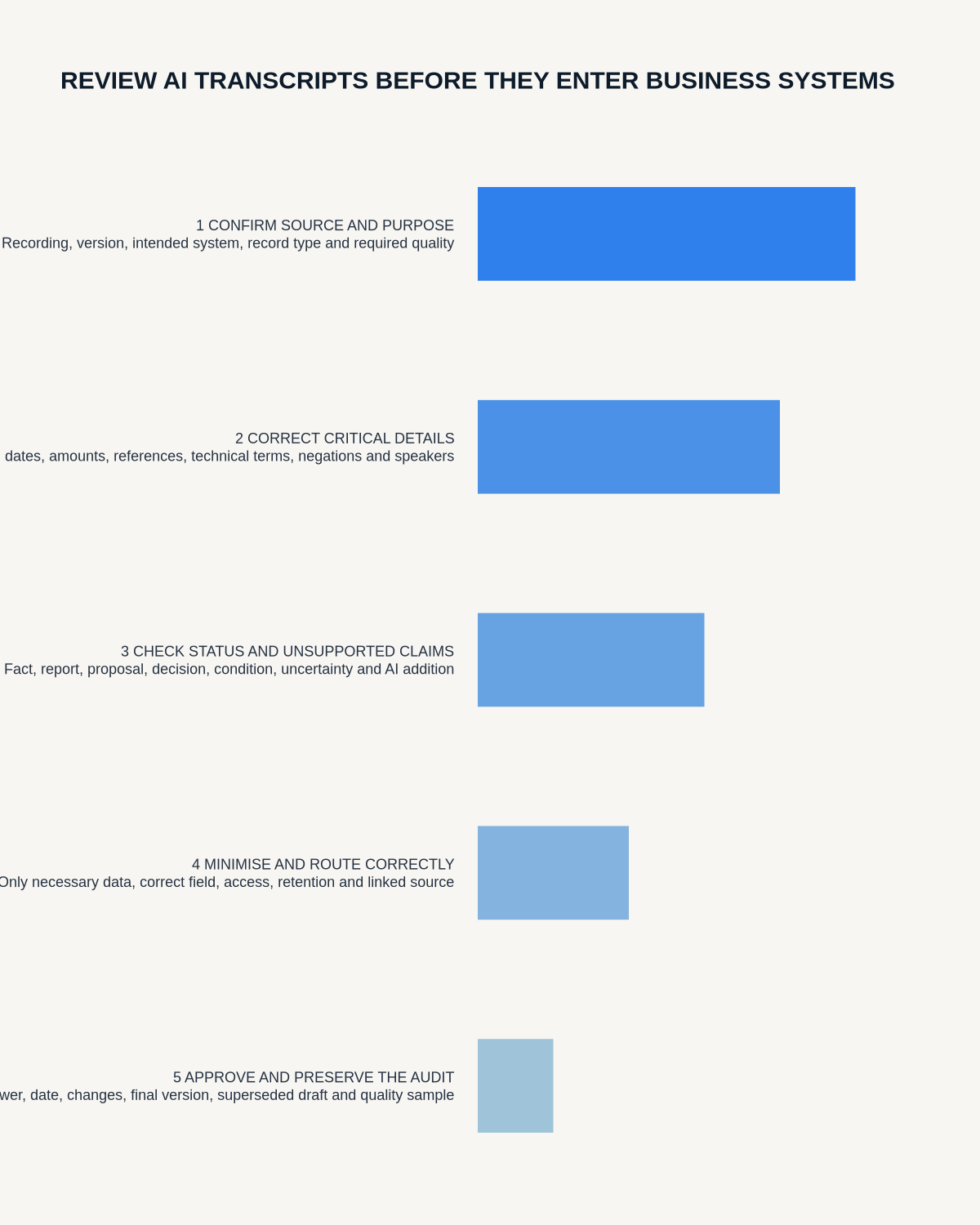
Quick answer: review an AI transcript in three passes before it enters a CRM, case file, project system, knowledge base or approved minutes. First verify critical wording against the audio, then confirm the status of decisions and actions, and finally remove content that is unnecessary or unsuitable for the destination.
Decision focus: use the method below only where it produces a recoverable source, a verifiable output and a clear next action. If one of those fails, change the workflow rather than trusting a polished summary.
Evidence basis and limits
- Decision factors covered: Pass two: verify status and meaning; Pass three: check destination fitness; Apply risk-based review depth.
- Evidence rule: Claims are weighted by consequence: capture failure, changed meaning, access and recovery matter more than polished wording.
- Boundary: Examples and workflow recommendations must be tested with representative recordings, the intended users and the actual approval process before rollout.
Once an error enters a business system it can become searchable, copied into later work and treated as fact. Fluency is not proof of accuracy.

Pass one: verify the source
Match the recording to the correct event and replay sections containing material information. Prioritise:
- names, organisations and speaker labels;
- dates, times, figures, units and reference numbers;
- negative and conditional wording;
- technical, legal, medical or product terminology;
- quotations and disputed wording;
- overlapping, quiet or noisy passages.
Mark genuinely unclear wording with a timestamp rather than replacing it with plausible text.
Pass two: verify status and meaning
Classify each important point as discussion, proposal, recommendation, agreement in principle, conditional approval, final decision, action, risk, issue, open question, rejected option or superseded position.
| Risky AI transformation | Required check |
|---|---|
| “We could” becomes “we will” | Confirm authority and decision wording |
| One view becomes consensus | Preserve attribution and dissent |
| Approximate date becomes exact | Check source or mark uncertainty |
| Suggested task becomes assigned work | Verify owner acceptance and deadline |
Pass three: check destination fitness
Ask what the receiving system genuinely needs. A CRM note should not contain an entire internal debate. A case record needs source status. Approved minutes need decisions and actions. A knowledge article needs tested, reusable instructions.
Remove irrelevant personal information, informal commentary, duplicated material and content that the destination audience should not receive.
Apply risk-based review depth
- Low impact: check identifiers, actions and summary meaning.
- Medium impact: replay every commitment, figure, condition and decision.
- High impact: use qualified review, timestamps, controlled approval and a second reviewer where required.
The apparent readability of the transcript should never reduce the review depth.
Keep a correction and approval trail
For important records, retain the transcript version, source reference, reviewer, correction date, reason and approval state. Distinguish a correction to what was said from a later change in the business position.
Transfer only the approved output
Mark drafts clearly and prevent unreviewed summaries from entering formal systems. Transfer the minimum necessary content, retain source access only where justified and apply the destination system's permissions and retention rules.
Correct downstream copies
If a material error is discovered after transfer, correct the authoritative record, identify copied downstream versions, inform affected owners where necessary and preserve the correction evidence. Do not silently change one copy while leaving conflicting versions elsewhere.
Transcript-to-system workflow
- Match the recording to the correct event.
- Replay critical source details.
- Verify decision and action status.
- Remove irrelevant or excessive content.
- Check destination fields and access.
- Record reviewer and approval state.
- Transfer the approved output.
- Resolve temporary audio and draft retention.
Workflow choice matrix for How to Review AI Transcripts Before They Enter Business Systems
Choose the method that protects the source and reduces downstream correction. The table makes the non-hardware options explicit.
| Condition | Preferred route | Why |
|---|---|---|
| Repeatable remote work with approved integrations | Cloud software | Automation and central collaboration may outweigh device independence. |
| In-person, mobile or unreliable-connectivity work | Dedicated recorder | Independent capture and a recoverable local source are usually more resilient. |
| Recording is refused, prohibited or unnecessary | Manual notes / no recording | Respecting the boundary is the correct workflow, not a product failure. |
| High-risk or mixed work | Governed hybrid | Separate capture, review, approval and retention rather than trusting one tool. |
Frequently asked questions
Can a transcript go directly into a CRM?
Only after review and reduction to information appropriate for that system.
Should every word be checked?
Review depth should match risk, but every material fact, decision, action and condition must be checked.
What if audio remains unclear?
Preserve uncertainty, add a timestamp and seek confirmation rather than inventing a confident replacement.
What if an error is found after transfer?
Correct the authoritative record, trace downstream copies and retain the amendment trail.
Can a polished AI summary replace the transcript review?
No. A summary can hide omissions, changed certainty and speaker-attribution errors.
Authoritative guidance and related reading
- NIST AI Risk Management Framework guidance on measurement and oversight
- ICO data-protection principles
- How to Standardise AI Meeting Notes Across a Team
- How to Assign Ownership for Recordings, Transcripts and Summaries
Final approval checklist
- Correct event and source matched
- Material facts replayed
- Decision status verified
- Actions have accepted owners and dates
- Uncertainty remains visible
- Content fits the destination
- Reviewer and approval recorded
- Temporary copies resolved
Related AI voice recorder guides
On this page
More in this topic: Recording governance and quality
Show 7 closely related guides
- What to Do When Someone Refuses to Be Recorded
- How to Draft a Consultation Response from Recorded Feedback
- How to Create an AI Voice Recording Quality Scorecard
- How to Run a Voice Recording DPIA Workshop
- How to Create a Voice Recording Exception and Escalation Process
- How to Train Staff to Use AI Voice Recorders Responsibly
- How to Build an Approved-Use Matrix for Voice Recording
Related guides
See whether Halo fits this workflow
Review the NERALVO Halo specifications, included services, delivery information and current offer only after completing the guide.
Found an error or an out-of-date claim? Email support@neralvo.com with the article address and a supporting source.