The 60-second verdict
Quick answer: capture a relevant side conversation without losing speaker context by bringing it back into the main meeting, asking the speaker to restate the point clearly and confirming whether it is information, a proposal, a decision or an action. Private, irrelevant or unsupported fragments should not enter the formal record.
Decision focus: use the method below only where it produces a recoverable source, a verifiable output and a clear next action. If one of those fails, change the workflow rather than trusting a polished summary.
Evidence basis and limits
- Decision factors covered: Decide whether the side conversation belongs in the record; Use a verbal re-entry; Record speaker, subject and status separately.
- Evidence rule: The decision is based on the complete capture-to-action workflow, not a single feature or marketing accuracy percentage.
- Boundary: Examples and workflow recommendations must be tested with representative recordings, the intended users and the actual approval process before rollout.
Side conversations are difficult for both people and transcription systems. They are often quieter than the main discussion, may overlap another speaker and can lack the context needed to understand whether a remark was serious, agreed or even intended for the meeting.

Decide whether the side conversation belongs in the record
Apply a simple relevance test before trying to capture or transcribe it:
- Does the point affect the agenda, decision, risk or action?
- Was it intended for the whole group?
- Can the speakers restate it openly?
- Is recording it necessary and proportionate?
- Would including it create avoidable privacy or confidentiality risk?
If the answer is no, leave the fragment outside the approved meeting note. A recorder should not be repositioned to monitor private corners of the room.
Use a verbal re-entry
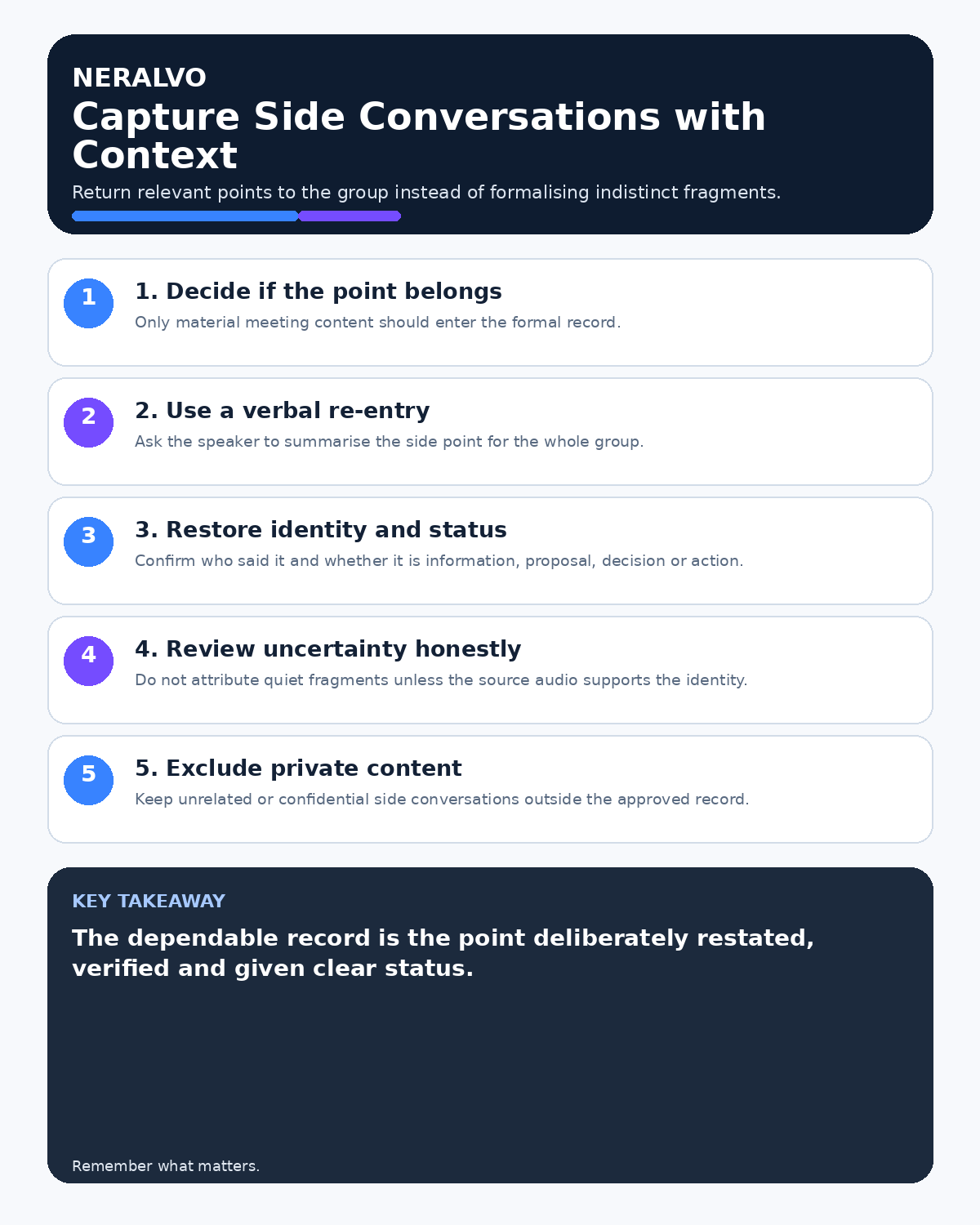
The chair should stop the competing discussion and bring the useful point back to the main channel. For example:
“For the record, Sam and Lee identified a delivery dependency. Sam, please summarise it for the group.”
This restores speaker identity, gives everyone the same context and allows the group to confirm, challenge or qualify the point.
Record speaker, subject and status separately
| Field | What to confirm |
|---|---|
| Speaker | Who is deliberately restating the point |
| Subject | The issue, dependency or evidence being discussed |
| Status | Information, concern, proposal, decision or action |
| Authority | Who can confirm or approve it |
| Next step | Owner, deadline and any condition |
Do not let a quiet suggestion become an approved decision merely because an AI summary removes the uncertainty around it.
Control simultaneous conversations
Several conversations at once reduce audibility and attribution. The chair should pause the main discussion, invite one contribution at a time and repeat any material outcome. For difficult sections, use the source-based process in How to Handle Overlapping Speech in AI Transcripts.
Mark uncertainty honestly
If a fragment cannot be attributed reliably, use a marker such as [side conversation—speaker unclear] with a timestamp. Do not identify a person from seating position, assumption or transcript context alone.
The deliberately restated version should form the formal note. The indistinct source fragment may remain in the audio under the approved retention process, but it should not be converted into an unsupported quotation.
Protect private and incidental speech
Recording arrangements should be clear to participants. Pause or stop for unrelated confidential discussion where appropriate, and avoid collecting bystander conversations outside the meeting purpose. Apply data minimisation to the transcript and final note.
If personal information is captured accidentally, restrict access and follow the organisation’s incident, correction or deletion process rather than circulating the raw passage.
Handle hybrid and remote side channels
Chat messages, private messages and breakout-room comments create the same context problem. A material point should be returned to the plenary discussion or entered into the controlled record with its source, status and authority. Do not silently merge private chat into meeting consensus.
Use a repeatable workflow
- Identify whether the side point is relevant.
- Pause the competing discussion.
- Ask one speaker to restate the point clearly.
- Confirm speaker, subject and evidence.
- Label the status: information, proposal, decision or action.
- Confirm authority, owner, deadline and conditions.
- Review the transcript against the source audio.
- Exclude private, irrelevant or unsupported fragments.
- Transfer material outcomes to the approved meeting record.
Workflow choice matrix for How to Capture Side Conversations Without Losing Speaker Context
Choose the method that protects the source and reduces downstream correction. The table makes the non-hardware options explicit.
| Condition | Preferred route | Why |
|---|---|---|
| High-risk or mixed work | Governed hybrid | Separate capture, review, approval and retention rather than trusting one tool. |
| Recording is refused, prohibited or unnecessary | Manual notes / no recording | Respecting the boundary is the correct workflow, not a product failure. |
| In-person, mobile or unreliable-connectivity work | Dedicated recorder | Independent capture and a recoverable local source are usually more resilient. |
| Repeatable remote work with approved integrations | Cloud software | Automation and central collaboration may outweigh device independence. |
Frequently asked questions
Should every side comment be included?
No. Include only material points deliberately returned to the meeting and confirmed in context.
Can a quiet fragment be attributed from context?
Not safely. Speaker identity should be supported by the audio or a clear restatement.
Should the recorder be moved closer to a side conversation?
No. Position it for the authorised main meeting and use facilitation to recover relevant points.
What if the side discussion changes a decision?
Bring the revised position back to the main meeting and obtain a fresh, explicit confirmation from the appropriate authority.
Useful resources
- ICO guidance on data minimisation
- How to Record Meetings with Frequent Interruptions
- How to Capture Questions from the Back of a Room
- View Halo specifications against the evidence checklist
Final context checklist
- Relevance established
- Point restated to the group
- Speaker identity supported
- Status and authority confirmed
- Private fragments excluded
- Actions have owners and deadlines
- Formal record checked against source audio
On this page
Related guides
See whether Halo fits this workflow
Review the NERALVO Halo specifications, included services, delivery information and current offer only after completing the guide.
Found an error or an out-of-date claim? Email support@neralvo.com with the article address and a supporting source.