The 60-second verdict
Quick answer: create a stakeholder map from interview recordings by defining the decision first, separating formal authority from operational influence, source-labelling every claim and turning the verified map into specific engagement actions with owners and review dates.
Decision focus: use the method below only where it produces a recoverable source, a verifiable output and a clear next action. If one of those fails, change the workflow rather than trusting a polished summary.
Evidence basis and limits
- Decision factors covered: Define the decision or change; Use four evidence dimensions; Separate fact, report and interpretation.
- Evidence rule: The decision is based on the complete capture-to-action workflow, not a single feature or marketing accuracy percentage.
- Boundary: Examples and workflow recommendations must be tested with representative recordings, the intended users and the actual approval process before rollout.
Interview recordings reveal how people believe an organisation works, but each participant sees only part of the system. A useful map preserves uncertainty and distinguishes documented governance from perception, reputation and informal influence.

Define the decision or change
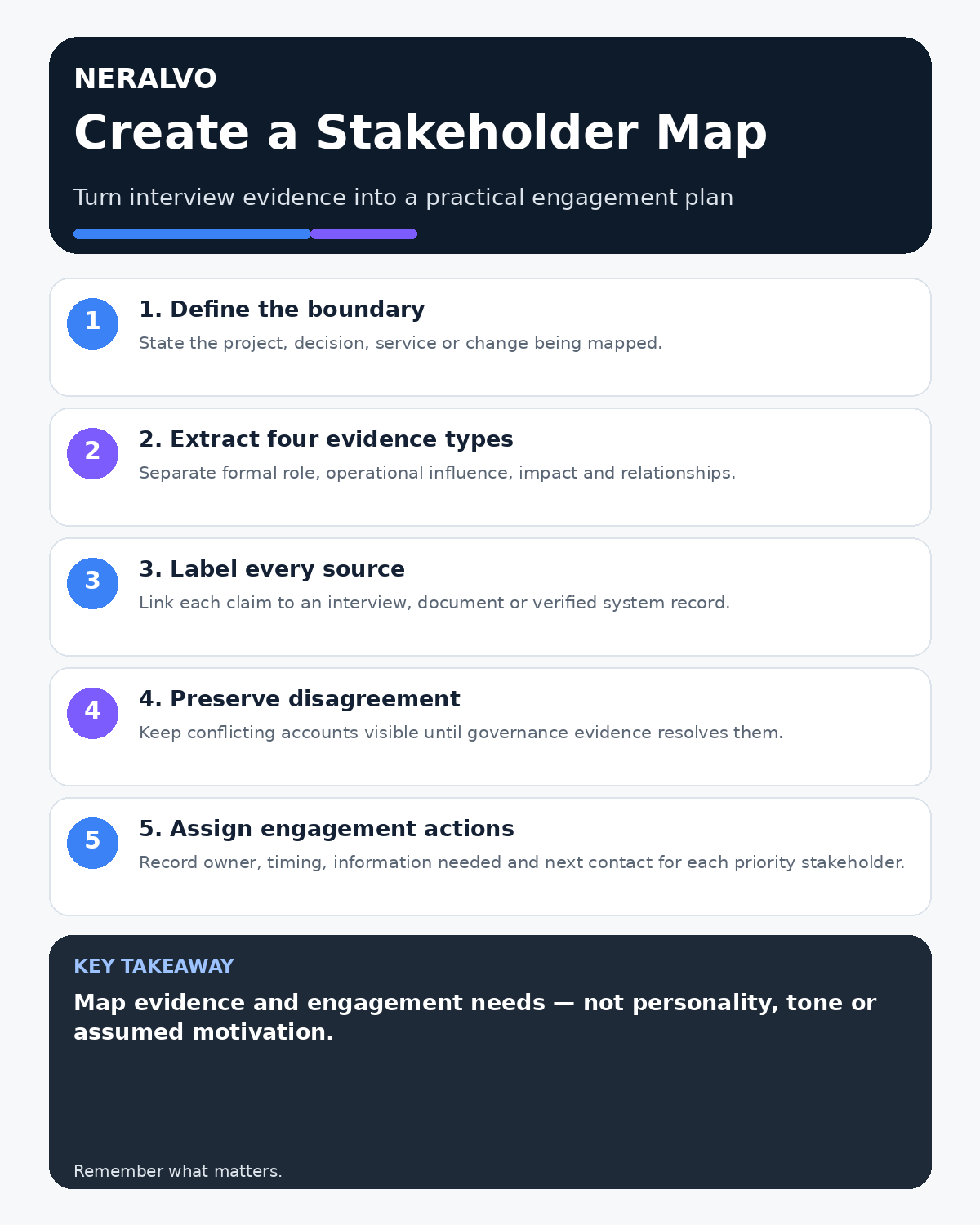
Stakeholder importance depends on context. State the project, service, decision, geographical boundary, implementation period and outcome being mapped. A person who can approve funding may not control daily adoption, while an operational team with no formal authority may determine whether the change works.
Use four evidence dimensions
- Formal authority: documented approval, governance or accountability.
- Operational influence: practical ability to enable, delay, interpret or shape delivery.
- Impact and interest: how the change affects the stakeholder and what they need.
- Relationships and dependencies: information routes, handoffs, trust and reliance between groups.
Build a source register
For every interview, record the participant role, interview date, scope, source-audio reference, transcript version and any confidentiality restriction. Link formal claims to organisation charts, terms of reference, delegations or controlled process documents.
“Finance must approve” is different from “finance usually influences the decision.” Keep the source and evidence status visible.
Separate fact, report and interpretation
- Verified: supported by an authoritative document or confirmed decision.
- Reported: stated by an interviewee but not independently confirmed.
- Observed: evidenced through behaviour, workflow or historical decisions.
- Interpretation: the analyst’s working explanation.
- Unknown: requires clarification or further evidence.
Do not use tone, confidence or sentiment to infer trustworthiness, resistance, motivation or character.
Create a practical stakeholder row
| Field | What to record |
|---|---|
| Role or group | Named role, team or affected community |
| Decision role | Approve, advise, deliver, consult or informed |
| Impact and influence | Rating with evidence and rationale |
| Position | Attributed objective, concern or condition |
| Engagement | Purpose, owner, channel and timing |
Preserve conflicting accounts
Two interviewees may describe authority or influence differently. Keep both accounts until governance evidence, decision history or direct confirmation resolves the conflict. A disagreement can reveal unclear governance rather than one unreliable participant.
Include affected people with limited formal power
Do not rank stakeholders only by seniority. People with high impact and limited voice may need accessible consultation, representation or a protected feedback route. Record the likely consequence of excluding them.
Turn the map into an engagement plan
- High authority, low current knowledge: concise decision briefing.
- High operational influence: early implementation testing.
- High impact, limited voice: inclusive consultation and accessible feedback.
- Conflicting authority accounts: governance clarification before commitment.
- Critical dependency: named engagement owner and decision deadline.
Each engagement action should state the information or decision required, owner, date and evidence of completion.
Protect interview privacy
Use only the information needed for engagement planning. Avoid permanent labels based on private opinion. Restrict raw recordings and detailed transcripts, and de-identify sensitive comments where possible.
Review the map after change
Update the map after role changes, governance decisions, supplier changes, implementation evidence or failed engagement. Keep a version date and reason for each material change.
Workflow choice matrix for How to Create a Stakeholder Map from Interview Recordings
Choose the method that protects the source and reduces downstream correction. The table makes the non-hardware options explicit.
| Condition | Preferred route | Why |
|---|---|---|
| High-risk or mixed work | Governed hybrid | Separate capture, review, approval and retention rather than trusting one tool. |
| Recording is refused, prohibited or unnecessary | Manual notes / no recording | Respecting the boundary is the correct workflow, not a product failure. |
| In-person, mobile or unreliable-connectivity work | Dedicated recorder | Independent capture and a recoverable local source are usually more resilient. |
| Repeatable remote work with approved integrations | Cloud software | Automation and central collaboration may outweigh device independence. |
Frequently asked questions
Is seniority the same as influence?
No. Formal authority, operational influence and personal impact should be recorded separately.
Can AI classify someone as resistant?
No. Record expressed concerns, decisions and observable behaviour without inferring personality or motivation.
How often should the map be reviewed?
Review it whenever governance, roles, impacts or delivery evidence materially change.
Useful resources
- Association for Project Management stakeholder-engagement principles
- How to Build a Requirements Traceability Matrix
- How to Create a Benefits Map
- View Halo specifications against the evidence checklist
Final stakeholder-map checklist
- Decision boundary defined
- Authority and influence separated
- Every material claim source-labelled
- Conflicting accounts visible
- Affected low-power groups included
- Engagement actions have owners and dates
- Privacy and version control applied
On this page
More in this topic: Multilingual meetings and interview research
Show 5 closely related guides
- How to Create Accurate Bilingual Meeting Notes from One Recording
- How to Handle Code-Switching in AI Transcripts and Mixed-Language Meetings
- How to Record Multilingual Team Meetings Responsibly and Accurately
- How to Turn Expert Interviews into Safe Troubleshooting Guides
- AI Voice Recorder for Webinars: From Live Session to Verified Notes and Actions
Related guides
See whether Halo fits this workflow
Review the NERALVO Halo specifications, included services, delivery information and current offer only after completing the guide.
Found an error or an out-of-date claim? Email support@neralvo.com with the article address and a supporting source.