The 60-second verdict
Quick answer: train staff to use AI voice recorders responsibly with role-based practical exercises covering when not to record, participant explanations, audio capture, transcript correction, approved-system transfer, retention and incident response. Attendance at a video tutorial is not evidence of competence.
Decision focus: use the method below only where it produces a recoverable source, a verifiable output and a clear next action. If one of those fails, change the workflow rather than trusting a polished summary.
Evidence basis and limits
- Decision factors covered: Train by role; Module 1: decide whether to record; Module 2: explain recording clearly.
- Evidence rule: A claim earns weight only when the source, date, configuration and limitation are clear enough for a reader to check.
- Boundary: Examples and workflow recommendations must be tested with representative recordings, the intended users and the actual approval process before rollout.

Train by role
- Recorder user: purpose, participant information, placement, naming and transfer.
- Transcript reviewer: speakers, material facts, uncertainty and corrections.
- Meeting owner: purpose, boundaries and output approval.
- System administrator: accounts, access, export and deletion.
- Manager: approved uses, exceptions, incidents and monitoring.
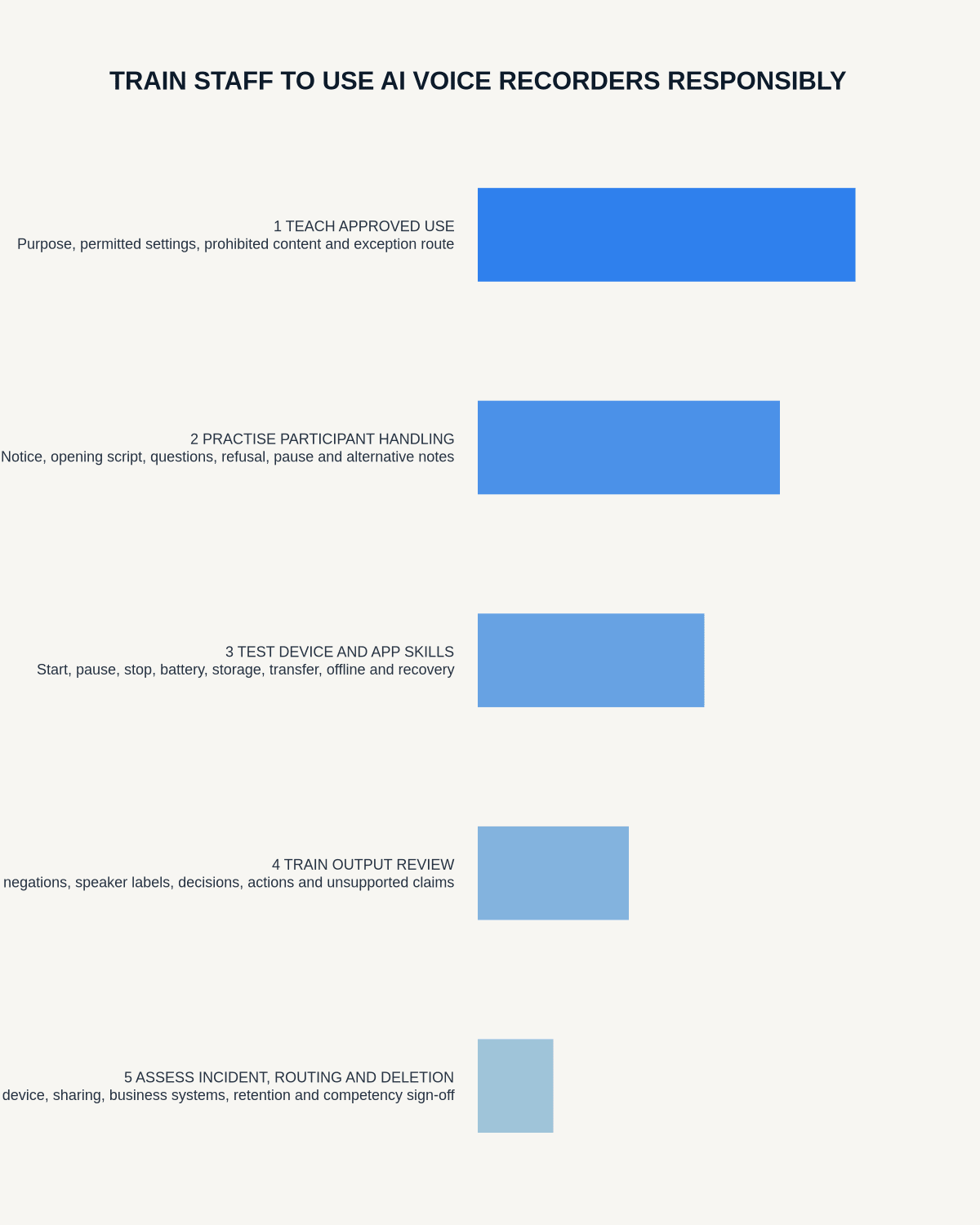
Module 1: decide whether to record
Staff should check purpose, approved meeting type, approved equipment and account, participant information, less intrusive alternatives and any restricted or sensitive element. Include scenarios where the correct decision is not to record.
Module 2: explain recording clearly
Practise a short explanation covering purpose, AI processing, access and alternative arrangements. Include late joiners, participant objections and a meeting that moves unexpectedly into a sensitive topic.
Module 3: capture usable audio
Use practical exercises in a quiet room, long table, noisy room, multi-speaker discussion, supported call and low-battery or limited-storage scenario. Include poor placement caused by a phone case, clothing or laptop.
Module 4: challenge AI output
Give trainees a transcript containing deliberate errors:
- wrong speaker;
- incorrect date or figure;
- missing negative word;
- proposal presented as a decision;
- wrong action owner;
- summary that removes disagreement;
- unnecessary personal information.
Require correction against the source audio and an explanation of which errors could cause harm.
Module 5: complete the real workflow
Trainees should create the organisation's actual output—minutes, CRM note, case note, report or task entry—then move it into the authoritative system, apply access controls and resolve temporary files correctly.
Module 6: practise failure recovery
Simulate failed sync, one-sided call audio, wrong meeting assignment, incorrect sharing, lost device, excessive capture and a materially false AI summary. Competence includes knowing when to stop, preserve evidence and escalate.
Assess practical competence
| Competence area | Evidence |
|---|---|
| Recording decision | Correctly approves, escalates or refuses a scenario |
| Participant handling | Clear explanation and objection route |
| Output review | Material errors corrected from source |
| Incident response | Evidence preserved and correct escalation used |
Reinforce after launch
Use short refreshers based on real anonymised defects. Reassess after major app, device, supplier or policy changes and where monitoring reveals repeated workarounds.
Workflow choice matrix for How to Train Staff to Use AI Voice Recorders Responsibly
Choose the method that protects the source and reduces downstream correction. The table makes the non-hardware options explicit.
| Condition | Preferred route | Why |
|---|---|---|
| Repeatable remote work with approved integrations | Cloud software | Automation and central collaboration may outweigh device independence. |
| In-person, mobile or unreliable-connectivity work | Dedicated recorder | Independent capture and a recoverable local source are usually more resilient. |
| Recording is refused, prohibited or unnecessary | Manual notes / no recording | Respecting the boundary is the correct workflow, not a product failure. |
| High-risk or mixed work | Governed hybrid | Separate capture, review, approval and retention rather than trusting one tool. |
Frequently asked questions
Is a video tutorial enough?
No. Staff need practical assessment using realistic scenarios and failures.
Should everyone receive identical training?
No. Use common foundations with role-specific competence.
What is the best training outcome?
Selective, accountable use and confidence to recognise when recording is inappropriate.
How should competence be recorded?
Keep the assessed scenario, result, assessor, date, limitations and retraining trigger.
Should staff be tested after an update?
Yes where the change materially affects capture, access, processing, export or retention.
Authoritative guidance and related reading
- ICO accountability and governance guidance
- How to Create an AI Voice Recording Policy for Work
- How to Build an Approved-Use Matrix for Voice Recording
Final training checklist
- Training is role-based
- Decision not to record is covered
- Participant explanations are practised
- Capture conditions are tested
- Transcript errors are challenged
- Failures are rehearsed
- Competence is assessed practically
- Refresh and reassessment triggers are set
Related AI voice recorder guides
On this page
Related guides
See whether Halo fits this workflow
Review the NERALVO Halo specifications, included services, delivery information and current offer only after completing the guide.
Found an error or an out-of-date claim? Email support@neralvo.com with the article address and a supporting source.