The 60-second verdict
Underwriting conversations contain facts, estimates, assumptions and negotiated positions that can look similar in an ordinary transcript. An AI voice recorder can preserve risk interviews and referral discussions, but the final note must identify which information came from the proposer, broker, surveyor or underwriter.
Best fit: Underwriters who need recoverable audio and human-verified notes in an authorised workflow. Use another method when: recording is prohibited, a participant declines or the approved process requires manual notes.
Evidence basis and limits
- Decision factors covered: The underwriting value is an assumption register; Referral-call structure; Do not let AI decide the risk.
- Evidence rule: The decision is based on the complete capture-to-action workflow, not a single feature or marketing accuracy percentage.
- Boundary: Examples and workflow recommendations must be tested with representative recordings, the intended users and the actual approval process before rollout.
The underwriting value is an assumption register
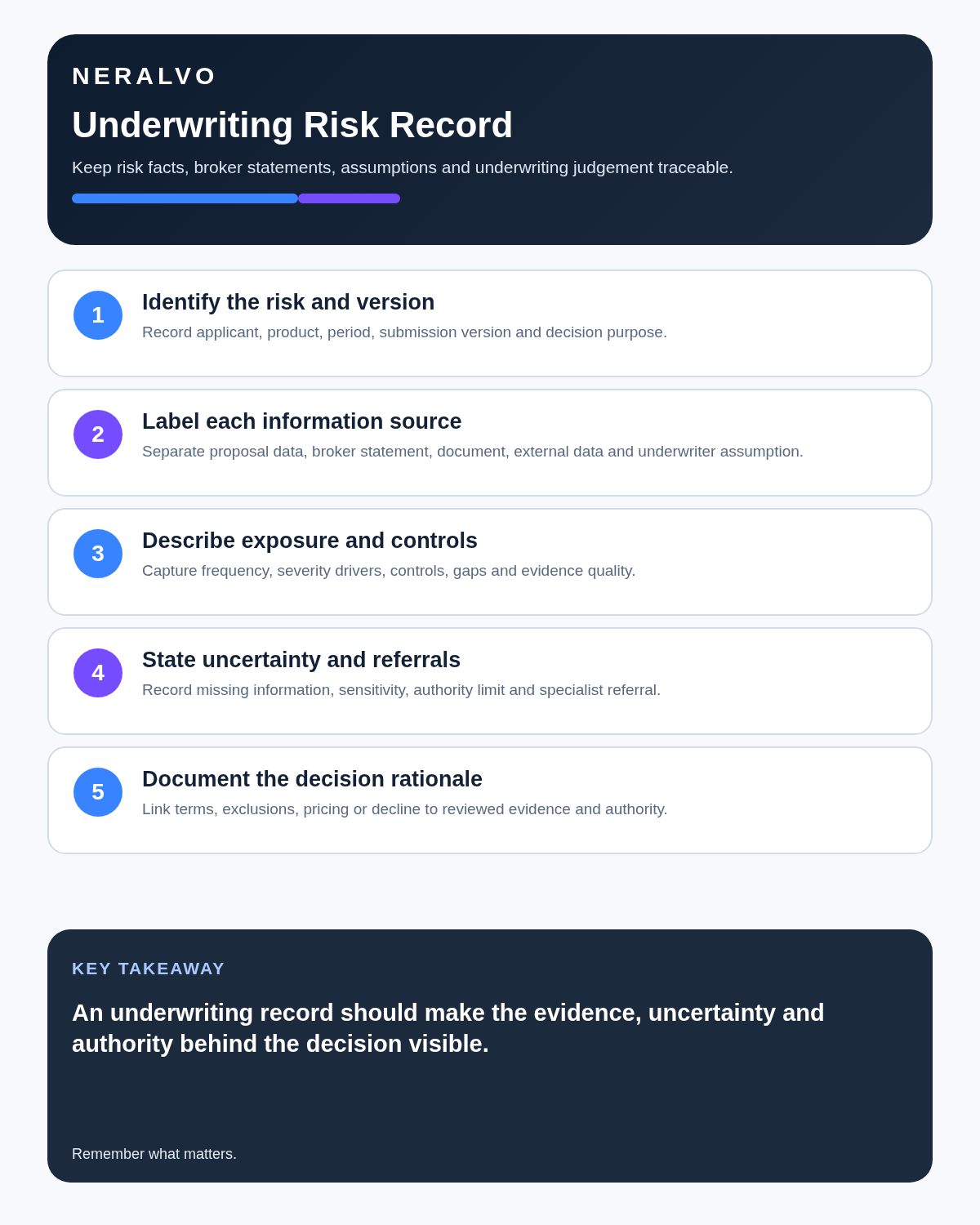
After a risk interview, do not ask only for a summary. Extract four separate lists:
- Confirmed facts: supported by proposal information or evidence.
- Reported information: stated by the broker or customer but not yet verified.
- Underwriting assumptions: used temporarily to assess the risk.
- Outstanding evidence: required before terms or a final decision.
This separation prevents an AI-generated note from turning a working assumption into a policy fact.
Questions worth preserving exactly
Recording can be especially useful when the answer contains qualifications:
- Nature and extent of operations.
- Changes since the last period.
- Claims history and circumstances.
- Controls, maintenance and supervision.
- Subcontractors and third-party dependencies.
- Maximum values and accumulations.
- Business continuity arrangements.
- Planned changes during the policy period.
Check figures, dates and technical terms against supporting documents.
Referral-call structure
| Section | What the note should show |
|---|---|
| Risk | Concise description and relevant exposure |
| Reason for referral | Authority limit, unusual feature or uncertainty |
| Evidence | Documents, survey information and interview source |
| Assumptions | Temporary positions requiring confirmation |
| Options discussed | Terms, exclusions, limits or further information |
| Decision | Authorised outcome and conditions |
| Owner | Who obtains evidence or communicates terms |
Do not let AI decide the risk
AI can organise wording and identify repeated themes. It should not determine acceptance, pricing, policy wording, authority or regulatory treatment. Those decisions require the insurer’s models, evidence, guidelines and authorised judgement.
Broker conversations
A broker may explore several options without accepting any. Review the transcript for language such as:
- “Could consider”.
- “Subject to”.
- “Indicative only”.
- “I will confirm”.
- “The client may accept”.
Preserve those qualifications. A polished summary should not make preliminary terms look binding.
A practical underwriting workflow
- Use the approved process for recording.
- State risk reference, participants and purpose.
- Ask structured questions but allow explanatory answers.
- Repeat important figures and conditions.
- Generate a transcript and assumption register.
- Check the source and supporting documents.
- Record the authorised decision separately.
- Move actions into the underwriting system.
- Apply retention rules to source and draft files.
Renewal and change interviews
At renewal, compare the current conversation with the prior record. The useful output is not a generic summary but a change log:
- New activities or locations.
- Revenue, payroll or value changes.
- Control improvements or deterioration.
- New claims or near misses.
- Ownership and management changes.
- Outstanding recommendations.
AI can help locate differences, but each change must be confirmed against the current proposal and evidence.
Where NERALVO Halo fits
NERALVO Halo can capture risk interviews, broker calls and internal referral discussions for later processing. Its current specification includes 64GB local storage, NOTE and CALL modes, up to 35 hours of recording and Bluetooth transfer to DOWAY.
DOWAY can generate transcripts, summaries, speaker-separated notes, templates, translations and mind maps. CALL mode compatibility varies by phone, operating system and call route, so test the exact telephony setup.
Use only within the insurer’s approved recording, confidentiality and data-retention process.
Review the current NERALVO Halo specification.
Underwriting-note quality check
- Are facts, reports and assumptions separated?
- Are figures and dates verified?
- Is the reason for referral clear?
- Are preliminary options distinguished from authorised terms?
- Are conditions and outstanding evidence visible?
- Is the final decision recorded by the authorised person?
Cloud software, a dedicated recorder or manual notes?
For Underwriters, the right answer changes with the setting. This matrix deliberately gives each method a situation where it can be the strongest choice.
| Situation | Best starting point | Reason |
|---|---|---|
| scheduled remote meetings | Cloud meeting software | Native remote-meeting workflows can be more efficient here. |
| in-person or mobile work | Dedicated recorder | A separate battery and recoverable local source improve resilience. |
| recording is refused or prohibited | Manual notes or an approved alternative | Manual notes are the correct control when recording is unavailable. |
| mixed online and offline work | Governed hybrid | A hybrid can combine automation with reliable physical capture. |
Related guides
Bottom line
For underwriters, an AI voice recorder is most useful as a source for an accurate risk interview and assumption register. It can improve traceability and reduce typing, but risk selection and terms remain human, evidence-led decisions.
Profession workflow
Visual map for AI Voice Recorder for Underwriters: Better Risk Interviews and Assumption Registers
- Prepare the approved useDefine purpose, safe position, permission and the required formal record.
- Capture context firstState the case, asset, person, location or event identifier before detail.
- Human-verify evidenceCheck technical terms, units, names, dates, decisions and uncertainty.
- Complete the formal recordTransfer only verified information and apply access and retention controls.
On this page
More in this topic: Finance, audit and risk roles
Show 4 closely related guides
- AI Voice Recorder for Emergency Planners: Better Exercises, Debriefs and Action Tracking
- AI Voice Recorder for Payroll Managers: Better Change Logs and Approval Control
- AI Voice Recorder for Auditors: Better Walkthroughs and Evidence Trails
- AI Voice Recorder for Tax Advisers: Better Fact Patterns and Advice Notes
Related guides
See whether Halo fits this workflow
Review the NERALVO Halo specifications, included services, delivery information and current offer only after completing the guide.
Found an error or an out-of-date claim? Email support@neralvo.com with the article address and a supporting source.