The 60-second verdict
Accountancy students need to understand not only how a journal, calculation or audit response is produced, but which framework applies, which period it relates to and how the final treatment can be proved.
Best fit: Accountancy Students who need recoverable audio and human-verified notes in an authorised workflow. Use another method when: recording is prohibited, a participant declines or the approved process requires manual notes.
Evidence basis and limits
- Decision factors covered: The framework → period → principle → proof workflow; Stage 1: Identify the framework; Stage 2: Match the rule to the period.
- Evidence rule: The decision is based on the complete capture-to-action workflow, not a single feature or marketing accuracy percentage.
- Boundary: Examples and workflow recommendations must be tested with representative recordings, the intended users and the actual approval process before rollout.
An AI voice recorder for accountancy students can support permitted lectures, private explanations of worked examples and consented project meetings. It cannot determine the applicable accounting, audit or tax rule without the correct jurisdiction, framework, period and evidence.
The framework → period → principle → proof workflow
| Stage | Accountancy question | Output |
|---|---|---|
| Framework | Which accounting, audit, tax or management-accounting rules apply? | Correct rule set |
| Period | Which reporting, audit or tax period is being examined? | Applicable effective date |
| Principle | Why is the item recognised, measured, presented or tested this way? | Technical reasoning |
| Proof | Which calculation, reconciliation and source demonstrate the answer? | Reproducible conclusion |
This workflow stops a familiar journal entry or confident AI explanation from being applied to the wrong entity, period or rule.
Stage 1: Identify the framework
Before solving the example, state:
- Jurisdiction.
- Entity type and reporting basis.
- UK-adopted international standards, UK GAAP or another framework.
- Accounting, audit, tax or management-accounting context.
- Any course-specific assumptions.
FRS 102 is based on the IFRS for SMEs Accounting Standard but includes significant UK and Ireland amendments. They should not be treated as interchangeable.
Use the Financial Reporting Council’s current FRS 102 resources and the authoritative materials specified by the course.
Stage 2: Match the rule to the period
A publication date is not necessarily the date a requirement becomes mandatory. Record:
- Reporting or audit period.
- Standard edition or revision.
- Effective date.
- Transitional provisions.
- Whether early application is permitted or assumed.
- The tax year or accounting period stated in the question.
For example, the FRC’s September 2024 edition of FRS 102 incorporates Periodic Review 2024 amendments whose principal effective date is 1 January 2026, while later amendments can carry different dates. Revised auditing standards may also be published before their future effective dates.
The student should check the current FRC standard and the exact period rather than automatically applying the newest document found in search results.
Stage 3: Explain the principle
A worked answer should explain why the treatment follows from the rule. Depending on the topic, consider:
- Recognition criteria.
- Initial and subsequent measurement.
- Classification.
- Presentation and disclosure.
- Audit assertion and risk.
- Tax rule and jurisdiction.
- Management-accounting objective.
- Judgement, estimate and uncertainty.
Memorising a journal without understanding the underlying principle makes it difficult to solve a changed scenario.
Stage 4: Prove the answer
Build a transparent evidence chain:
| Proof element | Check |
|---|---|
| Source | Authoritative paragraph, legislation or course material |
| Inputs | Correct figures, dates, currency and units |
| Calculation | Reproducible workings and signs |
| Journal or treatment | Correct accounts, classification and period |
| Reconciliation | Totals agree to the source data |
| Reasonableness | Result is conceptually and numerically plausible |
An AI answer may balance numerically while remaining conceptually wrong. Redo every calculation independently.
Check debit, credit and sign errors
Speech recognition can confuse:
- Debit and credit.
- Positive and negative signs.
- Thousands and millions.
- Percentages and decimal points.
- Current and comparative periods.
- Assets, liabilities, income and expenses.
- Cash flow and profit.
Write the calculation and journal using the course’s approved notation. Check the effect on the financial statements rather than relying only on whether debits equal credits.
Separate accounting judgement from arithmetic
Many questions involve estimates and professional judgement. Record:
- The assumption made.
- Evidence supporting it.
- A reasonable alternative.
- Sensitivity to change.
- Required disclosure.
- What additional evidence would improve the conclusion.
AI should not hide uncertainty by selecting one precise number without showing the assumptions.
Use audit examples as evidence problems
For an audit question, connect:
- Financial-statement area.
- Relevant assertion.
- Risk of material misstatement.
- Control or substantive response.
- Evidence expected.
- Limitation or unresolved issue.
- Reporting consequence where relevant.
Check the current UK auditing standard and its effective date. A revision published during one year may apply only to periods commencing on or after a later date.
Keep tax periods explicit
Tax rates, thresholds, allowances and filing rules can change. State the jurisdiction and tax year before calculating. Use official or course-approved materials for that period and do not reuse a remembered figure from another year.
Protect placement and client information
Accountancy and audit placements may involve payroll data, tax identifiers, client records, commercially sensitive information and audit evidence. Do not record meetings or dictate client details into a consumer AI service unless the employer, client where relevant, and university have approved the complete workflow.
Use fictional or properly sanitised examples for revision. Permission to record a lecture does not extend to a client or placement meeting.
Maintain academic integrity
AI must not invent:
- Transactions.
- Audit evidence.
- Standard paragraphs.
- Tax rules.
- References.
- Calculations or workings.
Follow the assessment’s AI rules, retain workings and be able to reproduce the answer independently.
A concise worked-example voice-note script
- Framework: state jurisdiction and reporting basis.
- Period: identify the reporting, audit or tax period.
- Issue: define the transaction, balance or assertion.
- Principle: state the rule and why it applies.
- Calculation: identify inputs, units and signs.
- Treatment: state the journal, disclosure or audit response.
- Proof: name the source and reconciliation.
- Variation: define one changed scenario to practise.
How NERALVO Halo can support accountancy study
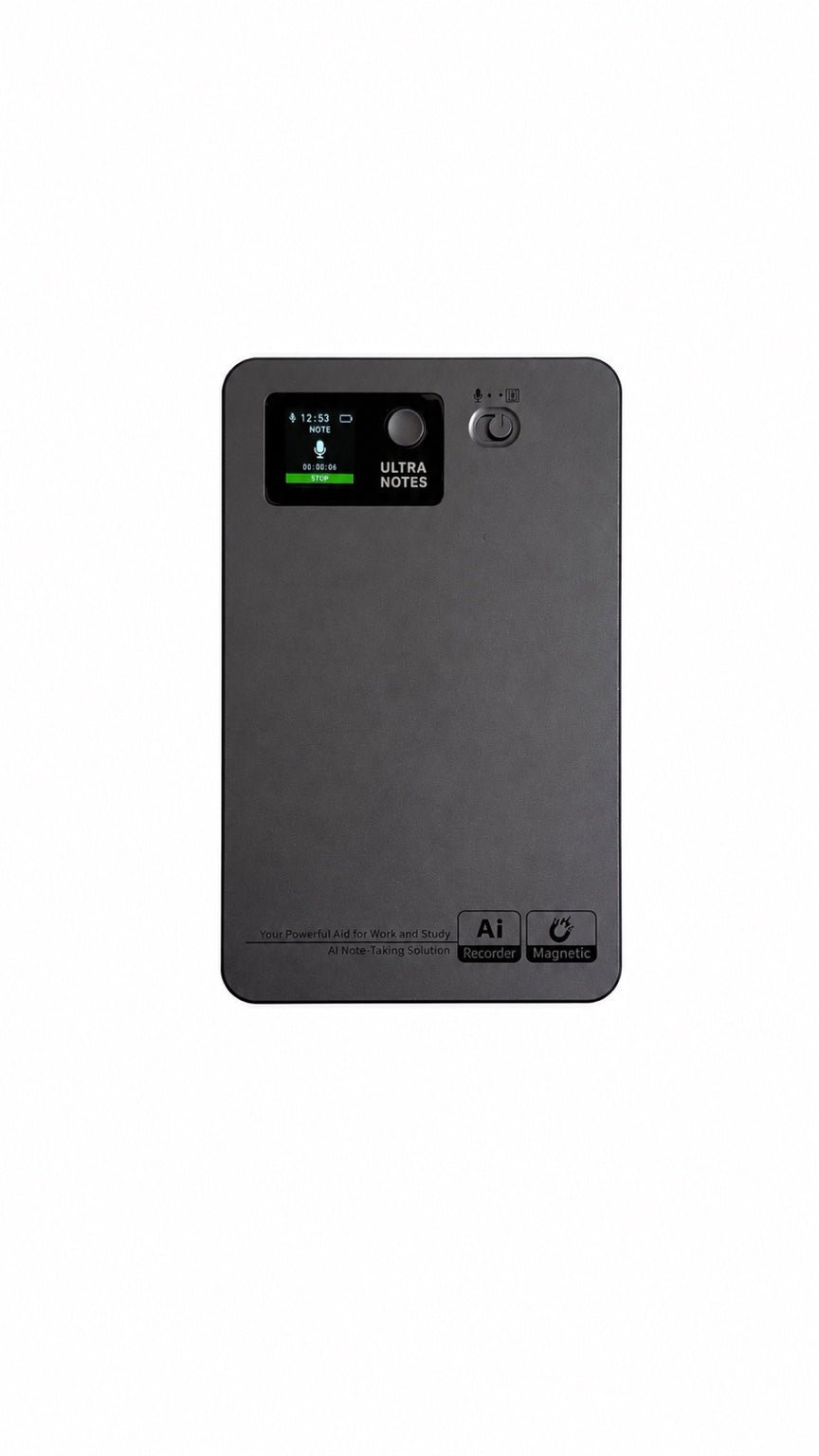
View Halo specifications for accountancy students use can support permitted lectures, private worked-example explanations and consented project meetings. It includes NOTE mode, supported CALL capture, 64GB local storage, up to 35 hours of recording and Bluetooth sync with DOWAY. DOWAY can create transcripts, summaries, speaker-separated notes, templates, translations, mind maps and exportable files, with one year of DOWAY Max included from activation.
Halo is a drafting aid—not an accounting-standard database, calculator, audit file or approved system for confidential client information.
Accountancy-note quality check
- Was the correct framework identified?
- Was the effective period checked?
- Is the technical principle explained?
- Were figures, signs, currencies and units verified?
- Can the calculation be reproduced independently?
- Does the journal or treatment follow the evidence?
- Are judgement and uncertainty visible?
- Is placement or client information protected?
- Is assessed work authentic and attributable?
A strong accountancy recording workflow identifies the right framework and period, explains the principle and proves the final treatment through transparent workings.
Cloud software, a dedicated recorder or manual notes?
For Accountancy Students, the right answer changes with the setting. This matrix deliberately gives each method a situation where it can be the strongest choice.
| Situation | Best starting point | Reason |
|---|---|---|
| scheduled remote consultations | Cloud meeting software | Native remote-meeting workflows can be more efficient here. |
| in-person consultations or ward handovers | Dedicated recorder | A separate battery and recoverable local source improve resilience. |
| a patient declines or policy prohibits recording | Manual notes or an approved alternative | Manual notes are the correct control when recording is unavailable. |
| mixed remote and clinical work | Governed hybrid | A hybrid can combine automation with reliable physical capture. |
Related AI voice recorder guides
See the guides for accountants, auditors, business students and MBA students.
Related guides
Profession workflow
Visual map for AI Voice Recorder for Accountancy Students: Lectures, Worked Examples and Revision Notes
- Prepare the approved useDefine purpose, safe position, permission and the required formal record.
- Capture context firstState the case, asset, person, location or event identifier before detail.
- Human-verify evidenceCheck technical terms, units, names, dates, decisions and uncertainty.
- Complete the formal recordTransfer only verified information and apply access and retention controls.
On this page
Related guides
See whether Halo fits long-form study capture
After checking permission and your institution’s rules, compare Halo’s stated battery, storage and export workflow with the way you actually study.
Found an error or an out-of-date claim? Email support@neralvo.com with the article address and a supporting source.