The 60-second verdict
Business students work with company cases, financial evidence, competing stakeholder interests and group decisions. A recorder can preserve the reasoning behind a recommendation, but it cannot make outdated figures current or turn a familiar framework into justified analysis.
Best fit: Business Students who need recoverable audio and human-verified notes in an authorised workflow. Use another method when: recording is prohibited, a participant declines or the approved process requires manual notes.
Evidence basis and limits
- Decision factors covered: The decision → evidence → options → commitment workflow; Stage 1: Define the decision; Stage 2: Separate facts, assumptions, opinions and unknowns.
- Evidence rule: Claims are weighted by consequence: capture failure, changed meaning, access and recovery matter more than polished wording.
- Boundary: Examples and workflow recommendations must be tested with representative recordings, the intended users and the actual approval process before rollout.
An AI voice recorder for business students can support permitted lectures, private case analysis, presentation rehearsal and consented project meetings. It cannot verify company data, make a strategic decision or replace the student’s independent critical work.
The decision → evidence → options → commitment workflow
| Stage | Business question | Output |
|---|---|---|
| Decision | What precise choice must be made? | Defined problem |
| Evidence | Which dated facts support or challenge the diagnosis? | Verified evidence base |
| Options | What realistic alternatives and trade-offs exist? | Comparable choices |
| Commitment | What is recommended, who acts and how will success be tested? | Accountable recommendation |
This workflow prevents the analysis from starting with a preferred answer and searching for evidence afterwards.
Stage 1: Define the decision
State the decision in one sentence. Include:
- The organisation or business unit.
- The specific choice.
- The relevant time horizon.
- The decision-maker.
- The main constraint.
- The measure of success.
“Analyse the company” is not a decision. “Should the retailer enter market X in the next two years without reducing operating cash below the stated threshold?” is clearer and testable.
Stage 2: Separate facts, assumptions, opinions and unknowns
| Category | Example | Treatment |
|---|---|---|
| Fact | Revenue reported for a named period | Verify source, date, currency and definition |
| Assumption | Customer demand will grow at a stated rate | State basis and test sensitivity |
| Opinion | Management believes the brand is premium | Attribute the source |
| Unknown | Competitor response | Identify research or scenario needed |
AI summaries often present all four categories in the same confident tone. Restore the distinction before analysing the case.
Verify company and market evidence
Company leadership, prices, regulation and performance can change. Record the source and date for every material figure.
Check:
- Annual, quarterly, forecast or trailing period.
- Reported versus adjusted measure.
- Revenue, profit, cash flow and valuation as separate concepts.
- Currency and exchange-rate basis.
- Geographic and segment definitions.
- Whether the source is primary, independent or promotional.
- Whether later information changes the case.
Use company filings, audited reports and reliable official or industry sources where appropriate. Do not invent precision where the evidence is incomplete.
Use frameworks as lenses
SWOT, PESTLE, Five Forces, value-chain and other frameworks can reveal different parts of a problem. They do not produce a recommendation automatically.
For each framework point, ask:
- What evidence supports it?
- Why is it material to this decision?
- What competing interpretation exists?
- What does the framework fail to capture?
- Would the conclusion change without this point?
Remove generic statements that could apply to any company.
Stage 3: Compare real options
Include more than the preferred choice. Depending on the case, options may include:
- Proceed now.
- Pilot or stage the decision.
- Partner, acquire or build internally.
- Choose a narrower segment.
- Delay pending evidence.
- Do nothing.
Compare options using consistent criteria such as value, cost, risk, capability, timing, reversibility and stakeholder impact.
Make stakeholders and trade-offs visible
A recommendation may benefit one group while transferring cost or risk to another. Record:
- Customer effect.
- Employee or supplier effect.
- Investor or lender implications.
- Regulatory and community impact.
- Short-term versus long-term trade-off.
- Who carries implementation risk.
A strong analysis does not hide an adverse consequence merely because the headline financial result looks attractive.
Stage 4: Create an accountable commitment
A recommendation should include:
- The selected option.
- The evidence-based rationale.
- The most important trade-off.
- The assumption that could invalidate it.
- The first implementation step.
- Owner and deadline.
- Leading and outcome measures.
- A review or stop condition.
This turns a classroom recommendation into a decision model that can be challenged.
Use group recordings as decision logs—not surveillance
Where everyone agrees and university rules permit recording, convert a project meeting into:
| Record field | Required detail |
|---|---|
| Decision | What the group agreed |
| Evidence needed | Research still outstanding |
| Action | Specific deliverable |
| Owner | Named accountable member |
| Deadline | Date and time |
| Document | Controlled file to update |
Confirm decisions and owners in writing. AI may misattribute speakers or convert a suggestion into an agreement.
Practise presentations through challenge
A private recording can reveal weak signposting, unsupported claims and poor explanation of figures. After the first rehearsal, ask:
- What is the decision?
- Which evidence is strongest?
- Which assumption is weakest?
- Why is the rejected option inferior?
- What would change the recommendation?
- How will implementation be measured?
Practise answering rather than memorising an AI-generated script.
Protect confidential projects and placements
Live briefs, internships and consultancy modules may involve customer information, internal data, intellectual property or non-disclosure obligations. Do not place that material into a consumer transcription workflow unless the organisation and university approve the device, account and processing route.
A consented classroom group recording does not authorise recording at an employer or client site.
Maintain academic integrity
Follow the exact AI and collaboration rules for each assessment. AI may organise permitted notes, but evidence selection, evaluation and recommendation remain the student’s responsibility.
Do not submit invented data, references, group contributions or generated analysis as independent work. Retain the evidence trail and disclose assistance where required.
A concise business-case voice-note script
- Decision: state the precise choice.
- Evidence: name the source, date and material fact.
- Assumption: identify what is uncertain.
- Options: list realistic alternatives.
- Trade-off: state who benefits and who carries risk.
- Recommendation: give the rationale and stop condition.
- Action: name the next research task, owner and deadline.
How NERALVO Halo can support business study
Check whether NERALVO Halo fits business students work can support permitted lectures, private case analysis, presentations and consented group meetings. It includes NOTE mode, supported CALL capture, 64GB local storage, up to 35 hours of recording and Bluetooth sync with DOWAY. DOWAY can create transcripts, summaries, speaker-separated notes, templates, translations, mind maps and exportable files, with one year of DOWAY Max included from activation.
Halo is a drafting aid—not a company-data source, strategic decision engine or approved system for confidential employer information.
Business-case quality check
- Is the decision precise?
- Are facts, assumptions, opinions and unknowns separated?
- Were dates, currencies and financial definitions verified?
- Does every framework point connect to evidence?
- Were realistic alternatives compared consistently?
- Are stakeholder trade-offs visible?
- Does the recommendation include measures and a stop condition?
- Were group decisions and contributions confirmed?
- Is confidential project information protected?
A strong business-student recording workflow captures the reasoning behind a decision and converts it into a recommendation that can be verified, challenged and implemented.
Cloud software, a dedicated recorder or manual notes?
For Business Students, the right answer changes with the setting. This matrix deliberately gives each method a situation where it can be the strongest choice.
| Situation | Best starting point | Reason |
|---|---|---|
| scheduled remote consultations | Cloud meeting software | Calendar automation and shared integrations are usually the strongest advantage. |
| in-person consultations or ward handovers | Dedicated recorder | Independent capture reduces reliance on an active phone or laptop. |
| a patient declines or policy prohibits recording | Manual notes or an approved alternative | The boundary takes priority over convenience. |
| mixed remote and clinical work | Governed hybrid | Use each method only in the setting it actually fits. |
Related AI voice recorder guides
See the guides for business analysts, project managers, founder meetings and university lecturers.
Related guides
Profession workflow
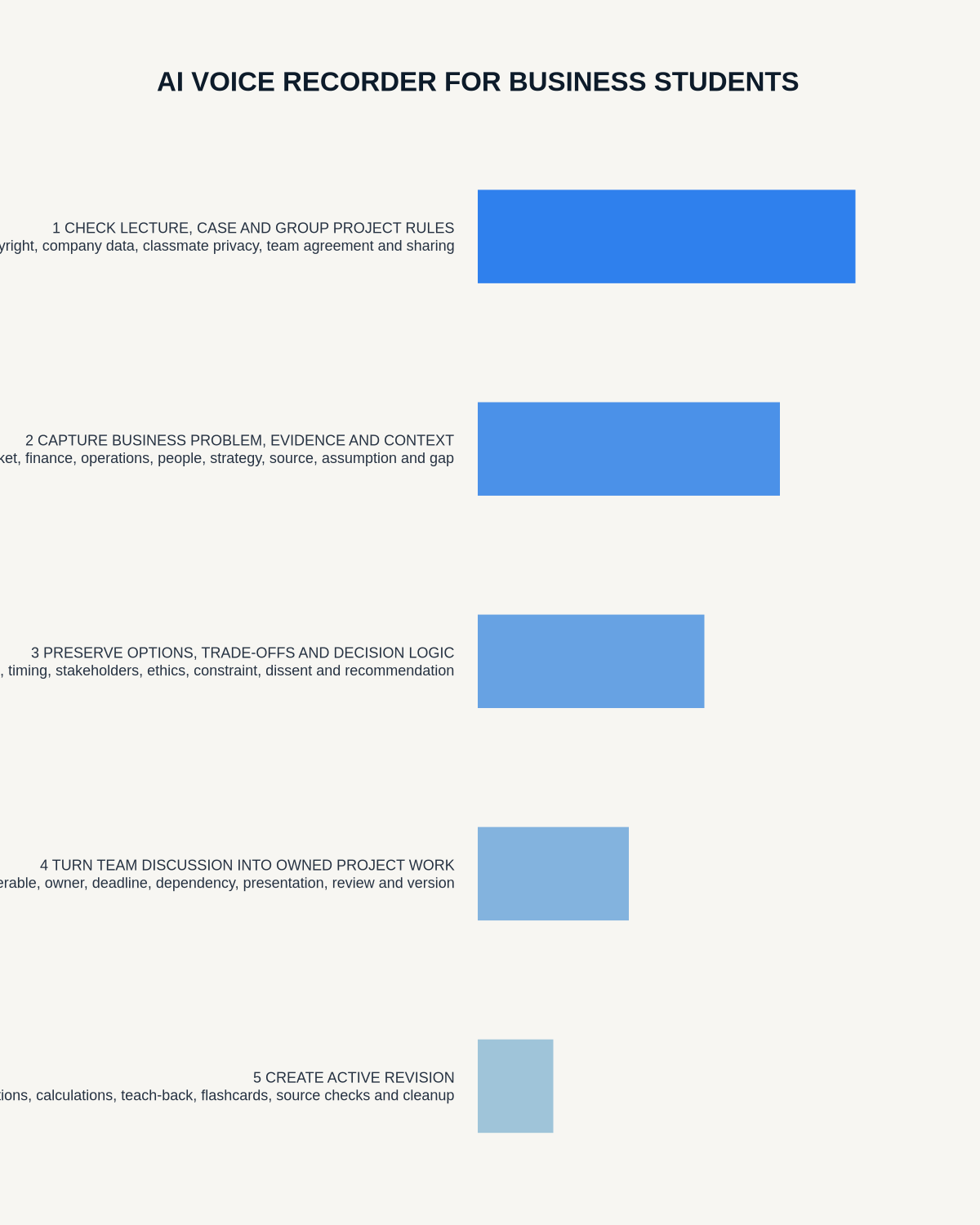
Visual map for AI Voice Recorder for Business Students: Lectures, Case Studies and Group Projects
- Prepare the approved useDefine purpose, safe position, permission and the required formal record.
- Capture context firstState the case, asset, person, location or event identifier before detail.
- Human-verify evidenceCheck technical terms, units, names, dates, decisions and uncertainty.
- Complete the formal recordTransfer only verified information and apply access and retention controls.
On this page
Related guides
See whether Halo fits long-form study capture
After checking permission and your institution’s rules, compare Halo’s stated battery, storage and export workflow with the way you actually study.
Found an error or an out-of-date claim? Email support@neralvo.com with the article address and a supporting source.