
The 60-second verdict
Quick answer: an AI voice recorder can help accountants preserve authorised client explanations and follow-up commitments, but the working paper must keep client statements, documentary evidence, professional analysis and conclusions visibly separate.
Best fit: Accountants who need recoverable audio and human-verified notes in an authorised workflow. Use another method when: recording is prohibited, a participant declines or the approved process requires manual notes.
Evidence basis and limits
- Decision factors covered: The five-column evidence note; Where recording may help; The meeting-to-file protocol.
- Evidence rule: The decision is based on the complete capture-to-action workflow, not a single feature or marketing accuracy percentage.
- Boundary: Examples and workflow recommendations must be tested with representative recordings, the intended users and the actual approval process before rollout.
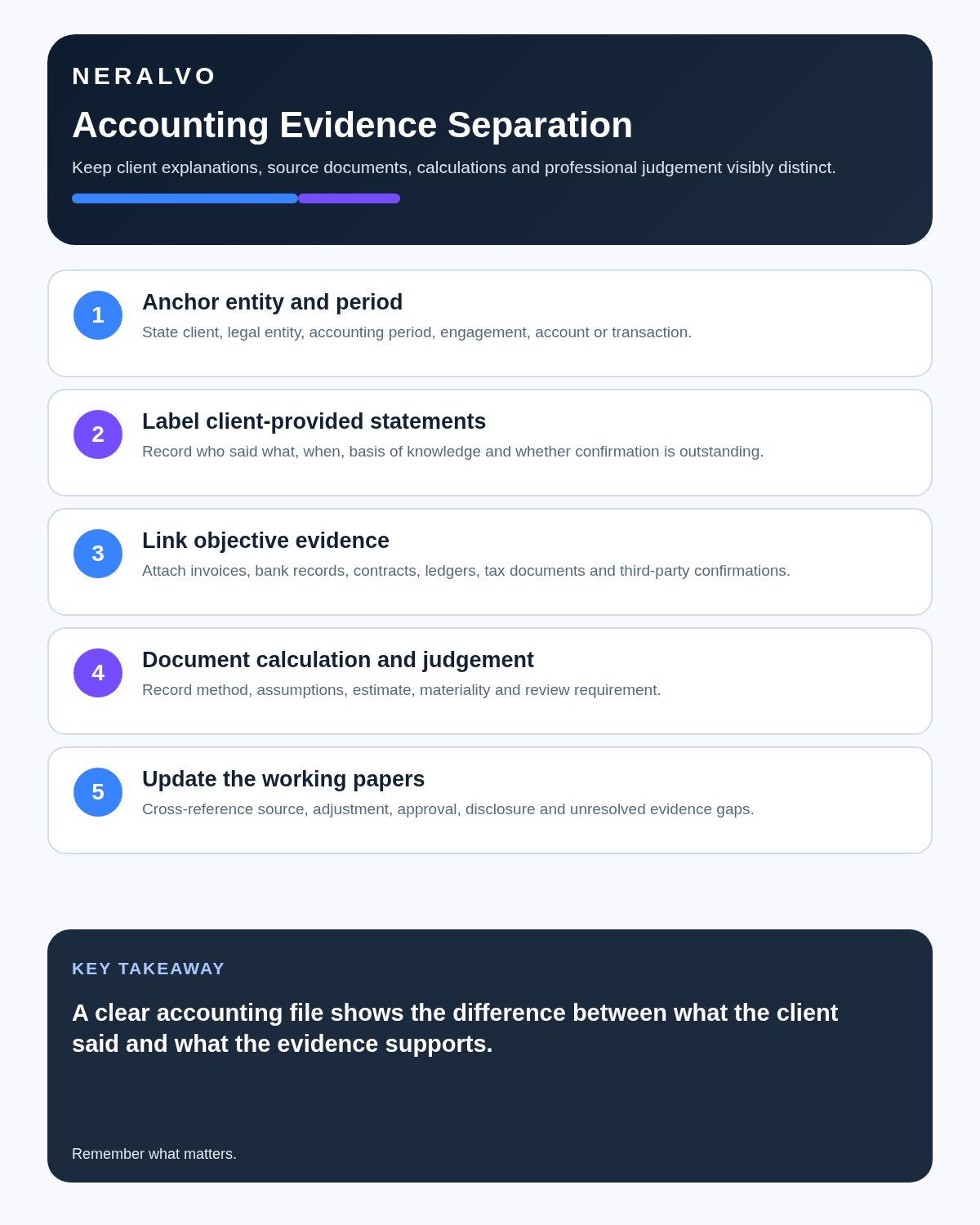
A client meeting can explain an accounting issue. It cannot prove the accounting entry.
An AI recorder helps an accountant recover what the client said, which documents were mentioned and what follow-up was agreed. The professional record must still separate statement, evidence, analysis, advice and conclusion.
The five-column evidence note
| Client statement | Evidence required | Professional analysis | Conclusion status | Action |
|---|---|---|---|---|
| “The £18,000 payment was a director loan.” | Bank record, agreement and ledger detail | Assess legal substance and accounting treatment | Unverified | Client to supply agreement by Friday |
| “Stock fell because damaged items were discarded.” | Stock records and write-off evidence | Assess quantity, valuation and cut-off | Partially supported | Review inventory report |
| “The van is used only for business.” | Ownership, mileage and use records | Consider accounting and tax implications | Pending | Send vehicle questionnaire |
This structure prevents a fluent transcript from becoming an unsupported file conclusion.
Where recording may help
- new-client onboarding covering ownership, systems and responsibilities
- year-end meetings with several balances and missing records
- bookkeeping-query calls involving multiple transactions
- management-account reviews explaining operational variances
- advisory meetings with assumptions and alternatives
- private post-call dictation where client recording is unnecessary
The meeting-to-file protocol
- Decide whether recording is necessary and permitted.
- Explain the purpose and approved processing route.
- Repeat important entity names, figures, periods and dates clearly.
- Generate the transcript through the approved service.
- Correct speakers, terminology, figures and negations.
- Populate the five-column evidence note.
- Compare statements with ledgers, documents and external evidence.
- Prepare the concise professional file note.
- Confirm important advice and responsibilities in writing where appropriate.
- Apply retention to audio, draft transcript and final record separately.
What AI can recover—and what the accountant must decide
| AI may identify | Professional determination |
|---|---|
| A client mentioned a transaction | Substance, recognition, classification and disclosure |
| A figure or deadline was spoken | Whether it agrees to authoritative records or requirements |
| The client proposed a treatment | Whether the treatment is technically correct |
| A document was promised | Whether the evidence is sufficient and reliable |
| The client sounded certain | Whether scepticism and further work remain necessary |
Write advice with assumptions and limits
An AI summary may make an exploratory conversation sound final. The reviewed note should show:
- the question the client asked
- facts and assumptions used
- information still missing
- alternatives discussed
- advice actually provided
- technical or engagement limitations
- client decision and responsibility
- required review or approval
Professional ethics and technology controls
Accountants remain responsible for integrity, objectivity, professional competence and due care, confidentiality and professional behaviour when using recording and AI tools. Technology should support professional judgement rather than weaken scepticism or blur the distinction between explanation and evidence.
Review the ICAEW Code of Ethics resources and the firm’s current technology, confidentiality and quality-management procedures.
Confidentiality across the complete lifecycle
A recording workflow may create local audio, app copies, cloud transcripts, summaries, exports, emails and final notes. The firm should control:
- approved devices and accounts
- processors and subprocessors
- processing location and transfers
- model-training terms
- workspace access and offboarding
- export and public-link settings
- retention and deletion for every copy
- incident response and supplier exit
Do not record payment-card information, passwords, one-time passcodes or recovery keys.
A concise final file-note format
- Client, entity and period
- Purpose and participants
- Material client statements
- Evidence received and outstanding
- Professional analysis completed or pending
- Advice, assumptions and qualifications
- Client instructions or decisions
- Actions, owners and deadlines
- Reviewer and approval status
- Disposition of source audio and transcript
The full transcript should not be pasted into the file merely because it exists.
Where NERALVO Halo fits
View Halo specifications for accountants use is a slim magnetic recorder with 64GB local storage, NOTE and CALL modes, up to 35 hours of recording and Bluetooth transfer to DOWAY. DOWAY can create transcripts, summaries, speaker-separated notes, templates, translations and mind maps, with one year of DOWAY Max included from activation.
NOTE mode may support approved client meetings, internal reviews and private post-call notes. CALL mode is supported rather than universal. The firm should assess the complete device and app workflow before client use.
Cloud software, a dedicated recorder or manual notes?
For Accountants, the right answer changes with the setting. This matrix deliberately gives each method a situation where it can be the strongest choice.
| Situation | Best starting point | Reason |
|---|---|---|
| scheduled remote client meetings | Cloud meeting software | Native remote-meeting workflows can be more efficient here. |
| in-person visits and travel | Dedicated recorder | A separate battery and recoverable local source improve resilience. |
| a client declines or policy requires manual notes | Manual notes or an approved alternative | Manual notes are the correct control when recording is unavailable. |
| mixed CRM and field work | Governed hybrid | A hybrid can combine automation with reliable physical capture. |
Frequently asked questions
Can a transcript prove an accounting treatment?
No. It proves only what was said. The treatment must be supported by appropriate evidence and professional analysis.
Should every client meeting be recorded?
No. Recording should be necessary, proportionate, permitted and useful for the engagement.
Can AI draft the final working paper?
It can support a first draft, but the accountant must verify facts, evidence, analysis, conclusions and review status.
Should raw audio remain on the client file?
Only where the firm’s purpose, policy and retention decision justify it.
Final accounting-record check
- Are client statements separate from evidence?
- Are figures, periods and entities verified?
- Are assumptions and limitations visible?
- Does each conclusion show its evidence and analysis?
- Are actions owned and dated?
- Are all audio and transcript copies controlled?
Bottom line: AI recording can reduce reconstruction work, but it cannot turn a client explanation into sufficient appropriate evidence or replace an accountant’s judgement.
Related AI voice recorder guides
On this page
Related guides
See whether Halo fits this workflow
Review the NERALVO Halo specifications, included services, delivery information and current offer only after completing the guide.
Found an error or an out-of-date claim? Email support@neralvo.com with the article address and a supporting source.