The 60-second verdict
MBA students are expected to move beyond identifying a technically attractive answer. They need to understand organisational context, build support, make an accountable commitment and learn from what implementation produces.
Best fit: MBA Students who need recoverable audio and human-verified notes in an authorised workflow. Use another method when: recording is prohibited, a participant declines or the approved process requires manual notes.
Evidence basis and limits
- Decision factors covered: The context → coalition → commitment → consequence cycle; Stage 1: Diagnose the context; Keep case discussions genuinely discussable.
- Evidence rule: The decision is based on the complete capture-to-action workflow, not a single feature or marketing accuracy percentage.
- Boundary: Examples and workflow recommendations must be tested with representative recordings, the intended users and the actual approval process before rollout.
An AI voice recorder for MBA students can support permitted case discussions, consented team projects, executive-communication practice and private leadership reflection. It cannot make confidential employer information safe to process or replace leadership judgement.
The context → coalition → commitment → consequence cycle
| Stage | Leadership question | Output |
|---|---|---|
| Context | What conditions, incentives and constraints shape the decision? | Organisational diagnosis |
| Coalition | Whose support, challenge or authority is required? | Stakeholder strategy |
| Commitment | What decision, owner and execution model are being chosen? | Accountable action |
| Consequence | What happened, who was affected and what should change? | Leadership learning |
This cycle distinguishes MBA leadership analysis from a standard business-case recommendation.
Stage 1: Diagnose the context
Before proposing a framework, identify:
- The precise management decision.
- Organisation, business model and lifecycle.
- Current performance and dated evidence.
- Formal authority and informal influence.
- Incentives and competing objectives.
- Culture, capability and execution history.
- External market, regulation and stakeholder pressure.
- The assumption most likely to invalidate the diagnosis.
A strategy that is rational on paper may fail because the organisation cannot or will not execute it.
Keep case discussions genuinely discussable
Case-method learning often depends on participants testing unfinished ideas. Routine recording can reduce candour or turn exploratory comments into permanent records.
Follow the instructor’s rule. Where recording is permitted:
- Explain the specific purpose.
- Obtain genuine agreement.
- Respect licensed case restrictions.
- Capture only the useful section.
- Do not redistribute class audio.
- Delete it under the programme arrangement.
Attendance or silence is not an adequate substitute for clear permission.
Stage 2: Map the coalition
| Stakeholder field | Question |
|---|---|
| Interest | What outcome does this group want? |
| Power | What can it approve, block or influence? |
| Evidence | What would change its position? |
| Risk | What cost or loss does it carry? |
| Engagement | Inform, consult, negotiate or involve? |
| Commitment | What specific support is required? |
A voice note can preserve competing interpretations, but it should not become behavioural surveillance of classmates or colleagues.
Stage 3: Make the commitment executable
A leadership recommendation should state:
- The decision.
- The evidence-based rationale.
- The main trade-off.
- The accountable executive or team.
- The first 30-, 60- or 90-day action.
- Resources and capabilities required.
- Leading and outcome measures.
- Escalation and stop conditions.
- Communication to affected stakeholders.
AI can format this list but cannot decide whether the organisation has the authority, resources or legitimacy to proceed.
Convert team meetings into explicit commitments
For a consented project meeting, verify and transfer:
- Decision made.
- Evidence still required.
- Action and owner.
- Deadline.
- Dependency.
- Controlled document to update.
- Unresolved dissent or risk.
Confirm the record in writing. Speaker identification and AI summaries can misattribute a suggestion or make disagreement disappear.
Stage 4: Review consequences, not just intention
Leadership reflection should examine what the decision produced:
- Expected outcome.
- Actual outcome.
- Stakeholder effect.
- Unintended consequence.
- Signal that was missed.
- Assumption that failed.
- The student’s own behaviour and influence.
- What would change in the next decision.
A polished reflection that protects the student’s preferred self-image has little value. Use observable evidence and feedback.
Keep reflection focused on the student
Do not secretly record colleagues for personality or leadership analysis. A private note can examine the student’s own listening, conflict response, use of evidence, power and accountability without creating an archive of other people’s mistakes.
Where a team discussion is recorded, everyone should understand the purpose, access and retention.
Verify current business evidence
Company leadership, results, market conditions, prices and regulation can change. Record the source and date for every material fact.
Separate:
- Audited result.
- Management forecast.
- Analyst estimate.
- Case assumption.
- Student scenario.
Do not allow AI to combine periods, currencies or definitions into a confident but invalid comparison.
Protect employer and client information
Live projects may contain strategy, pricing, customer information, personnel issues, security detail or intellectual property. Do not upload that material to a consumer transcription service unless the employer, client and university approve the device, account and processing route.
Use minimum necessary information and transfer final decisions into the approved project system. Follow non-disclosure and retention requirements.
Practise executive communication
A useful private rehearsal answers:
- What decision is required?
- Why now?
- Which evidence matters most?
- What is the strongest objection?
- What trade-off is being accepted?
- Who owns execution?
- How will progress and failure be recognised?
Practise concise answers rather than memorising generated management language.
Maintain academic integrity
Follow the specific AI, case and collaboration rules for each assessment. Do not submit invented data, executive interviews, project contributions or generated analysis as independent work.
The student remains responsible for evidence selection, critical evaluation, recommendation and reflection.
A concise MBA leadership voice-note script
- Context: state the decision and organisational constraint.
- Evidence: identify the dated fact and key assumption.
- Coalition: name the stakeholder, power and required support.
- Commitment: state decision, owner and first action.
- Measure: define success and stop conditions.
- Consequence: identify impact and possible unintended effect.
- Reflection: state what the student would do differently.
How NERALVO Halo can support MBA study
View Halo specifications for mba students use can support permitted case discussions, consented project meetings, private leadership reflection and presentation practice. It includes NOTE mode, supported CALL capture, 64GB local storage, up to 35 hours of recording and Bluetooth sync with DOWAY. DOWAY can create transcripts, summaries, speaker-separated notes, templates, translations, mind maps and exportable files, with one year of DOWAY Max included from activation.
Halo is a drafting aid—not a leadership assessor or approved system for confidential employer and client information.
MBA-note quality check
- Was the organisational context diagnosed before selecting a framework?
- Was class or team recording genuinely permitted?
- Were stakeholders, incentives and power mapped?
- Does the commitment include ownership and execution?
- Are consequences and dissent preserved?
- Is leadership reflection evidence-based and focused on the student?
- Were current business facts verified?
- Is confidential project information protected?
- Is assessed work independent and attributable?
A strong MBA recording workflow captures not only what decision appears attractive, but how leaders build commitment, execute it and learn from the consequences.
Cloud software, a dedicated recorder or manual notes?
For MBA Students, the right answer changes with the setting. This matrix deliberately gives each method a situation where it can be the strongest choice.
| Situation | Best starting point | Reason |
|---|---|---|
| scheduled remote consultations | Cloud meeting software | Native remote-meeting workflows can be more efficient here. |
| in-person consultations or ward handovers | Dedicated recorder | A separate battery and recoverable local source improve resilience. |
| a patient declines or policy prohibits recording | Manual notes or an approved alternative | Manual notes are the correct control when recording is unavailable. |
| mixed remote and clinical work | Governed hybrid | A hybrid can combine automation with reliable physical capture. |
Related AI voice recorder guides
See the guides for business students, executive assistants, project managers and business analysts.
Related guides
Profession workflow
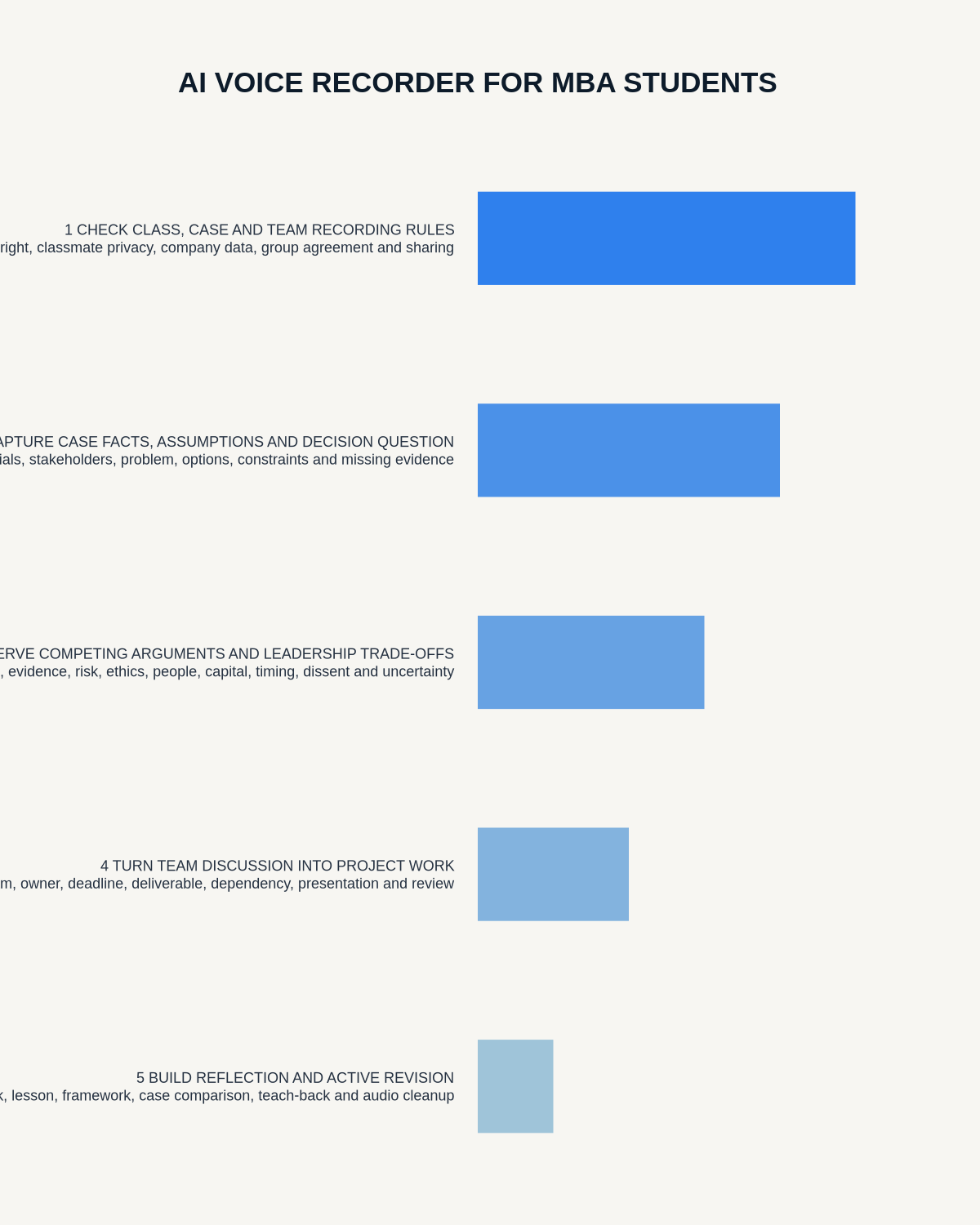
Visual map for AI Voice Recorder for MBA Students: Case Discussions, Team Projects and Leadership Reflection
- Prepare the approved useDefine purpose, safe position, permission and the required formal record.
- Capture context firstState the case, asset, person, location or event identifier before detail.
- Human-verify evidenceCheck technical terms, units, names, dates, decisions and uncertainty.
- Complete the formal recordTransfer only verified information and apply access and retention controls.
On this page
Related guides
See whether Halo fits long-form study capture
After checking permission and your institution’s rules, compare Halo’s stated battery, storage and export workflow with the way you actually study.
Found an error or an out-of-date claim? Email support@neralvo.com with the article address and a supporting source.