The 60-second verdict
Quick answer: compliance officers can use an AI voice recorder to preserve authorised interview evidence, but every statement should be linked to the applicable requirement, test method, evidence source, finding and remediation action. Legal conclusions, severity ratings, risk acceptance and closure decisions must remain under authorised human control.
Best fit: Compliance Officers who need recoverable audio and human-verified notes in an authorised workflow. Use another method when: recording is prohibited, a participant declines or the approved process requires manual notes.
Evidence basis and limits
- Decision factors covered: Define the review before recording; Capture interview statements accurately; Create a requirement-evidence-test record.
- Evidence rule: A claim earns weight only when the source, date, configuration and limitation are clear enough for a reader to check.
- Boundary: Examples and workflow recommendations must be tested with representative recordings, the intended users and the actual approval process before rollout.
Compliance work needs a traceable line from obligation to evidence, conclusion and verified remediation. A fluent transcript can help reconstruct an interview, but it cannot prove that a control operated or decide that a breach occurred.

Define the review before recording
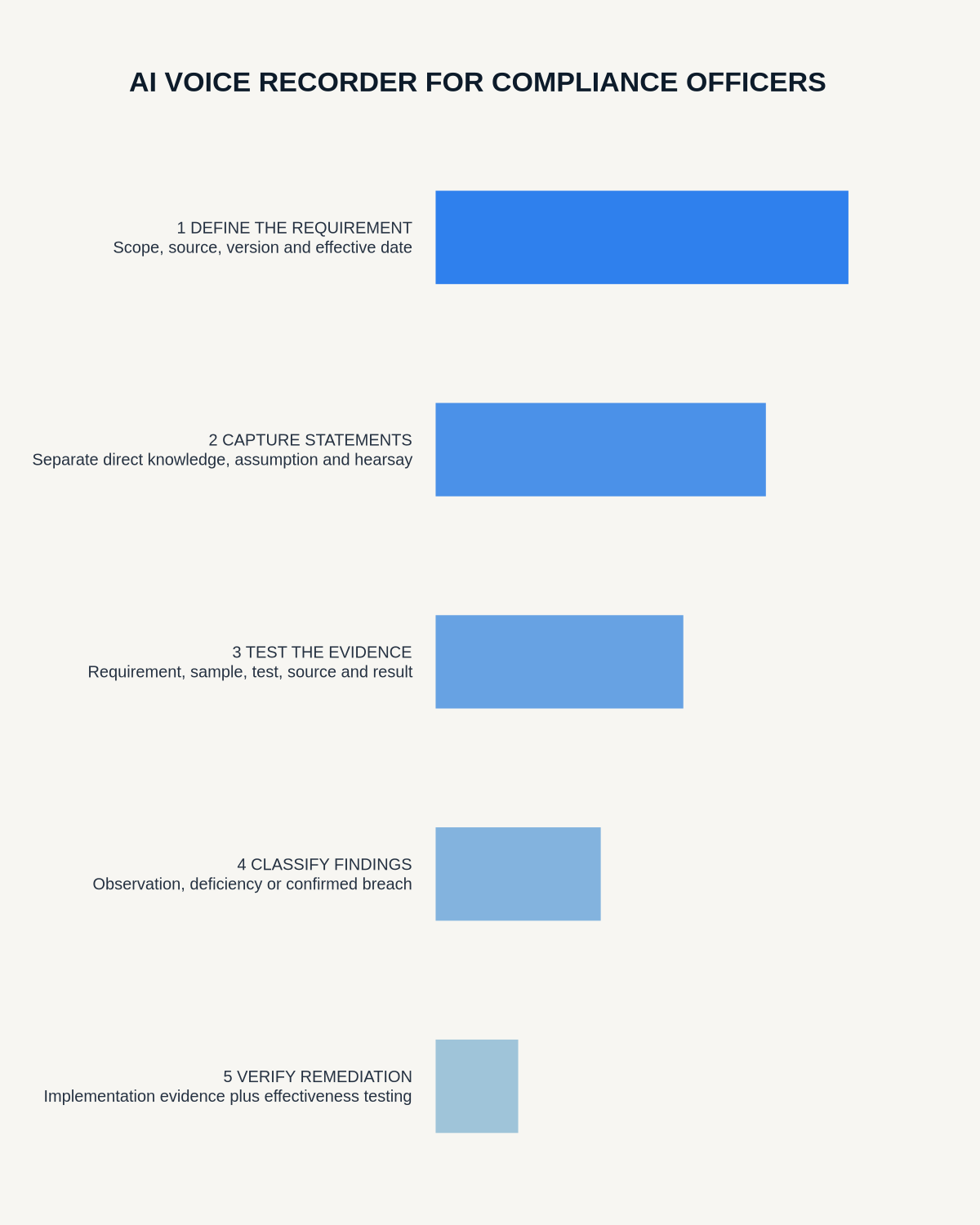
State whether the work is routine monitoring, a thematic review, assurance testing or an investigation. Record the business area, period, systems, locations, sample and exclusions. Identify each requirement by source, section, version and effective date.
Participants should understand whether the work is advisory, monitoring or investigative and how their information may be used.
Capture interview statements accurately
Start each file with the review reference, interviewee role, interviewer, date and purpose. Separate direct knowledge from assumption, hearsay and descriptions of normal practice.
A statement such as “we always complete the check” should be tested against documents, system records, samples or observation. Correct names, dates, figures, control references and negative wording against the audio.
Create a requirement-evidence-test record
- Requirement: the obligation or control statement.
- Population and sample: what was eligible and selected.
- Test: inspection, observation, reperformance, interview or analysis.
- Evidence: the document, system output or observation obtained.
- Result: pass, exception, inconclusive or not tested.
- Limitation: missing data, restricted access or unreliable source.
This prevents an interview description from becoming the sole evidence of control effectiveness.
Classify findings carefully
- Observation: a relevant point or improvement opportunity.
- Control deficiency: a control is absent, poorly designed or not operating as intended.
- Confirmed non-compliance: evidence meets the applicable criteria and the reviewer has authority to classify it.
Preserve contrary evidence and management explanations. Do not let AI-generated text decide that a regulatory threshold has been met.
Assess severity transparently
Use the approved method and record impact, likelihood, duration, affected population, detectability and mitigating controls where relevant. Risk ratings should not be generated automatically from interview tone or wording.
Test root cause rather than guessing
Separate the immediate cause from the underlying cause. An individual error may reflect unclear ownership, system design, workload, incentives, training or weak supervision. Test the hypothesis before designing remediation.
Build controlled remediation
Each action should identify:
- the finding addressed;
- owner and due date;
- specific deliverable;
- dependencies;
- implementation evidence;
- effectiveness test.
A revised procedure may prove implementation, but it does not prove that the control works consistently. Keep the finding open or appropriately qualified until the closure test is complete.
Manage governance and escalation
Track overdue actions, disputed findings, accepted risks and matters requiring senior or specialist review. Risk acceptance should name the authorised owner, rationale, conditions and review date.
Use a controlled post-review workflow
- Transfer recordings under the review reference.
- Correct transcripts and remove unnecessary personal information.
- Map statements to requirements and evidence.
- Draft findings with contrary evidence and limitations.
- Complete severity and root-cause review.
- Agree remediation and closure evidence.
- Validate implementation and test effectiveness.
- Retain or delete source audio under the approved schedule.
Cloud software, a dedicated recorder or manual notes?
For Compliance Officers, the right answer changes with the setting. This matrix deliberately gives each method a situation where it can be the strongest choice.
| Situation | Best starting point | Reason |
|---|---|---|
| scheduled remote meetings | Cloud meeting software | Auto-join and central collaboration can remove routine admin. |
| in-person or mobile work | Dedicated recorder | Dedicated hardware suits movement, variable rooms and offline source capture. |
| recording is refused or prohibited | Manual notes or an approved alternative | A clear alternative respects policy and participant choice. |
| mixed online and offline work | Governed hybrid | One governed process prevents gaps between desk and field work. |
Frequently asked questions
Can an interview prove that a control works?
No. It is one evidence source and should be tested against records, samples, observation or reperformance.
Can AI decide whether a breach occurred?
No. Regulatory interpretation and formal conclusions require authorised human judgement.
When is remediation complete?
When required implementation evidence exists and any necessary effectiveness test confirms that the control operates.
Should raw audio enter the compliance report?
Usually not. Use a checked, minimised finding record and restrict source access.
Useful resources
- ICO accountability and governance guidance
- Quarterly AI Voice Recording Governance Review Checklist
- AI Voice Recorder for Ombudsman Investigators
- Assess Halo against the compliance officers workflow matrix
Compliance checklist
- Scope and requirement version clear
- Statements attributed and evidence-tested
- Population and sample documented
- Observations, deficiencies and breaches separated
- Severity and root cause supported
- Every action has owner, date and closure evidence
- Effectiveness tested
- Human approval retained
On this page
Related guides
Check permission, retention and access before choosing hardware
Once the policy requirements in this guide are satisfied, compare Halo’s specifications, local storage, included services and current offer against your approved workflow.
Found an error or an out-of-date claim? Email support@neralvo.com with the article address and a supporting source.