The 60-second verdict
There is no single answer to “Can I record this meeting in the UK?” The correct decision depends on the purpose, participants, setting, organisational policy, professional duties, confidentiality, data protection and what will happen to the recording afterwards.
Use this guide when: the recording purpose, authority, participants, access and retention can be defined. Pause when: any of those controls is unclear.
Evidence basis and limits
- Decision factors covered: Use a six-gate decision; Record openly, not as a surprise; Workplace meetings need extra care.
- Evidence rule: A claim earns weight only when the source, date, configuration and limitation are clear enough for a reader to check.
- Boundary: This is practical information, not legal advice. Verify current ICO guidance, sector rules, contracts and organisational policy for the real use case.
This guide is a practical decision process rather than legal advice. For workplace, regulated or sensitive meetings, check current official guidance, contracts, internal policy and professional advice before recording.
Use a six-gate decision
| Gate | Question | Stop condition |
|---|---|---|
| 1. Purpose | What specific record or output is needed? | The purpose is vague or unrelated to the meeting. |
| 2. Authority | Who is authorised to approve recording? | No clear owner or policy route exists. |
| 3. People | Who will attend, including late joiners and remote participants? | Required notice or agreement cannot be provided. |
| 4. Sensitivity | Will the meeting cover health, employment, legal, financial or confidential information? | The proposed controls do not match the sensitivity. |
| 5. Technology | Where will audio and AI outputs be processed and stored? | The supplier, account or data route is not approved. |
| 6. Lifecycle | Who verifies, shares, retains and deletes the material? | No controlled destination or deletion rule exists. |
Record openly, not as a surprise
Where recording is approved, explain it before starting. A practical opening is:
“I would like to record this meeting so I can prepare an accurate note. The recording will be used for that purpose, available only to the authorised team and handled under our retention process. Is everyone content to proceed?”
Confirm the response on the record. Repeat the notice for anyone who joins late. If the meeting changes purpose or becomes more sensitive, pause and reassess.
Workplace meetings need extra care
For disciplinary, grievance, investigation, performance or occupational-health discussions, follow the organisation’s current policy and check current Acas guidance. Consider power imbalance, fairness, companion or representative rights, confidentiality and whether recording could inhibit participation.
An AI transcript should not replace the fair process, evidence review, approved minutes or decision letter required by the organisation.
Protect confidential and privileged material
Client, legal, commercial, safeguarding or security discussions may have separate restrictions. Confirm who may hear the recording and whether particular sections should not be captured. Never assume that participation in a meeting authorises unrestricted reuse or distribution.
Offer a real alternative
When someone declines recording, consider:
- a named note-taker
- agreed written minutes
- a post-meeting decision summary
- recording only a non-sensitive demonstration
- a separate approved call for the required information
Do not pressure a participant into accepting recording simply because the technology is convenient.
Run the meeting for accurate capture
- State names and roles at the start.
- Use one speaker at a time.
- Spell unusual names and references.
- Separate proposals from decisions.
- State objections and unresolved questions.
- Name one owner and date for every action.
- Recap the final position before ending.
Verify and transfer
After the meeting, correct names, figures, dates and speaker labels against the audio. Transfer verified decisions and actions into the approved case, HR, CRM or project system. Mark the official record clearly and apply the organisation’s retention rule to raw audio, transcript and exports.
How NERALVO Halo may support approved meetings
Check Halo specifications before applying this guidance provides NOTE recording for suitable meetings, supported CALL capture for compatible calls, 64GB local storage, up to 35 hours of recording and Bluetooth sync with DOWAY. DOWAY can generate transcripts and structured outputs, with one year of DOWAY Max from activation.
The device does not decide whether a meeting may be recorded. Approval, transparency, data handling and professional judgement remain with the organisation and participants.
Meeting-recording closeout
- The purpose and authority were clear.
- Participants received appropriate notice.
- Late joiners were informed.
- Sensitive sections were handled deliberately.
- The transcript was verified.
- The authoritative record was identified.
- Access and retention were applied.
- Any refusal or objection was respected and documented.
The safest approach is not to search for a blanket yes or no. It is to make a documented, purpose-specific decision for the actual meeting.
Workflow choice matrix for Recording Meetings in the UK
Apply the strongest control before choosing a device. The table makes the non-hardware options explicit.
| Condition | Preferred route | Why |
|---|---|---|
| Repeatable remote work with approved integrations | Cloud software | Automation and central collaboration may outweigh device independence. |
| In-person, mobile or unreliable-connectivity work | Dedicated recorder | Independent capture and a recoverable local source are usually more resilient. |
| Recording is refused, prohibited or unnecessary | Manual notes / no recording | Respecting the boundary is the correct workflow, not a product failure. |
| High-risk or mixed work | Governed hybrid | Separate capture, review, approval and retention rather than trusting one tool. |
Related guides
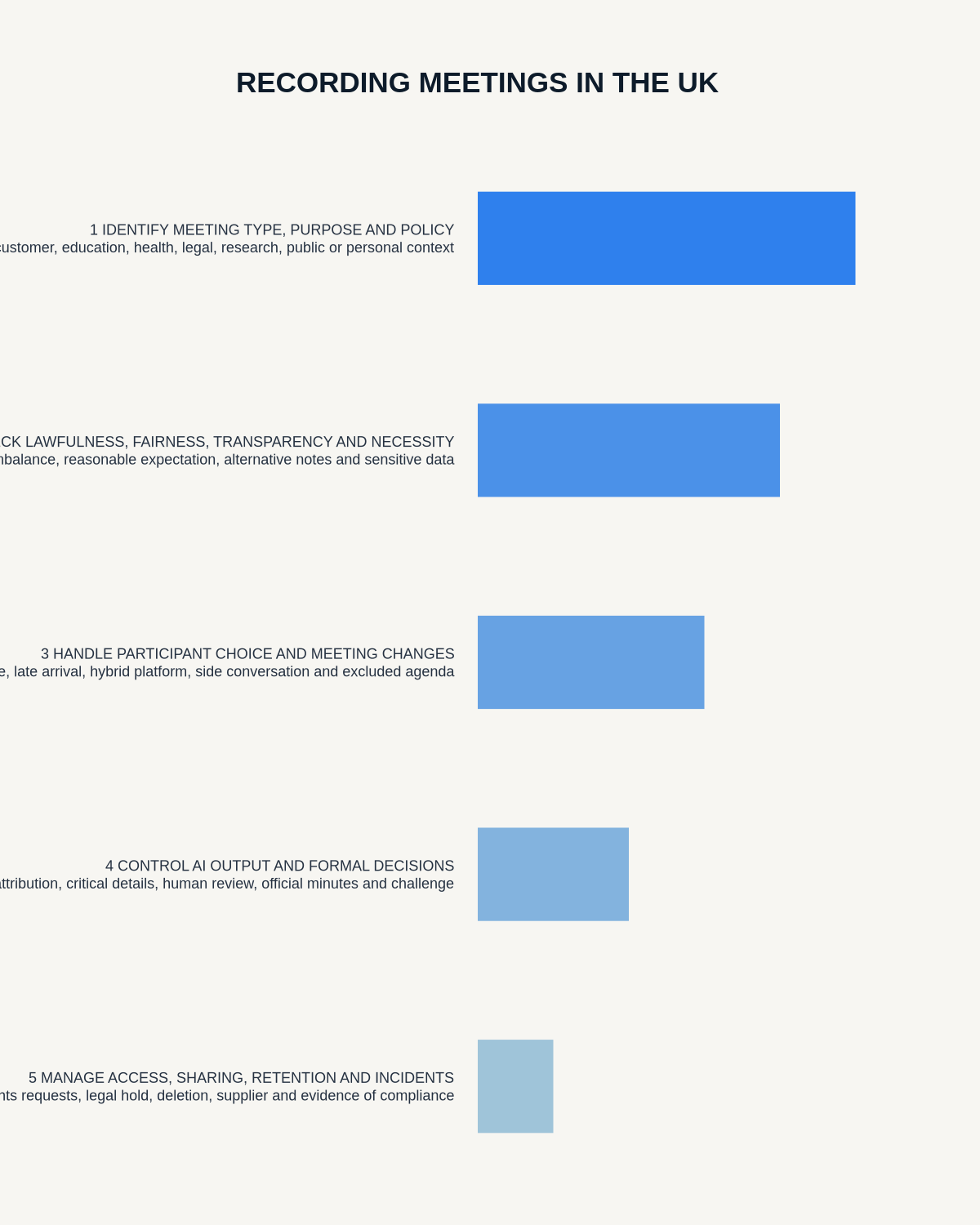
Governance control flow
Visual map for Recording Meetings in the UK: Legal, Privacy and Policy Checklist
- Confirm purpose and authorityCheck law, policy, participant information and an approved alternative.
- Minimise captureRecord only what the stated purpose requires.
- Verify and restrict accessHuman-check material details and protect raw audio and transcripts.
- Retain or delete deliberatelyApply the matter, policy or statutory retention rule.
On this page
Related guides
Check permission, retention and access before choosing hardware
Once the policy requirements in this guide are satisfied, compare Halo’s specifications, local storage, included services and current offer against your approved workflow.
Found an error or an out-of-date claim? Email support@neralvo.com with the article address and a supporting source.