
The 60-second verdict
Quick answer: consultants can use an AI voice recorder for authorised interviews and workshops, but the final deliverable must separate source material, stakeholder statements, coded evidence, hypotheses, conclusions and recommendations.
Best fit: Consultants who need recoverable audio and human-verified notes in an authorised workflow. Use another method when: recording is prohibited, a participant declines or the approved process requires manual notes.
Evidence basis and limits
- Decision factors covered: The five-link evidence chain; Separate experience from explanation; Create an evidence register.
- Evidence rule: A claim earns weight only when the source, date, configuration and limitation are clear enough for a reader to check.
- Boundary: Examples and workflow recommendations must be tested with representative recordings, the intended users and the actual approval process before rollout.
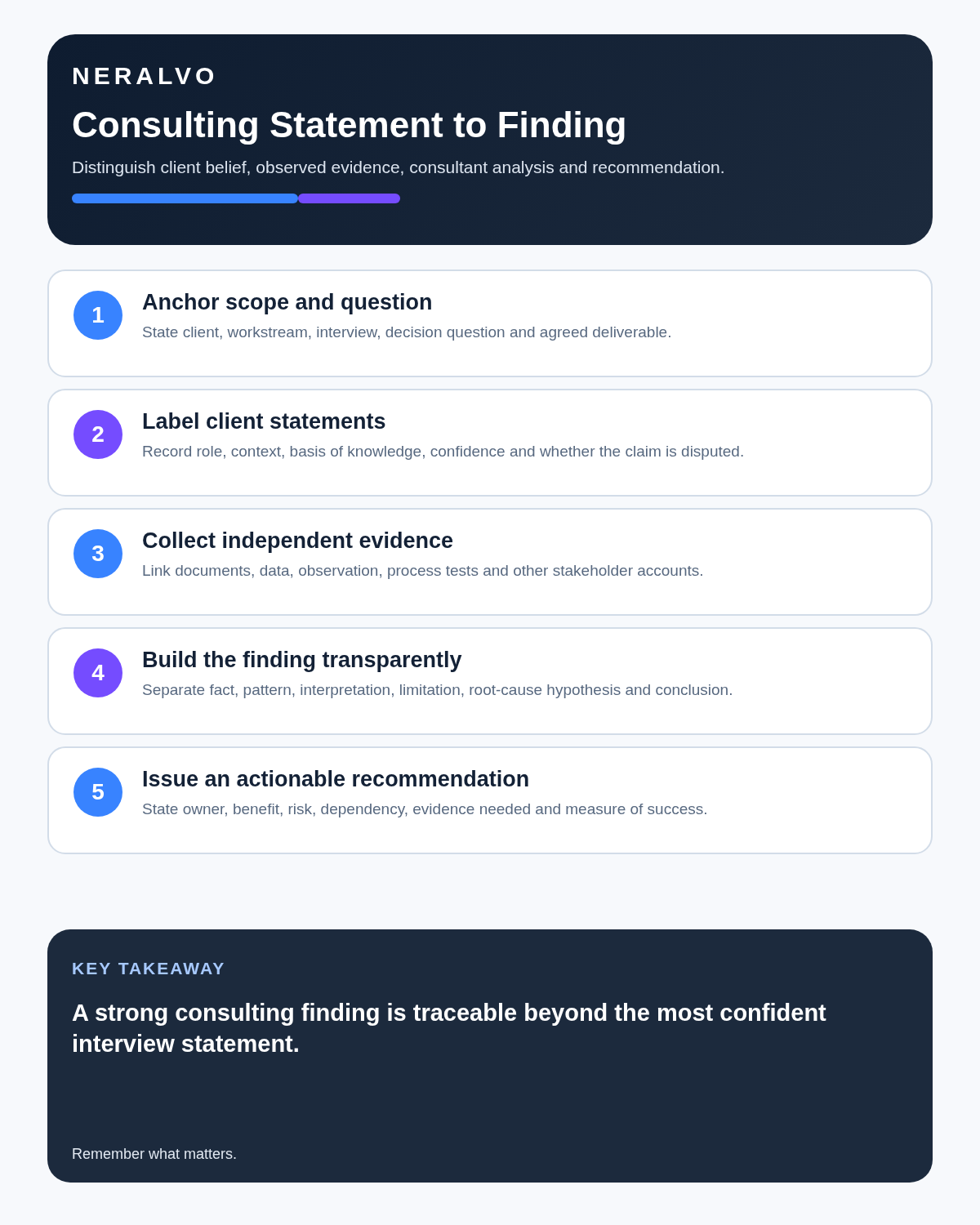
A consulting transcript is not a finding. It is one source inside an evidence chain.
The defensible sequence is source material, coded evidence, tested hypothesis, conclusion and recommendation. Skipping a stage allows one confident stakeholder, repeated rumour or attractive AI summary to become “the client truth”.
The five-link evidence chain
| Link | Consulting purpose | Quality check |
|---|---|---|
| Source | Audio, transcript, document, data or observation | Can it be identified and revisited? |
| Coded evidence | Relevant extract classified consistently | Does the passage retain context and attribution? |
| Hypothesis | Possible explanation of the problem | What evidence would disprove it? |
| Conclusion | Best-supported interpretation | Does it acknowledge uncertainty and contradiction? |
| Recommendation | Proposed client action | Is it feasible, proportionate and linked to evidence? |
Define the question and sample before interviewing
“Talk about operations” is not a research question. A stronger purpose is: “Identify why supplier onboarding exceeds the 20-day target and which stages create avoidable delay.”
Plan perspectives such as:
- process owners;
- frontline users;
- different locations or business units;
- customers or suppliers where relevant;
- technology and data owners;
- people affected by exceptions.
Several similar interviews from one team cannot establish organisation-wide consensus.
Separate experience from explanation
Useful follow-up questions include:
- Did you observe that directly?
- Can you give a recent example?
- How often does it happen?
- Which system or document would confirm it?
- Who experiences the process differently?
- What evidence would show this explanation is wrong?
Code each statement as direct experience, opinion, hearsay, proposed solution or verified fact.
Create an evidence register
| Field | Example |
|---|---|
| Research question | Why does onboarding exceed target? |
| Evidence reference | INT-07, 00:24:18–00:25:11 |
| Stakeholder group | Procurement operations |
| Evidence statement | Risk-category changes repeat three approvals |
| Evidence type | First-hand operational experience |
| Corroboration | Workflow log and two further interviews |
| Contradiction | Policy owner says only one approval should repeat |
| Interpretation | System routing may differ from intended policy |
| Confidence | Medium pending configuration review |
| Next test | Analyse 30 recent cases |
Run the contradiction test
- Which interviews disagree?
- Is the strongest quotation an unusual case?
- Are repeated views independent or part of one shared narrative?
- Does operational data support the claim?
- Is the participant describing policy or actual practice?
- Could another cause explain the same symptom?
- Which stakeholder group is missing?
A finding becomes stronger when it survives challenge, not when the team collects more similar quotations.
Do not count themes as truth
Frequency can matter, but repeated statements are not automatically representative or accurate. One rare interview may reveal a serious control failure, while repeated opinions may reflect the same incorrect assumption.
Record the number of independent sources, sample coverage, evidence type, supporting documents or data, contradictions and confidence level.
Workshops need a different output
Separate:
- confirmed facts;
- assumptions requiring evidence;
- options;
- authorised decisions;
- actions with owners and dates;
- open questions;
- out-of-scope topics.
Enthusiasm in the room is not client approval.
Keep private consultant memos labelled
A post-interview dictation can capture hypotheses, contradictions and next questions. Label it as analyst interpretation and do not store personal impressions as stakeholder evidence.
Client-data and supplier controls
Consulting recordings may contain strategy, employee information, financial data, legal advice and security detail. Review:
- the engagement contract and client instructions;
- controller and processor responsibilities;
- processing locations and international transfers;
- subprocessors and model-training terms;
- workspace access and public-link settings;
- retention, deletion and export;
- incident notification and service exit.
See the ICO’s IT supplier guidance.
Professional standards and transparency
Professional consulting standards emphasise ethical behaviour, client service, transparency and value. Recorded research should therefore explain how evidence was collected, avoid overstating representativeness, protect client material and make uncertainty visible.
The Management Consultancies Association’s Consulting Excellence principles and the Chartered Management Consultant framework provide useful professional context for evidence handling, ethics and client value.
Where NERALVO Halo fits
Assess Halo against the consultants workflow matrix provides NOTE mode, supported CALL capture, 64GB local storage, up to 35 hours of recording and DOWAY transcripts, summaries and structured notes. It may support approved discovery interviews, process walkthroughs, workshops and private consultant memos.
The client and consulting firm should approve the complete processing route before confidential material is captured.
Cloud software, a dedicated recorder or manual notes?
For Consultants, the right answer changes with the setting. This matrix deliberately gives each method a situation where it can be the strongest choice.
| Situation | Best starting point | Reason |
|---|---|---|
| scheduled remote client meetings | Cloud meeting software | Auto-join and central collaboration can remove routine admin. |
| in-person visits and travel | Dedicated recorder | Dedicated hardware suits movement, variable rooms and offline source capture. |
| a client declines or policy requires manual notes | Manual notes or an approved alternative | A clear alternative respects policy and participant choice. |
| mixed CRM and field work | Governed hybrid | One governed process prevents gaps between desk and field work. |
Frequently asked questions
Can a transcript become a consulting finding?
No. It is source material that must be coded, corroborated, challenged and interpreted.
Can AI generate the final recommendation?
It can organise evidence, but accountable consultants must test the reasoning, feasibility, risk and client impact.
Does repeated mention prove a problem is widespread?
No. Consider sample design, source independence, operational data and contradictory evidence.
Should all interviews be recorded?
No. Use recording only where approved, necessary and proportionate.
Final deliverable test
- Can the underlying source be located?
- Was the passage corrected and kept in context?
- Is it direct evidence or interpretation?
- What corroborates it?
- What contradicts it?
- How representative is the sample?
- What uncertainty remains?
- Does the recommendation follow from the evidence?
Bottom line: build an auditable chain, test contradictions and keep every recommendation connected to reviewed source material and client outcomes.
Related guides
On this page
Related guides
See whether Halo fits this workflow
Review the NERALVO Halo specifications, included services, delivery information and current offer only after completing the guide.
Found an error or an out-of-date claim? Email support@neralvo.com with the article address and a supporting source.