
The 60-second verdict
Quick answer: customer-success teams can use an AI voice recorder to build a verified account timeline across onboarding, adoption, QBRs, escalations and renewal, while keeping the CRM, success plan and support systems authoritative.
Best fit: Customer Success who need recoverable audio and human-verified notes in an authorised workflow. Use another method when: recording is prohibited, a participant declines or the approved process requires manual notes.
Evidence basis and limits
- Decision factors covered: The account-timeline model; Onboarding: establish the baseline; Adoption reviews: connect behaviour to cause.
- Evidence rule: A claim earns weight only when the source, date, configuration and limitation are clear enough for a reader to check.
- Boundary: Examples and workflow recommendations must be tested with representative recordings, the intended users and the actual approval process before rollout.
Customer-success notes become useful when they show how the account changed over time.
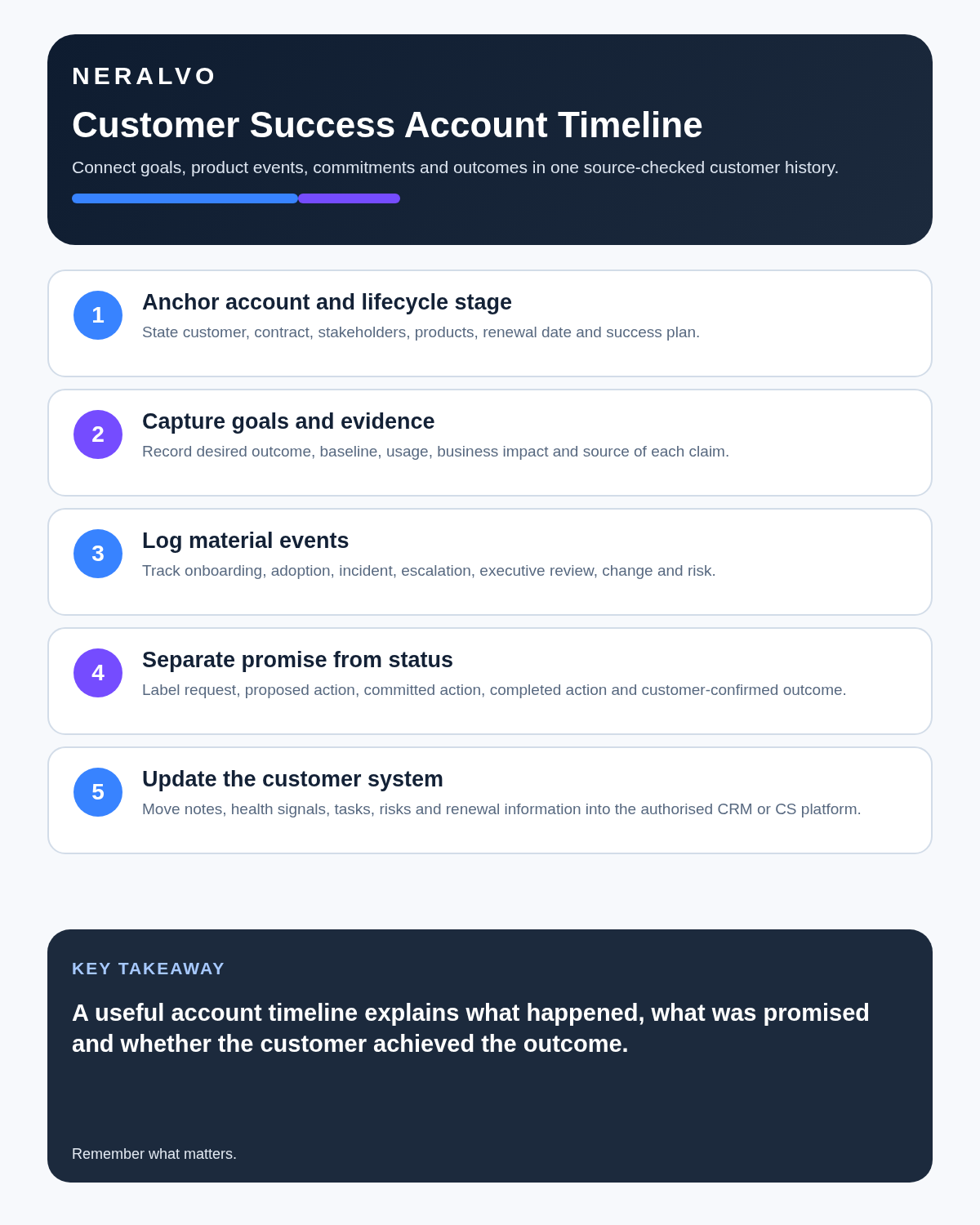
A single meeting summary cannot explain whether an onboarding blocker was resolved, a promised integration was delivered or a renewal concern has repeated for six months. The account timeline connects each verified conversation to the next decision.
The account-timeline model
| Timeline entry | What to record |
|---|---|
| Customer goal | Outcome, measure and target date in the customer’s language |
| Evidence | Usage, result, quotation or operational example |
| Blocker | What prevents progress and which workflow is affected |
| Commitment | Exact action, owner and deadline |
| Stakeholder change | New sponsor, lost champion, user group or decision authority |
| Risk signal | Verified concern and business impact |
| Intervention | Training, technical work, escalation or commercial action |
| Result | What changed after the intervention |
Onboarding: establish the baseline
An approved onboarding recording should produce a success baseline:
- business outcome
- current process
- success measure
- implementation responsibilities
- data or integration dependencies
- training audiences
- executive and operational stakeholders
- first value milestone
The customer should receive a reviewed recap. Hidden internal hypotheses should stay out of the customer-facing version.
Adoption reviews: connect behaviour to cause
Usage data may show low activity. The conversation may explain missing permissions, slow workflows, a departed champion or incomplete training. Capture the explanation, then verify it through product data, support records or the responsible stakeholder.
QBRs: compare outcome against baseline
A strong QBR record contains:
- original goal
- current result
- evidence and method
- value gap
- strategic changes
- stakeholder changes
- open commitments
- renewal or expansion implications
- next measurable milestone
Do not replace evidence with “customer happy”. Record the result recognised by the customer and what remains unresolved.
Escalations: preserve severity without creating promises
| Category | Example |
|---|---|
| Customer account | What they report happened |
| Verified fact | Confirmed incident or product behaviour |
| Business impact | Users, revenue, compliance or deadline affected |
| Requested remedy | What the customer wants |
| Agreed commitment | What an authorised person actually promised |
| Unknown | What still requires investigation |
An AI summary should not soften the concern or turn a proposed remedy into an agreed commitment.
Renewal risk requires a traceable signal
Useful signals include incomplete implementation, missing outcomes, sponsor loss, supplier review, repeated unresolved issues, changed budget ownership, concentrated usage and explicit price, value or trust concerns.
For every risk, link the source meeting, date, stakeholder, business impact, mitigation, owner and reassessment date.
Do not turn sentiment into a health score
Automated emotion or sentiment can misread direct communication, humour, cultural differences or frustration about one issue. Use observable evidence and exact language. Human account owners remain responsible for interpretation.
The post-call account update
- Correct speakers, product names, dates and figures.
- Extract new timeline events.
- Compare them with previous commitments.
- Update the CRM with concise verified information.
- Route technical problems to support or engineering.
- Route commercial changes to the renewal or opportunity record.
- Send a reviewed customer recap.
- Create actions with owners and deadlines.
- Apply retention to the recording and transcript.
Keep one source of truth
- CRM: goal, stakeholders, risk, commercial status and next milestone.
- Success plan: outcomes, measures, interventions and progress.
- Support: reproducible technical issue and business impact.
- Project tool: implementation actions and dependencies.
- Customer recap: agreed facts and commitments only.
Do not paste full transcripts across CRM, Slack, support tickets and documents.
Customer confidentiality
Record selectively and follow customer contracts, privacy notices, organisational policy and data-protection requirements. Check permitted meeting types, participant information, AI processing, workspace access, export and deletion.
How NERALVO Halo fits
Assess Halo against the customer success workflow matrix includes NOTE mode, supported CALL capture, 64GB local storage, up to 35 hours of recording and DOWAY transcription and structured notes, with one year of DOWAY Max. It may support approved onboarding, QBRs, workshops and private post-call reflections.
Cloud software, a dedicated recorder or manual notes?
For Customer Success, the right answer changes with the setting. This matrix deliberately gives each method a situation where it can be the strongest choice.
| Situation | Best starting point | Reason |
|---|---|---|
| scheduled remote client meetings | Cloud meeting software | Auto-join and central collaboration can remove routine admin. |
| in-person visits and travel | Dedicated recorder | Dedicated hardware suits movement, variable rooms and offline source capture. |
| a client declines or policy requires manual notes | Manual notes or an approved alternative | A clear alternative respects policy and participant choice. |
| mixed CRM and field work | Governed hybrid | One governed process prevents gaps between desk and field work. |
Frequently asked questions
Should the full transcript enter the CRM?
Usually no. Store the concise verified business record.
Can AI predict renewal?
No. It can surface candidate signals, but account owners must assess evidence, context and commercial reality.
Does a customer request become a commitment?
No. Record it as requested until an authorised person agrees the remedy, conditions and timing.
How should stakeholder changes be recorded?
Record the person, role, date, decision authority and impact on goals, delivery or renewal.
Final account-timeline checklist
- Original goal and success measure clear
- Evidence linked to each material update
- Blockers and commitments owned
- Customer request separate from supplier promise
- Stakeholder changes recorded
- Renewal risks traceable
- Authoritative systems updated
- Source retention controlled
Bottom line: an AI recorder helps customer success when it preserves change, not merely conversation.
Related AI voice recorder guides
On this page
Related guides
See whether Halo fits this workflow
Review the NERALVO Halo specifications, included services, delivery information and current offer only after completing the guide.
Found an error or an out-of-date claim? Email support@neralvo.com with the article address and a supporting source.