The 60-second verdict
Quick answer: recruiters can use an AI voice recorder to improve factual interview notes, but candidate evidence, recruiter interpretation, scoring and hiring decisions must remain separate. Voice, accent, pace and emotion should never be treated as reliable indicators of competence, honesty or culture fit.
Best fit: Recruiters who need recoverable audio and human-verified notes in an authorised workflow. Use another method when: recording is prohibited, a participant declines or the approved process requires manual notes.
Evidence basis and limits
- Decision factors covered: Why transcripts do not remove interview bias; Prepare before recording; Give candidates plain information.
- Evidence rule: Claims are weighted by consequence: capture failure, changed meaning, access and recovery matter more than polished wording.
- Boundary: Examples and workflow recommendations must be tested with representative recordings, the intended users and the actual approval process before rollout.

Check whether NERALVO Halo fits recruiters work can support approved interviews. It cannot decide suitability, rank candidates fairly or replace the organisation’s recruitment process.
Why transcripts do not remove interview bias
A detailed transcript can improve recall while still encouraging selective interpretation. AI summaries may highlight fluent answers, omit uncertainty or infer confidence from delivery rather than evidence.
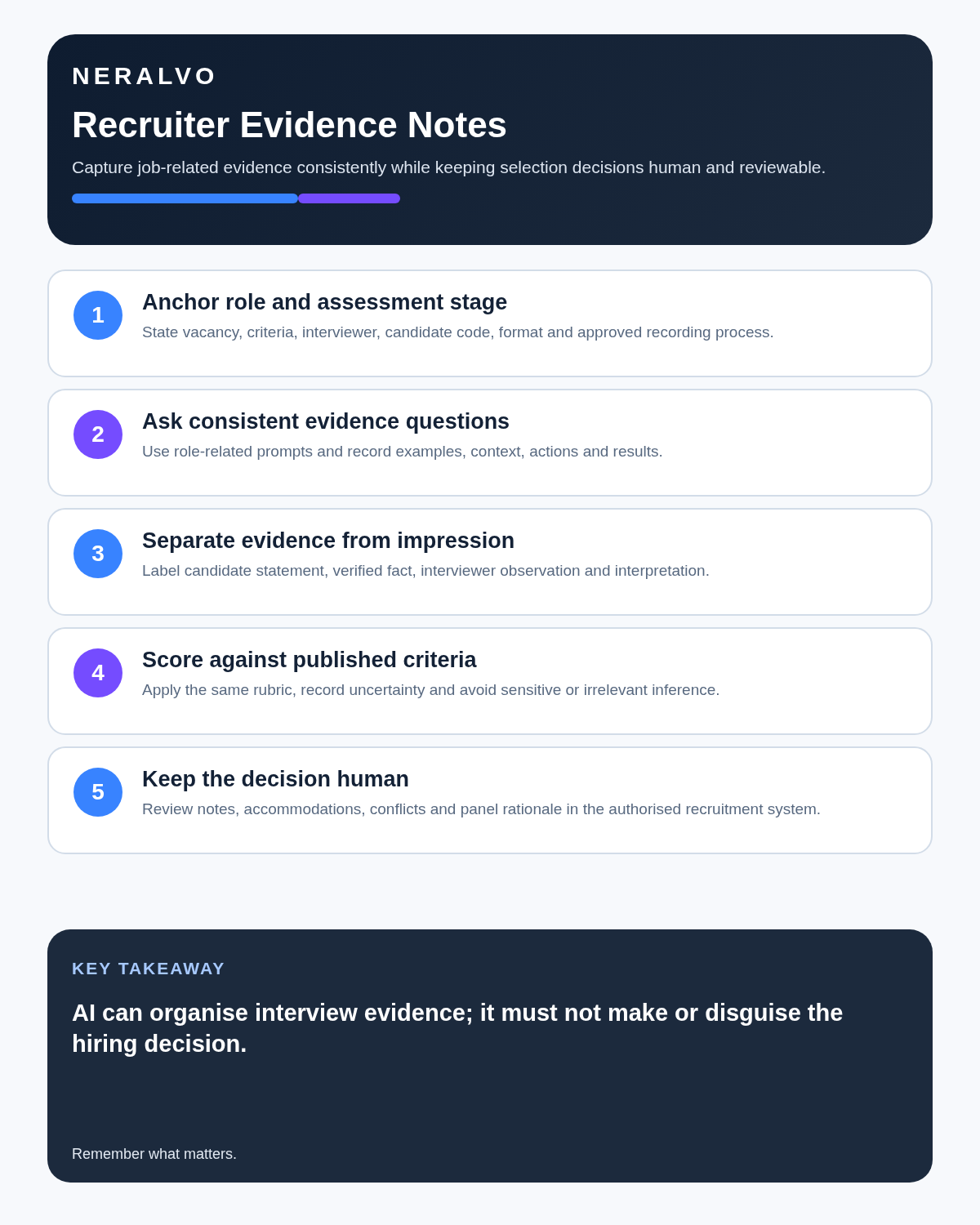
The role → question → answer → evidence → inference → score → decision workflow
| Stage | Question | Output |
|---|---|---|
| Role | Which job-related criterion is being assessed? | Defined standard |
| Question | Was the candidate asked a consistent relevant question? | Comparable prompt |
| Answer | What did the candidate actually say? | Attributed source |
| Evidence | Which situation, action, reasoning and result support the criterion? | Job evidence |
| Inference | What interpretation is the assessor making? | Visible judgement |
| Score | How does evidence map to the predefined anchor? | Provisional rating |
| Decision | What does the authorised panel conclude after comparison? | Human outcome |
Prepare before recording
- Job-related criteria.
- Consistent core questions.
- Evidence and scoring anchors.
- Reasonable-adjustment process.
- Recording information and alternative.
- Access, retention and deletion.
Give candidates plain information
Before the interview, explain that audio will be recorded or transcribed, the recruitment purpose, whether AI creates notes only or supports any assessment process, who can access the data, how long it will be kept, what alternative is available and how the candidate can request correction or raise a concern.
Do not make a candidate discover the recording from a device light or automated message after the interview has started.
Use evidence notes, not personality labels
| Weak note | Stronger evidence note |
|---|---|
| Not senior enough | Example did not show ownership beyond the immediate task |
| Great communicator | Explained a complex change, adapted for two audiences and measured understanding |
| Lacked confidence | Answer contained no decision rationale or result evidence |
| Culture fit concern | Response did not address the named collaboration criterion |
Do not infer traits from voice
Accent, nervousness, disability-related speech, language fluency, cultural style and speaking speed are not reliable proxies for intelligence, honesty, motivation or job performance. Do not use emotion, personality, truthfulness or sentiment scoring in hiring decisions.
Understand the automated-decision boundary
A transcription tool is not automatically an automated hiring system. Risk increases when transcript, voice or summary output feeds ranking, rejection, profiling or shortlist decisions without meaningful human review.
The UK Data (Use and Access) Act 2025 changed the framework for significant automated decisions, with most remaining data-protection provisions commencing on 5 February 2026. Recruitment organisations should apply current data-protection requirements, transparency, fairness, challenge routes and human intervention to the actual workflow they deploy.
See the ICO’s current recruitment and selection guidance.
Require meaningful human review
A person does not add meaningful oversight by merely clicking “approve” on an AI recommendation. The reviewer should:
- Understand the criteria and evidence.
- Have authority to change the outcome.
- Check factual and attribution errors.
- Consider reasonable adjustments and relevant context.
- Identify patterns of disadvantage.
- Record why the final decision was made.
Verify transcript risk fields
- Candidate and interviewer names.
- Dates, employers and job titles.
- Qualifications, numbers and outcomes.
- Negative wording.
- Speaker attribution.
- Reasonable-adjustment discussion.
- Candidate questions and commitments.
Use consistent questions without making interviews robotic
Ask the same core questions and assess against the same criteria, while allowing follow-up questions that clarify the candidate’s evidence. A recording helps revisit the example without forcing every answer into a generic summary.
Score independently before panel discussion
Each interviewer should record provisional evidence-based scores before group debate. Compare differences against the criteria rather than seniority, intuition or an AI ranking. Preserve legitimate disagreement until it is resolved through the authorised process.
Protect candidate data
Use approved accounts, restrict access and keep only data required for recruitment. Health, disability, right-to-work and background information may require separate restricted handling. Full transcripts may contain unrelated personal information and should not automatically enter the ATS.
Store the minimum verified evidence and decision record required by policy, and apply the organisation’s retention schedule to source audio and working drafts.
Run a bias and accuracy audit
Test the workflow across representative interview conditions:
- Different accents and first languages.
- Remote and in-person audio.
- Several speakers.
- Technical terminology.
- Reasonable adjustments.
- Names, numbers and dates.
Record correction rates and check whether errors or missing attribution affect some candidate groups more often than others. Change the workflow where the pattern could disadvantage candidates.
How NERALVO Halo fits recruiters
NERALVO Halo includes NOTE mode, supported CALL mode, 64GB local storage, up to 35 hours of recording and Bluetooth sync with DOWAY. CALL mode is not universal, so test the exact phone, case and route. DOWAY provides transcripts, summaries, speaker-separated notes, templates, translations, mind maps and exports, with one year of DOWAY Max included. Human assessors remain responsible for fairness and accuracy.
Cloud software, a dedicated recorder or manual notes?
For Recruiters, the right answer changes with the setting. This matrix deliberately gives each method a situation where it can be the strongest choice.
| Situation | Best starting point | Reason |
|---|---|---|
| scheduled remote client meetings | Cloud meeting software | Calendar automation and shared integrations are usually the strongest advantage. |
| in-person visits and travel | Dedicated recorder | Independent capture reduces reliance on an active phone or laptop. |
| a client declines or policy requires manual notes | Manual notes or an approved alternative | The boundary takes priority over convenience. |
| mixed CRM and field work | Governed hybrid | Use each method only in the setting it actually fits. |
Frequently asked questions
Can AI rank candidates from transcripts?
It should not replace job-related human assessment and may reproduce bias.
Can speaking style be scored?
Only where a specific communication competency is genuinely job-related, assessed transparently and based on evidence rather than accent or personality.
Should full interview audio enter the ATS?
Usually no. Store the minimum verified evidence and decision record required by policy.
Does a human approving an AI score make the process human-led?
Not by itself. The reviewer must understand the evidence, be able to change the result and exercise independent judgement.
Final recruiter checklist
- Criteria and scoring anchors defined.
- Candidate informed and alternative available.
- Questions consistent and relevant.
- Evidence separated from inference.
- Voice traits excluded from judgement.
- Transcript details verified.
- Automated-decision risks assessed.
- Human review is meaningful and documented.
- Bias and accuracy testing completed.
- ATS, access and retention controlled.
Bottom line: recording can improve evidence quality, but fair recruitment depends on transparent capture, consistent criteria, visible reasoning, tested accuracy and accountable human decisions.
Related guides
See the guides for HR managers, recruitment consultants and project managers.
On this page
Related guides
See whether Halo fits this workflow
Review the NERALVO Halo specifications, included services, delivery information and current offer only after completing the guide.
Found an error or an out-of-date claim? Email support@neralvo.com with the article address and a supporting source.