The 60-second verdict
Quick answer: PR professionals can use an AI voice recorder for approved interviews, spokesperson preparation, issue meetings and media follow-up, but every quote, fact, embargo, statement version and commitment must be verified before release.
Best fit: PR Professionals who need recoverable audio and human-verified notes in an authorised workflow. Use another method when: recording is prohibited, a participant declines or the approved process requires manual notes.
Evidence basis and limits
- Decision factors covered: Why statement version control matters; Use five statement statuses; Maintain a statement ledger.
- Evidence rule: The decision is based on the complete capture-to-action workflow, not a single feature or marketing accuracy percentage.
- Boundary: Examples and workflow recommendations must be tested with representative recordings, the intended users and the actual approval process before rollout.

View Halo specifications for pr professionals use can preserve fast-moving discussions while the newsroom, stakeholder, crisis-log and approval systems remain authoritative.
Why statement version control matters
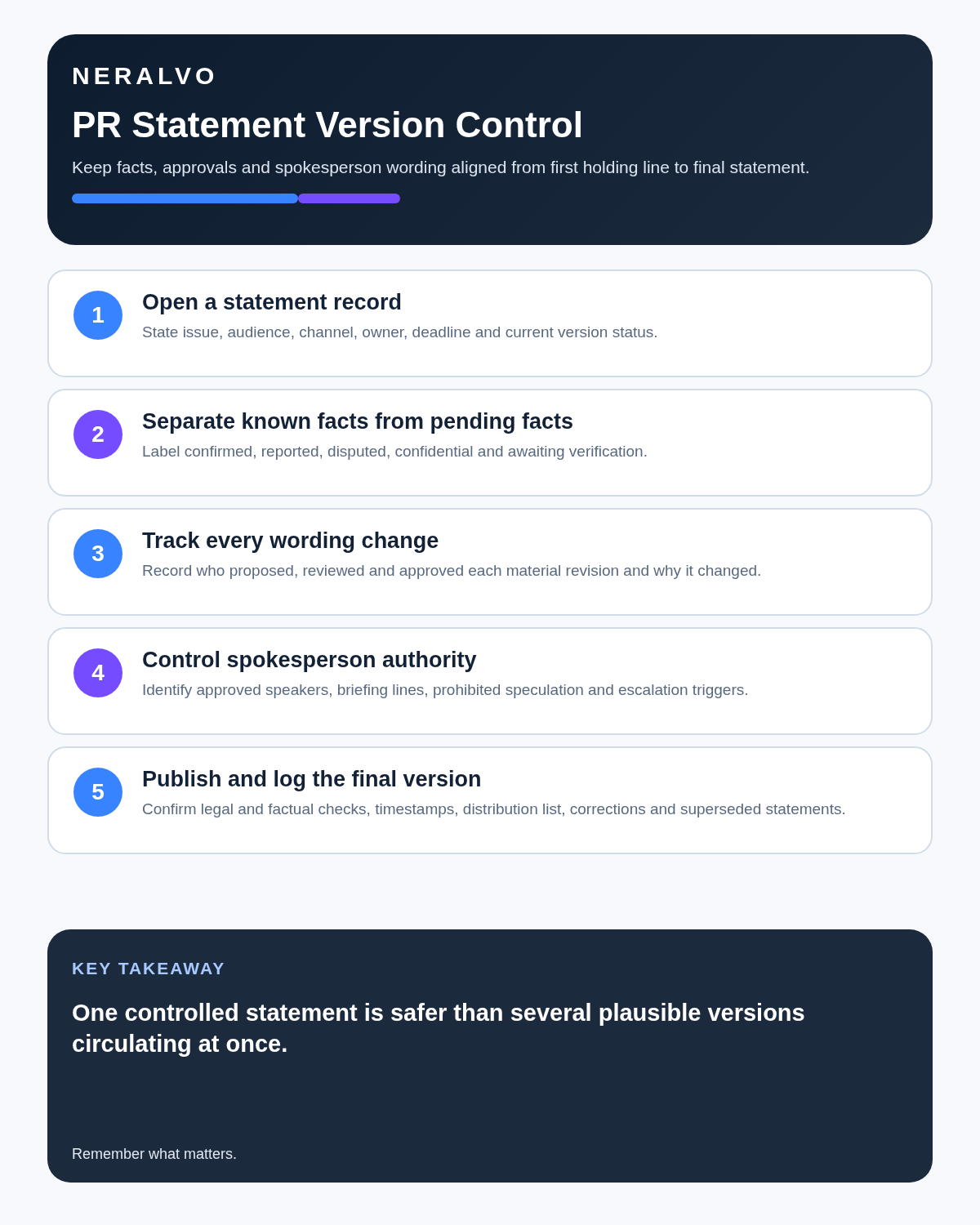
During a fast-moving issue, the dangerous sentence is often not wholly false—it is an earlier version that is no longer accurate. A transcript can preserve what was discussed, but it must not blur unverified reports, working facts, draft wording and approved public statements.
Use five statement statuses
| Status | Meaning | Rule |
|---|---|---|
| Unverified report | Information received but not confirmed | Keep internal, attributed and clearly provisional |
| Working fact | Supported information still under review | State source and limitation |
| Draft message | Proposed wording | Do not circulate externally |
| Approved statement | Version authorised for release | Record approver, channels and time |
| Superseded statement | Earlier wording no longer current | Withdraw from active use and preserve history |
An AI summary must not promote a working fact to confirmed status or present draft language as an external commitment.
Maintain a statement ledger
- Version number.
- Date, time and timezone.
- Verified facts included.
- Facts deliberately excluded or still under review.
- Exact approved wording.
- Approver and authority.
- Audience and release channels.
- Embargo or publication time.
- Expiry date or review trigger.
- Replacement or superseding version.
The ledger should identify one current approved statement for each audience and channel.
Use a fact → audience → message → proof → boundary workflow
- Fact: what is verified and current.
- Audience: the stakeholder and likely concern.
- Message: a clear position without overclaiming.
- Proof: the data, action, source or spokesperson supporting it.
- Boundary: confidential, off-record, embargoed, personal, legally restricted or unconfirmed material.
Build the VOICE briefing
- V — View: approved position and communication objective.
- O — Objective information: confirmed facts, sources and timestamps.
- I — Issues: difficult questions, criticism, uncertainty and affected stakeholders.
- C — Conditions: legal, privacy, commercial, regulatory and embargo limits.
- E — Escalation: what cannot yet be answered and who has authority to decide.
This prevents a spokesperson from filling an information gap with an unsupported answer.
Control interview terms before substantive discussion
Clarify whether the conversation is on the record, background, off the record or embargoed. Record the precise terms, who agreed them, the intended use and any publication time. Do not assume a private briefing may be quoted or published.
Verify every quotation
Check the complete question and answer, speaker, wording, context and approval route where required. Do not combine separate fragments into a sentence the spokesperson never said, remove a qualification that changes meaning or publish an AI-generated paraphrase as a direct quote.
Create an issue-status board
| Status | Meaning | Communication treatment |
|---|---|---|
| Confirmed | Verified and approved for use | May enter the current statement |
| Under investigation | Evidence incomplete | State that review is continuing |
| Holding line | Temporary approved response | Attach a review trigger |
| Embargoed | Restricted until a stated time | Record date, time and timezone |
| Confidential | Not for external distribution | Restrict access and exports |
Use a controlled crisis workflow
- Maintain one authoritative incident timeline.
- Correct transcript names, times and source attribution.
- Separate reports, verified facts, analysis and draft messages.
- Create or update the statement ledger.
- Prepare the VOICE briefing.
- Approve one external version for each relevant audience.
- Record every release channel, recipient group and time.
- Withdraw superseded wording from active folders and briefing packs.
- Update spokespeople, customer teams, executives and other stakeholders.
- Preserve the decision and approval history.
Attach review triggers to holding lines
A holding statement must remain true. “The investigation is continuing” becomes misleading once the cause is confirmed or the review closes. Record the event, fact, decision or deadline that requires the holding line to be reviewed or withdrawn.
Prepare spokespeople for challenge
Practise the main message, supporting evidence, likely difficult questions, known limitations and what cannot yet be answered. Preserve who owns each follow-up. Avoid memorising an AI-generated response that sounds polished but exceeds the verified facts.
Protect embargoes and confidentiality
Record exact embargo dates, times and timezones. Use approved accounts, restrict unreleased information and avoid public transcript links for crisis or pre-release material. A recording may contain legal advice, employee data, customer information, security details and commercially sensitive plans that do not belong in the public statement.
Protect sensitive and personal information
Use the minimum information required for the communication task. Separate employee, customer, health, legal and security records from general PR notes. Share only checked extracts through approved channels and apply distinct retention rules to raw audio, working transcripts, statement drafts and released materials.
Use a controlled post-meeting workflow
- Secure the source recording.
- Correct names, roles, dates, times and quotations.
- Label every material point by statement status.
- Verify claims against authoritative sources.
- Update the incident timeline and statement ledger.
- Obtain the required legal, executive or subject-matter approval.
- Release only the current approved version.
- Log channels and publication times.
- Remove superseded wording from active use.
- Apply access, retention and deletion controls.
How NERALVO Halo fits PR work
NERALVO Halo includes NOTE mode, supported CALL mode, 64GB local storage, up to 35 hours of recording and Bluetooth sync with DOWAY. DOWAY can create transcripts, summaries, speaker-separated notes, templates, translations, mind maps and exports, with one year of DOWAY Max included.
Halo may support approved interviews, spokesperson practice, issue meetings and compatible media calls. It is not a media-monitoring, legal-review, fact-checking or statement-approval system.
Cloud software, a dedicated recorder or manual notes?
For PR Professionals, the right answer changes with the setting. This matrix deliberately gives each method a situation where it can be the strongest choice.
| Situation | Best starting point | Reason |
|---|---|---|
| scheduled remote meetings | Cloud meeting software | Native remote-meeting workflows can be more efficient here. |
| in-person or mobile work | Dedicated recorder | A separate battery and recoverable local source improve resilience. |
| recording is refused or prohibited | Manual notes or an approved alternative | Manual notes are the correct control when recording is unavailable. |
| mixed online and offline work | Governed hybrid | A hybrid can combine automation with reliable physical capture. |
Frequently asked questions
Can an AI summary become the public statement?
No. Verify the facts, wording, authority, audience and release status through the approved process.
Does a confident source make a claim confirmed?
No. Confidence and evidence are different.
Can an old approved statement remain online?
Only where it remains accurate and appropriate. Superseded wording should be updated, withdrawn or clearly contextualised through the approved process.
Does an embargo apply without a precise time?
Record the agreed date, time and timezone to avoid ambiguity.
Final PR checklist
- Facts and sources verified.
- Statement statuses applied.
- Current version and approver clear.
- Interview terms recorded.
- Quotes checked against complete source audio.
- Holding lines have review triggers.
- Embargo date, time and timezone precise.
- Spokesperson boundaries and escalation route clear.
- Release channels logged.
- Superseded wording withdrawn from active use.
- Sensitive information restricted.
- Approved materials and decision history preserved.
Bottom line: AI recording can preserve exact wording and decisions. PR control comes from knowing which facts are verified and which statement version is approved, current and appropriate for each audience.
Related guides
On this page
Related guides
See whether Halo fits this workflow
Review the NERALVO Halo specifications, included services, delivery information and current offer only after completing the guide.
Found an error or an out-of-date claim? Email support@neralvo.com with the article address and a supporting source.