The 60-second verdict
Quick answer: copywriters can use an AI voice recorder to preserve customer language, objections, proof points and creative directions, but every phrase must remain connected to its context, permission and evidence status before it becomes copy, a claim or a testimonial.
Best fit: Copywriters who need recoverable audio and human-verified notes in an authorised workflow. Use another method when: recording is prohibited, a participant declines or the approved process requires manual notes.
Evidence basis and limits
- Decision factors covered: Build a permissioned language card; Keep five things separate; Use a customer → problem → mechanism → proof structure.
- Evidence rule: The decision is based on the complete capture-to-action workflow, not a single feature or marketing accuracy percentage.
- Boundary: Examples and workflow recommendations must be tested with representative recordings, the intended users and the actual approval process before rollout.
Customer language becomes useful copy only when the source, situation and permitted use remain attached. A recording can preserve exact wording, but it cannot make one customer’s comment representative or turn a private research interview into public endorsement.
Build a permissioned language card
| Field | What to record |
|---|---|
| Exact phrase | Checked wording and timestamp |
| Context | Question, task and customer situation |
| Segment | Relevant audience category |
| Permission | Internal research, anonymous quote, named testimonial or another approved use |
| Evidence status | Anecdote, repeated theme or supported claim |
| Review date | Permission, product or claim expiry point |
Keep five things separate
- Customer words: what one person said.
- Insight: interpretation across several sources.
- Message: the creative expression chosen by the copywriter.
- Claim: a factual proposition requiring substantiation.
- Testimonial: an authorised public endorsement.
An AI summary may merge these categories and make a customer phrase sound like a verified market-wide fact.
Use a customer → problem → mechanism → proof structure
- Customer: audience, situation and language.
- Problem: the friction, consequence and urgency.
- Mechanism: how the product or service helps.
- Proof: feature, demonstration, data, review or guarantee.
- Offer: price, inclusion, condition and next step.
This prevents attractive wording from outrunning what the product actually does.
Create a CLEAR brief
- C — Customer: audience and situation.
- L — Loss: problem and consequence.
- E — Evidence: product facts and proof.
- A — Action: desired response.
- R — Rules: tone, claims, exclusions and approver.
Use a claim ladder
| Claim level | Typical requirement |
|---|---|
| Feature fact | Current product specification |
| Direct functional benefit | Clear connection between feature and outcome |
| Reasonable outcome | Evidence and appropriate qualification |
| Comparative claim | Fair, current comparison using equivalent criteria |
| Performance, financial or health claim | Strong substantiation and specialist review |
The stronger the promise, the stronger the evidence and approval required.
Interview-to-copy workflow
- Define the research question and intended use.
- Explain recording and quotation permissions.
- Ask about recent real experiences rather than hypothetical preferences.
- Correct transcript wording, names and context.
- Create permissioned language cards.
- Separate individual anecdotes from repeated patterns.
- Build the customer, problem, mechanism and proof chain.
- Draft message options in the brand voice.
- Flag every direct and implied factual claim.
- Verify evidence and testimonial permission.
- Adapt the approved message for each channel.
- Complete client, brand and legal approval.
Do not smooth quotations silently
Editing for length must preserve meaning. Do not invent more polished wording and place it inside quotation marks. Keep enough source context to verify the approved quotation and preserve important qualifications.
Write channel-specific versions
- Landing page: full problem, mechanism, proof and objection handling.
- Paid ad: one focused promise supported by the landing page.
- Email: context, relevance and one clear action.
- Social post: concise insight with appropriate source or disclosure.
- Sales asset: approved claims and evidence matched to the audience.
Duplicating one AI-generated script across every surface usually weakens relevance and creates inconsistent claims.
Originality, testimonials and rights
Use interviews as research, not as permission to reproduce complete stories or third-party creative work. Agreement to participate in research does not automatically authorise a named testimonial, paid advertisement or permanent quotation.
For UK advertising, evidence should show that a testimonial is genuine, accurate and used with permission. Factual claims inside the testimonial still require suitable substantiation.
Authoritative source: review the ASA/CAP guidance on testimonials and endorsements before using customer quotations in UK advertising.
How NERALVO Halo may support copywriting
View Halo specifications for copywriters use can support approved customer interviews, creative briefs and private ideas through NOTE mode, supported CALL capture, 64GB local storage and DOWAY transcription tools. The permissioned voice-of-customer bank—not the raw transcript—should control reuse.
Final copy checklist
- Audience and situation are precise.
- Customer language is attributed and contextualised.
- Permission matches the intended format and channel.
- Insights are separated from individual anecdotes.
- Claims are current and substantiated.
- Quotations preserve meaning.
- Offer details and limitations are accurate.
- Brand, client and legal review are complete.
- The approved version is stored in the correct system.
Bottom line: strong copy begins with real language and ends with evidence that supports every meaningful promise.
Cloud software, a dedicated recorder or manual notes?
For Copywriters, the right answer changes with the setting. This matrix deliberately gives each method a situation where it can be the strongest choice.
| Situation | Best starting point | Reason |
|---|---|---|
| scheduled remote meetings | Cloud meeting software | Native remote-meeting workflows can be more efficient here. |
| in-person or mobile work | Dedicated recorder | A separate battery and recoverable local source improve resilience. |
| recording is refused or prohibited | Manual notes or an approved alternative | Manual notes are the correct control when recording is unavailable. |
| mixed online and offline work | Governed hybrid | A hybrid can combine automation with reliable physical capture. |
Related guides
Profession workflow
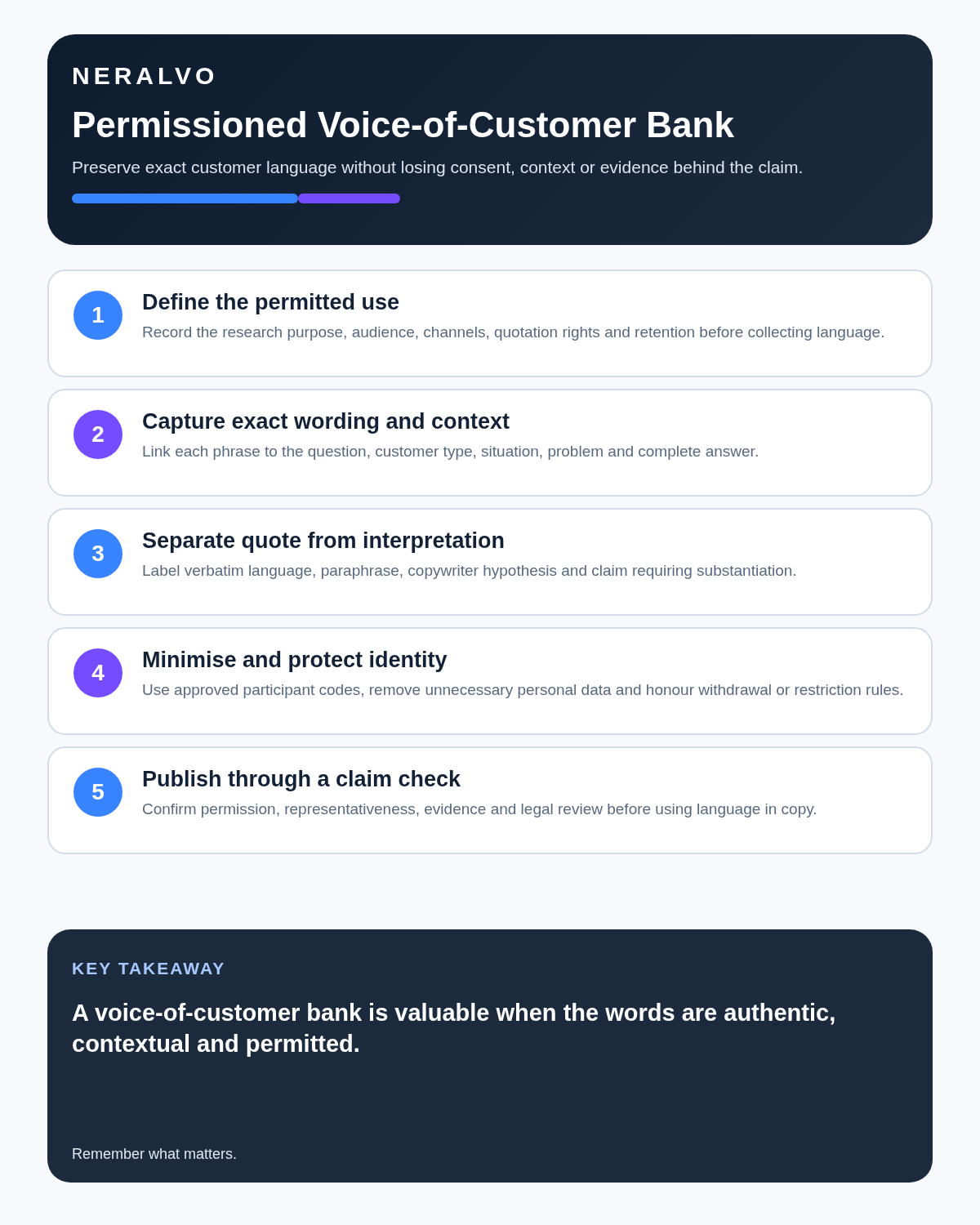
Visual map for AI Voice Recorder for Copywriters: Build a Permissioned Voice-of-Customer Bank
- Prepare the approved useDefine purpose, safe position, permission and the required formal record.
- Capture context firstState the case, asset, person, location or event identifier before detail.
- Human-verify evidenceCheck technical terms, units, names, dates, decisions and uncertainty.
- Complete the formal recordTransfer only verified information and apply access and retention controls.
On this page
Related guides
See whether Halo fits this workflow
Review the NERALVO Halo specifications, included services, delivery information and current offer only after completing the guide.
Found an error or an out-of-date claim? Email support@neralvo.com with the article address and a supporting source.